Monday, November 29, 2010

Major Art

(originally published in The Outreach Connection in November 2007)

You’ll have picked up that I’m not a sports nut of any kind, and I’m not equipped to muse about the ethics or aesthetics of those pursuits. So with that stipulated, I’ll throw out that I’m always puzzled by the regular scandals about steroids and other illicit pumping-up of “natural” ability. These practices, we’re told, are unfair; it’s cheating; it sets a bad example for the kids. As if much of anything in the bloated contemporary carcass of professional sport could be salvaged as an unmitigated good example. But anyway, the average athlete now is developed and maintained within a fitness, diet, and technological support regime having nothing to do with golden memories of sporting tradition. What’s “natural,” within this infrastructure, is a meaningless line in the corporate sand. Have everyone playing naked with 50-year-old equipment and then maybe we’ll see who’s really got the inherent distance over the others.

My Kid Could Paint That

But of course I’m forgetting about The Rules. However silly and degraded the parameters of fairness may be, the consensus about their applicability remains pretty strong. There’s every reason it would of course – even a minor sputtering in the professional sports machine would be an economic cataclysm far outpacing any hurricane or wildfire. Every time a child is born into a sports nut household, a CEO kisses his stock options.

None of which matters to me because, as I said, that’s not the house I live in. I’m more of your arty type. But watching Amir Bar-Lev’s documentary My Kid Could Paint That, a film in large part about the nature of art, I found myself drifting into the distraction set out above. Because more and more, the same could apply to art and culture. Of course, art doesn’t have rules in the sense that sport does. But it’s clear that notions of an artwork’s importance and influence often depend less on any rationalized internal merit than on how well it relates to a Bigger Story. The story may be (and indeed usually is) glib or crass, but it’s Established. And once it’s out there, like an incubator, it makes mountains out of dirt.

An obvious example – the obsession with weekend box office, now dutifully reported on every other news show. Only a tiny fraction of people go to the movies on any given weekend, and everyone knows that the question of what movies get widely exposed or don’t is a revenue-driven calculation, not an aesthetic one. It's virtually exactly the same as reporting which of the sundry new arrivals in the nation’s Loblaws and Sobeys flew most quickly off the shelves (which, frankly, would probably be more immediately useful to most viewers). But the one would seem tawdry and crass, whereas the box office derby seems culturally meaningful. Not to mention of course that it’s a convenient, ever-renewing springboard for wretched jovial chitchat.

Marla Olmstead

Bar-Lev’s film tracks another kind of example. Marla Olmstead was a 4-year-old girl from New York State, who liked to splash paint around on a canvas like many kids do. Her “work” (all entirely abstract and non-representational, but very vivid and colourful and nicely balanced) came to the attention of a local dealer, and then started selling, soon for tens of thousands of dollars at a time. With a big waiting list and worldwide media coverage, Marla’s career seemed to be set, until an edition of 60 Minutes suggested she might be getting more than a little help from Daddy (it was pivotal to this that a hidden camera, set up to record the artist at work, yielded only a single painting plainly inferior to the rest of the oeuvre, along with evidence of coaching). The interest in Marla took a dive.

At this point, Bar-Lev was already spending much time in the Olmstead household, filming a documentary intended to focus on the nature of art: even if the paintings seemed to have merit, what does it mean to valorize the work of a little girl who can’t tell you the first thing about why she did what she did. But the 60 Minutes expose shook his confidence, increasing his own need for proof – because in all the time he spent hanging out there, Marla would never paint on camera, supposedly out of shyness. A further video, organized by the family, only increased his doubts, and the project soon came to an unhappy, unresolved end.

The film has been widely admired as a “meditation on truth,” but I think this gives Bar-Lev too much credit. His wavering about his project is interesting to watch, and you sort of admire his decency in going easy on the family. But the fact remains that he could have used his access to resolve the mystery beyond any reasonable doubt – he could have set up his own hidden cameras, or questioned the kid more directly during his sessions alone with her, among other things. Even given the rather wishy-washy material that Bar-Lev delivers, his film seems to me to deliver virtual certainty that Mr. Olmstead (an amateur painter making a living as a night manager at Frito-Lay) heavily refined and prettified his daughter’s efforts, at a minimum. But Bar-Lev prefers not to reach such a conclusion, nor even to think about it very rigorously (there’s a general sense through the film that the 60 Minutes piece was a scummy low-blow, although it seems to have engaged more rigorously with the specific issue than Bar-Lev ever did).

Closer To God

More interesting is why it matters. If the thing looks that good on your wall, who cares that it’s (say) 80% or even 50% Marla, rather than 100%? A couple of the collectors interviewed in the film speak almost religiously about the work, as if harking back to the old notion of the artist being a vessel of God. Perhaps only an innocent and inexpressive artist can now carry true transcendent virtue, because only she could allow a pure transcription of His guiding spirit. Any adult intervention would immediately banish God’s signature, rendering even the most beautiful work merely another technical achievement.

In that case of course, it barely matters what the painting looks like, because you’re really paying to have the sainted stigmata on your wall. The artwork becomes merely a trace, an index. The case of Marla Olmstead (who apparently is still painting by the way, with her price tags again on an upward momentum) is a particularly vivid example of this recurring prototype. Because, if you buy that analysis, swooning over a vessel of God is certainly more virtuous than capitulating to big business (or to whatever Britney or Paris represent). Maybe it’s so with sports too – maybe for all my cynicism, there are still enough people who see Floyd Landis or Marian Jones as emissaries of something elementally wonderful and whose hearts are all but broken when that virtue is compromised. I sympathize, but I think we should all be more careful about where we invest our passions.

Sunday, November 28, 2010

Personal Damage

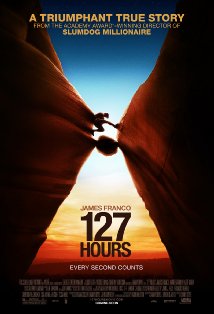
If nothing else, I’m grateful to Danny Boyle’s 127 Hours for not carrying out the implied threat of its first five minutes – to beat us over the head with frantic editing, speeded-up split screen imagery, ear-hurting music, and general compulsive jitteriness. I suppose Boyle’s intention is to have us feel how overwhelming the normal grind can be, and why a young guy like Aron Ralston (James Franco) would love escaping into America’s unspoiled grandeur. When Ralston hits the open spaces, the movie duly slows down: point made. But it’s a banal point, and a super-banal way of expressing it.

127 Hours

At this early stage, the viewer will already have Boyle’s film pegged pretty accurately. One needn’t worry about giving away spoilers in describing the plot – everyone knows Ralston’s arm got trapped by a fallen boulder and he only escaped by hacking it off with a blunt penknife and leaving it behind. The only question then is how the film will surmount the significant challenges of having only one character for most of its length, and furthermore, a character with very limited mobility (twenty years ago, there might also have been some intrigue in finding out how the movie would present the climactic self-surgery scene, but nowadays, digital effects make everything possible – initial reports suggested some viewers were fainting, but that sounds mostly like wishful thinking by marketers).

Boyle opens up the space by illustrating how Ralston’s mental space drifts between memories, self-recriminations, fantasies, ramblings. It’s all quite ably done, but to be blunt about it, he just isn’t that interesting a figure: he dredges up some dating regrets and a wish he’d returned his mother’s phone calls more diligently, and that’s about it. Franco is an engaging and resourceful actor, but achieves no more in the role than you’d expect from a competent performer – with nothing to bounce off against except rocks and his own wits, the role doesn’t really lend itself to great acting beyond a certain point.

Essential Cinema

I’ve written variations on this about a few people lately, but while Danny Boyle obviously has a talent for deploying the tools of cinema, and he’s good at keeping things peppy and colourful, that doesn’t inherently mean he’s an artist, that he has any ability to convey something we ought to give a damn about. 127 Hours reminds you at various points of films like Picnic At Hanging Rock and Walkabout, but only because Peter Weir and Nicolas Roeg were able to coax something other than pretty pictures out of all that desolation. I’m grateful too that Boyle doesn’t go in for a lot of sugary “triumph of the human spirit” uplift, but if he sees anything in this material other than a technical challenge, he fails in conveying what that is.

It’s really to the shame of the TIFF group that Boyle’s last film Slumdog Millionaire, a gaudy contrivance if there ever was one, made it onto their list of a hundred “Essential Cinema” films; I doubt anyone could rationally articulate what that movie’s “essentialness” consists of (certainly not in contributing to a meaningful sense of what it might mean to be born poor into the Indian slums, or how that might be remedied). Slumdog Millionaire isn’t actively repulsive, like Roberto Benigni’s Life Is Beautiful, which could only possibly have made the list on the basis of some train of thought about holding your enemies closer than your friends. It’s just a fine piece of coordination and imagination which, nevertheless, as an ongoing contribution to your life, doesn’t amount to a teaspoon of rice.

And so it is with 127 Hours. Without resorting to the transparent reviewer tricks of describing the plot in endless detail and suchlike, I can’t think of a single other thing to say about it.

Love And Money

In 1982 or 1983, I read a review of James Toback’s Love And Money in the old UK Monthly Film Bulletin, and on that basis it’s been on my mental to-see list ever since (I guess it must have been a good review, but I don’t even remember now); I’d periodically searched for it, without a glimmer of success. Until a few weeks ago, when it was suddenly on Amazon, as part of a treasure-trove Warner Archive program offering made-on-demand bare-bones DVDs of mostly unloved movies. So, finally, I saw it.

Toback made it after his first and still most admired movie, Fingers, and it represents an apparent attempt to replicate that film’s intensity and spikiness in a more ambitious, sprawling setting. The protagonist, Byron, (played by Ray Sharkey) is a bank loan officer, approached by Stockheinz (Klaus Kinski), a wealthy businessman, to buffer his relationship with the radically-minded president of a small South American country, who happens to be his close friend. Byron turns him down, focusing instead on pursuing Mrs. Stockheinz (Ornella Muti); when she abandons him, he takes the job after all. Remarkably, the great silent-era director King Vidor plays Byron’s hopelessly confused grandfather.

That summary only hints at the extreme oddity of Love And Money. The movie’s theme, I suppose, is the corrupt and dissatisfying nature of, well, virtually everything, and yet with a persistent sense of a fix that’s not beyond reach, if you have the balls and imagination to go for it: Vidor for instance embodies a past classicism now losing its way a bit (and when Byron has trouble getting aroused with Catherine Stockheinz initially, he remedies things by having her recite “The Star Spangled Banner”). Toback gives the film a rather garish, visually un-nuanced look which, along with the once-in-a-lifetime casting and the frequently deliberately ridiculous plotting, evokes an adult cartoon. It’s all fascinating, but it’s also not hard to see how it could be taken as being somewhat clumsy.

If memory serves, his next film, Exposed (another one I can’t locate anywhere at present, although I’ve seen it a few times over the years) was a significantly more accomplished fusion of disparate strands (Nastassia Kinski! Rudolf Nureyev! Fashion! Terrorists!). Since then, Toback’s output has been sporadic and highly variable – his most recent, a documentary on Mike Tyson, came out a couple of years ago. I don’t suppose anything of his came close to making the Essential Cinema list, but if you’re drawn to directors whose films feel like the outcome of lives rather than careers, he’s a magnet (by the way, nothing of King Vidor’s made that list either).

Anyway, Love And Money is well worth seeking out, as a film of considerable if rather messy ambition, not so old in the scheme of things, but still a relic from a vanished cinematic age, in which even if you didn’t like a particular movie, at least you generally saw some point to its existence.

Tuesday, November 23, 2010

Deathwatch


(originally published in The Outreach Connection in July 2006)


Last year I joined the Green Party, and I really wanted that to mean something. I went to some pub nights and donated money, and then I went to the meeting to select a candidate for my riding (I voted for the winner, me and eight others I think) and I expressed my willingness to help out. I was invited to a meeting to prep the candidate for the debates, with a view to maybe assisting with background research or something like that. And that was where the dream died for me. I was there for a couple of hours, just listening, and I was amazed by the knowledge of the participants – I certainly felt ashamed at how generic and vague my sense of Toronto is – and by the subtlety of the arguments. But it also made me angry. I didn’t want to listen to conversations, however eloquent and well informed, about immigration and public health and affordable housing – if I cared deeply about any of that I would have joined the Liberals or the NDP I guess. I was a single issue Green Party member – I wanted them to hammer that core overriding cause and leave the rest to take care of itself. Because otherwise, who will? Not the Conservatives, with Harper’s five pathetic priorities. Not the Liberals, where Ignatieff gets shot down for even musing about a carbon tax.

An Inconvenient Truth

So I left the meeting, and then I quit the party the next day – melodramatic I know, but at the time I thought a clean slate might propel me into something dynamic. I actually fleetingly thought about joining the Conservatives – something to do with the merit of converting a whore rather than a virgin – but that would just have been too disingenuous. So for now I’m confined to counting my personal virtues. Which are not bad I guess – I don’t drive at all, and I walk to work, and I recycle, and we just bought a new condo in an eco-friendly building. And I have a little project at work that may amount to something. I haven’t calculated my carbon footprint but I’d guess it’s relatively low. So that’s lots of points for me I guess. And of course it doesn’t mean a damn thing. It’s too late anyway. The planet’s basically dead and we just don’t know it yet. Isn’t that right?

Mixed in with the closing credits of An Inconvenient Truth, a film that lays out the facts and likely consequences of global warming with great precision, are various suggestions for what we can do – including the kind of stuff I’m doing already, calling your congressman, praying (for those who believe in that), oh, and urging other people to see An Inconvenient Truth (many of these tips, along with other surrounding information, are at the movie’s website at climatechange.net). All of this to a nice Melissa Ethridge tune. And the audience – a good sized audience for an afternoon – applauded, as audiences sometimes do at the Cumberland, which by the way is the only place in town that was showing the picture. You get my point, that An Inconvenient Truth might be the kind of movie that makes you feel good about feeling bad. Now I know these are not easy calculations. The movie is being seen, after all, even if primarily by Greens and yuppies and academics. And its prime mover Al Gore, for his own sanity, probably needs to maintain a sense of equanimity about life. And at this point, like so many other reviews of the film, I digress into using up space talking about Gore, who is after all one of the most fascinating figures of our time.

Evil Empire

The film is mainly a record of a presentation that he’s given to audiences all over the world, more than a thousand times he says, beautifully designed and very effectively delivered, crammed with statistics and snappy quotations and visual aids. From time to time the film deviates into anecdotes of Gore’s life, all of it familiar to anyone who’s been watching over the years – such as the death of his young son in an accident and that of his sister from lung cancer. This material is frankly trivial, set against the film’s primary purpose, and should have been left out. There are just a few references to the 2000 election, where of course Gore won the popular vote but then lost the big prize in murky circumstances. He kicks off the film with his signature line that he “used to be the next President of the United States.” Gore has nothing to gain from appearing resentful, and goes remarkably easy on the Bush administration. This is magnanimous, but I can’t believe he truly thinks it’s adequate.

Because as Gore fully knows, that closing list of small steps on the road to redemption is painfully inadequate. After 9/11, the US defined terrorism as the primary threat to civilization and, subject only to leaving enough room for various aspects of its ideological agenda, devoted itself almost exclusively (however haphazardly) to this mission. Even if one accepts that the Bush administration’s disinterest in environmental issues is based on a genuine uncertainty regarding the merit of the science (as opposed to a willful blindness fueled by the donations of corporate backers), in a situation where the risks of being wrong are so catastrophic, what rational alternative is there but to heed the downside and to act? When it’s random violence sourced from the Middle East (or that matter abortion, or vegetative women from red states), then every domestic life is precious and fundamental to the fabric of America. When it’s global warming (or that matter poverty, or the inadequacy of low-income health care) then the relative threat is rationalized away, or ignored altogether. This is more than merely inept. Whatever its underlying mentality, it’s functionally evil.

Choose Life

Gore’s statistics on the rise in carbon dioxide levels and other key indicators in recent years, and the near-term projections, are wretched, demonstrating categorically that we’re in uncharted territory. The film touches briefly on the industrialization of China, currently throwing up new coal burning power plants and wheeling out new cars onto the roads at a pace that admits no restraint or acknowledgement of limits. They’re merely catching up, of course, to what we’ve lived for fifty years. The projections are horrible, and how will this momentum be checked? Many of the phenomena he notes, such as the decline of the permafrost at the poles, are already in motion, and other writers have questioned whether they can be turned back. The need for action seems immense, unless we merely start preparing for a managed decline. In which case maybe it’s more comforting to be blind and oblivious, and functionally evil. At least that’s so for a generation like mine, which will probably be dead before the very worst is brought to bear.

As you can see, I’m dissatisfied by An Inconvenient Truth, although reviewing the movie is hardly the issue. To borrow a slogan from somewhere else, the issue is to choose life. But after seeing the film, I barely have any idea how we’re meant to do that.

Sunday, November 21, 2010

Jackals Galore

I wrote last week about some of the very long movies I’ve seen this year, and then on the following Sunday, I spent just short of six hours at the Bell Lightbox watching Olivier Assayas’ Carlos. I love Assayas’ work, but it wasn’t the easiest thing to commit to; I’d pulled the plug at the eleventh hour on a couple of previous attempts to make it there. I always find on such escapades that the first hour or two is toughest – the summit is just too far away – but then you relax into an alternative reality, and the six hours ultimately don’t seem like any more than, say, five.

Carlos

Anyway, the film’s moved on now, but I’d certainly recommend getting the DVD when it arrives; one needn’t even feel guilty about breaking it into installments since it was originally shown in three parts on French TV. Carlos (sometimes called the Jackal, although not in this film) was a terrorist (or revolutionary, or mercenary, or all of these and more), achieving notoriety in the seventies, later mostly ineffective and on the run before being captured in the 90’s. The film fluidly summarizes his career (acknowledging that there’s some fictionalization involved), entailing a dazzling variety of characters, incidents, locations and shifts of mood and pacing. Assayas is completely in control throughout, although perhaps inevitably has less room here for the mind-bending leaps of insight or structure that make his work so thrilling overall.

Globalization has been a big theme of his in recent years, and Carlos boldly extends this project. It reminds you how relatively unsophisticated things were even a few decades ago – Western society often seems to be sitting there for the taking, teetering behind confused direction and minimal security, just a big target range for a thriving network of young armed insurgents. As old ideologies fade and new calculations take over, Carlos’ swaggering militancy becomes embarrassing even to his former sponsors, and while that’s no doubt for the greater good as far as he’s concerned, it also points to the broader neutering and intellectual disarmament that’s marked the last few decades. At certain points, Carlos’ activities merely seem like the ultimate turn-on; there’s less discussion of causes and justifications in this movie than there was in Steven Soderbergh’s recent film about Che Guevara. But at a time when the gun-friendly Tea Party rhetoric often posits (even in these very words) a revolution to “take back” America, throwing up a whole new cast of young, new, uncompromising political princes, Carlos’ potential relevance (at least metaphorically) seems to increase; if, as we’re always told, so much of the established order is broken and likely to remain so, then you might ask why a self-styled visionary should feel obliged to conform to it. I don’t mean to say Assayas romanticizes Carlos exactly, but he makes it easy for us to.

Inside Job

The possible launching pad for the next Carlos might be indicated by Charles Ferguson’s documentary Inside Job: the 2008 financial crisis – why it happened, how it played out, what it means from here. Some documentaries, like last year’s Oscar-winner The Cove, show us something we’d likely never know about (other than vaguely) if the films themselves didn’t exist; Inside Job, like most of Michael Moore’s work, builds on material sitting mostly in plain sight. Of course, such films can still transform our understanding – just because something’s in plain sight doesn’t mean people have actually grasped what it is. For those who’ve been paying attention though, Ferguson’s film is much more a memory-jogger than a source of new information.

Almost none of the major figures in the crisis agreed to be interviewed for the film; Ferguson ungenerously rewards those who did agree by over-emphasizing their (relatively minor) transgressions and cruelly playing up the kinds of interview slips that can strike anyone. Coupled with a general lack of imagination (like, “Taking Care of Business” popping up on the soundtrack), a few unproductive detours (given the issues at stake, who cares, really, if the Wall Street crowd had a penchant for expensive hookers?) and an overly breezy pace (often suggesting Ferguson isn’t truly bringing the same seriousness to this as he did to his much better documentary about the Iraq war, No End In Sight), it doesn’t really coalesce to generate the intended sense of outrage. And on the big question of where we go from here, the film can offer no better than a weak invitation to battle, with narrator Matt Damon stating colourlessly over a hackneyed shot of the Statue of Liberty that “some things are worth fighting for.”

Missed Opportunity

It’s a missed opportunity to say the least, because the data in Inside Job could have contributed to a much more galvanizing treatment of the subject. One of Ferguson’s errors I think (an omission that also recurs in Moore’s work) is in focusing too much on, indeed, the “inside job” – the specific mechanisms that generated a huge housing/debt bubble and set up the subsequent collapse – and not enough on the broader ideology and culture that didn’t merely allow it to happen, but cheered it on at every step. The film has a clip of George W Bush, from early in his Presidency, defending the entitlement even of low income earners to be decent property owners. With hindsight, it’s presented as a tacit invitation for predatory mortgage lenders to descend on the poor, but it seems to me Bush was only throwing out an “American dream” platitude of the kind that continue to pepper Obama’s speeches and those of every other politician. Leaders may acknowledge the need for restraint and tough action, but a toxic mixture of gutlessness, collective stupidity and a misguided, historically outdated belief in US exceptionalism precludes making even the most obvious reforms.

It would have seemed incredible that having to bail out mismanaged private institutions with billions of dollars in public money wouldn’t have meaningfully changed the collective conversation about the place of those institutions in society, but that’s where we are. Things are so degraded that, as I write, it doesn’t even seem a Democratic President can hold the line on allowing the Bush-era tax cuts to expire for millionaires, despite the widespread awareness that inequality of wealth and opportunity has never been so profound. If the country can’t ask for that much of a sacrifice from its most privileged citizens, then what moral right does it retain to ask for anything from anyone?

Inside Job certainly prompts a lively discussion about such matters afterwards, but that’s not exactly hard to do. That line about some things being worth fighting for glosses over the fact that real fights involve real pain and sacrifice and loss. If the US had any wherewithal, it’d be drafting the terms of that fight now, while it still has something to bargain with.

Tuesday, November 16, 2010

Responsibility For The Image


(originally published in The Outreach Connection in March 2006)

Michael Haneke’s Cache (Hidden) is almost incalculably more satisfying than almost any other current release. The film can be viewed as a satisfying, vaguely Hitchcockian thriller, but at the same time that it caters to our taste for narrative momentum, it rigorously deconstructs and critiques that very desire. Ultimately it’s a serious inquisition into the morality of cinematic pleasure – a project that could have been somewhat academic, but seems to me in this case almost transcendentally gripping.

Questioning Reality

The film focuses on the host of a successful TV book show (Daniel Auteuil), living with his wife (Juliette Binoche) and young son in bourgeois elegance, who starts to receive a series of mysterious videos, first of the outside of their house, then of his childhood home, and then from other locations. These slowly form a narrative reaching back to a terrible act he committed as a child. I do not think I’m putting out a spoiler by revealing that the film never conclusively establishes the authorship of or strategy behind the tapes – those for whom such absence of closure would be an insurmountable problem might fairly be warned away. In the scheme of Cache, the omission is key to its broader purpose, to focus our attention not on the physical but rather the personal and political responsibility for images, and more importantly for that of the actions to which they relate.

The film is dazzlingly complex, but not in the knowing, ultimately hollow way of an Adaptation - it has the cool, unforced manner of a master drawing on a lifetime of reflection and inquiry. Key to this is how it systematically undermines the veracity of everything that’s presented to us, but without breaking the illusion of an observed narrative – there is no voice over or stepping outside the frame. The very first image in the film, staring at the house from a fixed point on an adjacent street, appears at first to be a normal establishing shot, but we soon discover it comes from a video, and is being watched by Auteuil and Binoche on a TV screen. There will be numerous other instances where something that we initially take as part of the film’s “current reality” similarly needs to be reinterpreted.

Conversely, there are numerous other scenes that appear to be shot from the perspective of a fixed hidden camera, but which are never identified as such. What these images have in common I think (Cache certainly deserves a second viewing, but I haven’t managed to do that at the time of writing) is that their “authorship” in the sense of personal culpability appears to belong to Auteuil, a modest cultural icon of intellectual communication who barely talks to his wife and never accepted responsibility for a self-serving act of years earlier (the fact that he committed this act as a young boy, for whom matters of personal culpability are inherently more ambiguous than for a grown man, is one of the film’s many subtleties).

Act Of Violence

So in a key scene, a character summons Auteuil to his home, where he carries out a startling, entirely unforeseen act of violence. The act is inherently theatrical, planned and orchestrated by the perpetrator. More broadly, the action represents the culmination of Auteuil’s destructive rewriting of the man’s life, both in childhood and in the film’s present. The shooting of the scene suggests a third unseen author (behind a possible hidden camera). Our immersion in the narrative is total – the violent act is as jolting as anything you will see this year. But it thwarts any easy interpretation or reaction.

Other juxtapositions generate further implications and analytical chains. A scene that appears at the time like a dream of Auteuil’s later appears to have been at least in part a flashback to actual events, but to actual events which he orchestrated and which carried grave results – so our initial sense of him as the mental author of the images needs to be replaced with an interpretation based on actions and consequences. A similar progression near the end of the film could be read the same way, but also conceivably as the opposite. The point is that our relationship with the image should never be simple, for the image is always an index of underlying events and is thus inherently moral and political. Our complacency as viewers is likely abhorrent to Haneke. In Cache he toys with it, by feeding us such an immaculate creation, and then deconstructs that creation so comprehensively that the scale of the exercise may at least partly evade us.

Michael Haneke

Haneke has explored this kind of subject matter before – most notoriously in the violent 1997 film Funny Games. In that work, a group of thugs terrorizes a bourgeois family – an inherently familiar exploitation scenario to which the film brings some analytical distance through its continual acknowledgment of itself as a movie. I don’t remember getting too many thoughts out of it beyond the trite and obvious. His most famous work is The Pianist, with Isabelle Huppert as a classical pianist carrying an almost terrifying catalog of sexual and psychological weaknesses. This too, at five years’ distance, might now warrant a second look I think. I remember it as almost impossible to watch after a while, and as such carrying some of the same themes about the nature of cinematic spectatorship that are more fully explained in Cache, but as being ultimately just too hermetic.

His most recent was Le Temps du Loup (shown at the 2003 film festival but otherwise not released here) – a chronicle of society barely holding itself together in the wake of an unexplained breakdown. It’s a more concentrated, in some ways straightforward work, profoundly depressing but carrying some distinct affirmation of human potential.

The examination of Haneke on the Senses of Cinema website is titled “A cinema of disturbance” and opens with the following quote from the director: “My films are intended as polemical statements against the American 'barrel down' cinema and its dis-empowerment of the spectator. They are an appeal for a cinema of insistent questions instead of false (because too quick) answers, for clarifying distance in place of violating closeness, for provocation and dialogue instead of consumption and consensus.” In the past, this has sometimes seemed wearying and rather hectoring, but not in Cache. Among other things, I’ve barely even mentioned how the film’s more formal project intersects with a piercing depiction of the central relationship, nor its use of racism, and the continuing ripples of France’s turbulent involvement in Algeria.

The film is culturally specific – it is, as one sometimes says, very French – and yet of universal applicability. It is as Haneke puts it a polemical statement, but is at the same time as elegant and seductive as Antonioni (whose use of space and architecture and absence came to my mind at times). It offers more than any current film, while withholding as much. It is simply – and you know I don’t use this word very often – a masterpiece.

Sunday, November 14, 2010

Three Big, Big Movies

This year, I’ve spent over a day of my life (some 29 hours in all) watching just three films – Bela Tarr’s Satantango (450 minutes), Masao Kobayashi’s The Human Condition (579 minutes, in three parts) and Jacques Rivette’s Out One (729 minutes, in eight parts). All three were long-standing ambitions of mine, especially Out One, which I’ve coveted for over twenty years not least because it’s been entirely inaccessible for most of that time (unlike the other two works, it remains unavailable on DVD). They were all terrific experiences, collectively making this one of the most glorious movie-watching years of my life.

The Human Condition

The Human Condition is the most accessible of the three from a narrative standpoint. Released between 1959 and 1962, and set during World War Two, it follows Koji, a promising young executive who takes a job as labour supervisor at a remote mining location, partly as a testing ground for his moderately radical theories of management and partly to gain an exemption from military service. The treatment of the Chinese interns tests both his theories and his humanitarianism, and when he crosses the line in aligning himself with them, he loses his exemption and gets drafted. He turns out to be a committed and skillful soldier, but often challenging authority through his insistence on human rights, for which he pays a price. He survives on the battlefield when almost all around him perish, and briefly exults in the idea that he may have become a monster, and that his ultimate survival is inevitable. The final three hours, when the fight is already lost and he merely fights to keep going, put this belief to an extreme test.

As the title implies, The Human Condition is a film of big ideas and ambitions, and on the face of it, it posits that the “condition” is one where any higher ideals will merely be crushed and betrayed. The film contains some epic confrontations as memorable as anything in cinema, always arising directly from the petty, hopeless interactions between human beings unable to grasp their common purpose. It’s very specifically a story of a certain time and place though; Koji’s misfortune is to be more modern than his surroundings, but his tenacity prefigures Japan’s postwar ascendancy.

Out One

Out One was filmed in and around Paris in 1970, not too far removed from the 1968 student protests, and (one now feels) at a time when intellectual disillusionment didn’t preclude an inherent sense of possibility and self-invention. The film spends much of its time simply observing actors at work, two different groups both rehearsing classical dramas. Intertwined with this, two unconnected grifters of sorts become aware of a mysterious group of thirteen that may exercise some kind of power, or may merely be a form of self-indulgent talking shop.

Of the three films, this is the one I felt the most urgent impulse to immediately watch again (not so easy to do in the circumstances, unfortunately); it’s far more oblique than The Human Condition. But that’s inherent to its purpose I think. The urge to generate meaning, to rearrange life as we find it, is strong in the film, but systemic heaviness is starting to descend: the two art projects have become self-contained, incapable of real communication. The length leaves no doubt about the sincerity of the attempt, but also illuminates the personal weaknesses and complexities that intervene, preventing any easy revelations or transformations. But while most of the characters fall short, Rivette never comes close to mere defeatism or cynicism. He’s still making films today, in his 80’s now, often allowing himself a playfulness that might have seemed gauche to many of the characters in Out One. His most moving character, played by Juliet Berto, constantly lies to and manipulates men, but has a lightness about her that transforms the film; however, she also pays its heaviest price. I’d like to think Rivette might have allowed her a different ending now (especially since Berto herself, a wonderful actress, died of cancer in her early 40’s).

Satantango

Bela Tarr is known for working in very long takes, often in black and white; his camera moves slowly and the world before it often functions more deliberately than our own – it’s as if his work were traveling toward a gravitational core where the conventional pace of things, both technical and behavioral, demands too high a price, and you’re forced to rediscover yourself through greater deliberation and incrementalism. I admire Tarr’s work, but he’s not one of my very favourites – I don’t always find his approach reveals anything fundamental about cinema nor about the world. At his least interesting, as perhaps in his most recent The Man From London, he can seem merely morose and evasive. But he’s also created many remarkable scenes and structures, and his work has a fierce, uncompromising quality.

Satantango, set around a poor rural community, turns around an initiative to establish a collective farming project; it may be a confidence trick, which however doesn’t preclude some associated possibility for spiritual cleansing. The film leaves an impression of multi-faceted devastation intermingled with the sense of grasping for something transcendent. At its most gripping, it takes us on virtually self-contained narrative trajectories - the most startling, to me, involving a young girl’s prolonged mistreatment of her cat, yielding a virtually Biblical arrival point – and the film is full of remarkable visual creations, set at unprecedented intersections of beauty and ugliness. In the end, it’s unquestionably grand, but in no way merely bombastic.

People are often rather taken aback when I tell them I just watched a movie of such length, but I admit I cheat more than a bit by breaking them into numerous installments, making the experience more analogous to watching a multi-episode TV drama (the aggregate length of which doesn’t seem to perturb anyone). Long films obviously aren’t self-evidently virtuous, but it’s equally as obvious that a vision’s validity shouldn’t be measured by its ability to fit into a two-hour window. The three films here represent drastically different justifications for over spilling that length. The Human Condition simply tells too big a story; Out One needs us to feel the exertion and exhaustion inherent in extracting meaning from confusing times; Satantango might be demanding, as proof of our essential validity in this world, that we just once test ourselves on a more exerting plane. I don’t want to diminish the commitment involved here. One can do a lot, for one’s own benefit and that of others, with the time spent on any of the three, let alone all of them. But more often, I expect we invest it instead into easy repetitions on what we did last week, and will soon be doing again.

Wednesday, November 10, 2010

Tracking Down The Clown


(originally published in The Outreach Connection in August 2006)

I was recently scrolling through the film section of the Guardian newspaper’s website, and I came across the following story:

“We've had Life is Beautiful and Jakob the Liar. Now the list of movies mixing clowning with the Holocaust is to grow with Adam Resurrected, a film adaptation of the book by Israeli novelist Yoram Kaniuk. The story centres on a Jewish circus clown who is kept alive by the Nazis to entertain his fellow Jews as they march to the gas chambers. Jeff Goldblum has signed to star while Paul Schrader will direct. A spring 2007 production start date has been pencilled in for the film.”

Paul Schrader

Now I’m always excited when Paul Schrader directs anything, because I’ve kept the faith through his up-and-down career, from hotshot screenwriter of Taxi Driver and Raging Bull, through some flashy early success as a director with American Gigolo, through films that gradually dwindled in momentum if not necessarily in interest, almost to the point of total wipeout, until Affliction and Auto Focus made him viable again. In particular, I must write an article one day on one of my all-time guilty pleasures, his version of Cat People (now that, as regular readers may recall, I’ve got my confessional piece on Blake Edwards’ “10” out of my system).

Most recently, Schrader suffered a real reversal when he was hired for his most commercial assignment in years, to direct the prequel to The Exorcist, and was then very publicly fired. Most versions of the story say the producers thought Schrader’s end product was too intense and not scary enough, although there were also reports of personal problems (a constant throughout Schrader’s career). The film got made over again, with reliable hack Renny Harlin, predictably bombed, and then Schrader’s version got let out after all (it’s played here on TMN). It’s better than Harlin’s but still beneath him. Happily, Schrader has recovered with a new film to come (which he describes as a take on an older version of the American Gigolo character, starring Woody Harrelson), and now the report on Adam Resurrected.

For a while it seemed that Schrader’s Exorcist film would join the ranks of legendary unseen movies, like all those barely glimpsed Orson Welles projects I wrote about recently…and this takes me back to what really grabbed me about that report in the Guardian. As students of cinema’s quirky back alleys will know, there was a third “clowning with the Holocaust” film that was never released, and that consequently possesses a quasi-mythic quality, although in this case, if you don’t know already what I’m talking about, you may be just about to wonder if this is the April 1 issue. Here it is. The film is (or was, or would have been) The Day The Clown Cried, directed by and written by and starring…Jerry Lewis.

The Day The Clown Cried

As a summary has it: “It tells the story of a self-centered circus clown, Helmut Doork, who is sent to a concentration camp after a drunken impersonation of Hitler. There, he befriends the Jewish children of the camp, and performs for them, angering the camp Commandant. He is accidentally sent with the children on a train to Auschwitz, and there, he is expected to lead the children, like a Pied Piper, to the gas chambers.”

Lewis shot the film in 1972 in Sweden, after losing 35 pounds for the role. The production was plagued (like all such lost films) by financial and logistical problems, and disappeared at the end into a sea of legal troubles, not helped by the fact that several people involved hated what they saw of the film and never want it released.

Lewis apparently keeps a videotape of the rough-cut in his office (in a Louis Vuitton briefcase) and has screened it for various people. The most evocative report we have of it comes from comedian Harry Shearer: “…seeing this film was really awe-inspiring, in that you are rarely in the presence of a perfect object. This was a perfect object. This movie is so drastically wrong, its pathos and its comedy are so wildly misplaced, that you could not, in your fantasy of what it might be like, improve on what it really is. Oh My God! – that’s all you can say.”

After I read that Guardian piece and Lewis’ lost film popped back into my mind, I did a Google search and came to the Subterranean Cinema website, which contains the Shearer quote, several accounts of the film’s making, some brief film clips from the set (accompanied, hilariously, by music from the Solaris soundtrack), and most astonishing of all, two complete drafts of the screenplay. If you have a general familiarity with Lewis’ acting and directing style, and you keep in mind the comments by Shearer and others, you can probably make a pretty good stab at visualizing the movie that might have resulted from this, and it is indeed, at best, not very good. Perhaps most distasteful of all is the prospect of the Holocaust serving primarily as a mere backdrop to a maudlin story of individual redemption (“I demand to be treated like a ‘clown’,” says Lewis’ character early on, before he’s sent to the camp, “not a stooge ... A ‘clown’ ... and a Person!”).

Filming The Holocaust

I didn’t care at all for Benigni’s Life Is Beautiful a few years ago (and was particularly not amused when he won the Oscar for best actor by beating – just to reach for another connection – Nick Nolte in Schrader’s Affliction), and have often disparaged those who tell me it’s an uplifting fable of the human spirit. I suppose I’m a little pious in this regard in that I’d probably look sceptically at any treatment of the Holocaust that isn’t primarily about the Holocaust. If there’s anything we should have learned from that, it’s the wrongness of looking away, and I think our obsessive focus on individual stories (whether of loss or transcendence) often amounts to looking away from the plight of the many. So to me, in a way, a film about the Holocaust that focuses on a single quirky protagonist tends to reinforce the complacency that generates vast injustice. I’m not particularly saying that’s a justified view – only saying it’s mine.

So I would probably hate The Day The Clown Cried. But man, how I’d love to get the chance. But the Subterranean Cinema website brings us as close as I would have imagined possible…and this is only one of the tantalizing tales on there. Folks, there are six million stories in the naked city of cinema, and this has been one of them. Now, what I’d really love is an angle on James Toback’s second film, Love And Money, which I’ve never known to be screened anywhere in my vicinity. How far underground is that by now?

(PS as of November 10, 2010 - you can read my article on Schrader's Cat People here. And I finally found Love And Money on DVD - I'll be watching it real soon. So maybe there's still hope for the Clown...)

Sunday, November 7, 2010

Close Enough


Another year, another Clint Eastwood movie, and another round of awe-stricken commentaries at how he keeps defying all Hollywood’s rules, if not God’s too. Hereafter doesn’t sound like one of his movies, which nowadays means it sounds exactly like one. Many reviewers seemed a bit puzzled by it, and online commentator Jim Emerson extended this into a broader comment on the nature of Clintness: “I'm not sure I could identify a Clint Eastwood movie on sight. Is there an identifiable Eastwood directorial vision or style, apart from a certain willfully "classical" gloss applied to a professional reserve that sometimes borders on indifference? ... when watching a post-Unforgiven Eastwood picture, I frequently detect a peculiar detachment, a feeling that I'm watching something coasting along on auto-pilot without any particular human or artistic vision to guide it…an almost mechanical disengagement from his material. Parts of some of these movies seem to have been made by robots.”

Eastwood’s Vision?

Earlier, in reviewing Eastwood’s Gran Torino, I took this shot at identifying what that “vision” might be:
  • … his aversion to over-embellishment, to over-lighting, over-acting, over-anything really counts for something. Despite presumably unlimited access to anything and anywhere he wants, Eastwood somehow manages to retain his maverick credentials. Over and over, his protagonists have to assert their rights and individuality against a corrupt or merely foolish governing machine. The movies aren’t morally complex or strident (Million Dollar Baby’s treatment of euthanasia might be the acid test here); they valorize self-determination, but despise those who fail to grasp their responsibilities (even if on occasion those responsibilities consist of little more than not being an a-hole). Eastwood’s fluid but terse style perfectly fits this instinct. Getting it close enough and moving on resembles an article of faith; dawdling perfectionists belong with the despised paper pushers of the Dirty Harry films.
His subsequent film Invictus, on paper a remarkable swerve into new territory, seemed to me to fit perfectly into this scheme. It’s actually a case study, illustrating Nelson Mandela’s wiliness, vision and strategic acumen through his approach to a particular task (winning the rugby world cup). I said: “There’s a comic element to this, and Eastwood doesn’t shy away from occasional hokiness – in the end, he just about surrenders completely to it...But as Gran Torino certainly showed, he’s not particularly interested in realism as it’s coded nowadays. His affinity with classic Hollywood stylization, filtered through his mega-pragmatic but principled work methods, goes on proving itself the most reliable tool-kit in the business.”

Hereafter

Eastwood might have chosen Hereafter solely to give those trusty tools a bit of a work-out. It’s a tale of the supernatural – three ultimately inter-connected stories asking (very gently) what happens after we die and what does that mean to those of us who are still here? Matt Damon is a psychic trying to escape his gifts and live a normal life. Cecile de France is a French TV journalist who survives the Indian Ocean tsunami, but also catches a glimpse of the beyond, and can’t go on living the same life afterwards. And a London schoolboy loses his identical twin brother but then feels lost in the world without him.
By its nature, the film suggests there is indeed something out there, but otherwise it’s just about as reserved on the matter as a movie could be. Except for the opening recreation of the tsunami, and some vague flashes of next-dimension stick figures and distorted faces, the film sets itself down squarely in earthly dilemmas – Damon’s factory job and would-be romance with a fellow student at his nighttime cooking class, de France’s workplace skirmishes, the little boy being taken from his addicted mother into foster care. One could either see much of this as dawdling, or more constructively as deliberately immersing us in the often arbitrary but inescapable detail of the earthly structures we’ve built for ourselves. Scene by scene, the movie suggests both the heaviness of being and loss that sustain our preoccupation with the hereafter, and the human noise that blocks our way to perceiving it (de France writes a book setting this out in conspiratorial terms; the little boy, trying to contact his brother, suffers through a series of fakes and idiots).

It barely matters, ultimately, that the movie presents some aspect of this as “real.” The final machinations, sealing the characters’ relationships to each other, are entirely earthbound, powered by movie-type coincidences. Going back to my earlier comments then, I’d locate Hereafter comfortably within the expanding Eastwood landscape: another example of getting close enough and moving on, not just in how to make a movie, but as a way of coping with the existential questions that tie many of us up in knots. And that line I had about the characters having to “assert their rights and individuality against a corrupt or merely foolish governing machine” takes on a whole new resonance when the flawed governing machine refers to, basically, existence itself.

The Crazies

In a very different vein, George Romero’s 1973 film The Crazies was a dry-run of sorts for the grandeur of his zombie series – a vision of society exploding from within, pockets of hope and activity being squeezed out one by one, ending on a note of broader impending doom. The trouble flows from a government plane that crashes near a small town, unleashing its biochemically deadly cargo, and Romero is remarkably deft at portraying the resulting mayhem on a low budget. While the often flat writing and acting and the cheesiness in the special effects are limitations of sorts, they’re also a kind of testimony to ragged authenticity, that we’re watching something from the frontlines, unmediated by studio calculation (the awful Carole Bayer Sager/Melissa Manchester song playing over the final credits almost scuppers this all by itself, but not quite).

I recently watched the remake from earlier this year, directed by Breck Eisner, and although it’s a proficient enough entertainment, it doesn’t carry an iota of the same impact. It stays fairly faithful to the original narrative while upgrading the acting chops and the production values; with every notional improvement to the original mix, it just drifts further into self-contained artificiality. What’s most disappointing is that the movie takes a premise full of allegorical possibilities and sidesteps virtually all of them, as if a depiction of present-day grass-roots America decimated from within should actually pin everything on runaway government science rather than runaway everything else. In this respect the movie is much more reassuring than jolting – absent the melodramatic intervention, it tells us the handsome sheriff would still be living happily with the pretty and pregnant town doctor, and the biggest threat to local peace would be the harmless town drunk. Actually it’s even more idyllic than that - he’s an ex-drunk.

Wednesday, November 3, 2010

Family Project


(originally published in The Outreach Connection in May 2005)

Rebecca Miller’s The Ballad Of Jack And Rose isn't really a good movie – it’s rambling and vague and under-developed. But it does have a definite loopy ambition, which coupled with some rather perverse undertones makes it far more fascinating than I expected from the diffuse trailer and generally bored reviews. Daniel Day Lewis plays Jack, an expatriate Scot who’s been living for decades on an island off the US East Coast – he used to be part of a thriving commune, but now it’s just him and his daughter Rose. Jack is dying from a heart condition, and he invites his girlfriend Catherine Keener and her late-teenage sons to move in. With no TV or other stimulation, this unleashes various batches of hormones, leading to various encounters and disasters.

Jack and Rose’s relationship has a potentially incestuous undertone, the sense of which seems to form at least part of Jack’s motivation to rearrange his life. He’s an idealist, but his idealism has become programmatic and dour – consisting of a rigorous daily regime and a hatred toward the property development that’s starting to eat across the island. Although Rose is happy with her life and resists change, she barely has a distinct personality. Her sense of her sexuality, for instance, seems abstracted, and when she loses her virginity to one of Keener’s sons it’s an action defined more by its effect on Jack than its effect on her (she hangs the blood stained sheet prominently on the washing line, with a helpful caption). This same event causes the accidental release of a snake that she’s stashed under the bed, which seems like a fairly obvious evocation of Eden and the apple.

Rebecca Miller

A cursory knowledge of the filmmaker only adds resonance to all this. Miller is the late Arthur Miller’s daughter, and Day Lewis is her husband. Arthur Miller was of course an icon whose life encompassed some startlingly vivid digressions. Day Lewis is famously wacky and idiosyncratic, lately seeming likely to give up acting altogether (this is only his third movie in ten years, after The Boxer and Gangs Of New York); he’s also the son of a writer, Cecil Day Lewis. It’s impossible to know what this all means as formative influence, but it wouldn’t be surprising if the director and her husband reinforced one another in maintaining a, let’s say, greater than average sense of self-dramatization. The Ballad Of Jack And Rose at times presents messy family dynamics as though they held some key to society.

Miller’s first film, Personal Velocity, rather impressed me at first viewing (in part because I was utterly unprepared for it). Based on her own short stories, it contains three modest stories of female lives in transition. The second, with Parker Posey as a Manhattan book editor who decides “to dump her beautiful husband like a redundant paragraph” is easily the best; it sweeps in a vast amount of digression and flavour while maintaining an exacting sense of pace and structure, and Posey is excellent in it. The first, with Kyra Sedgwick, is a bit weaker and the third, with Fairuza Balk, substantially so; these two stories seem to indicate over-confidence (in a worst case, arrogance) on Miller’s part, as if she equated her own observation with objective revelation.

Blind Beast

Part of the problem with Personal Velocity and The Ballad Of Jack And Rose is their lack of anything much you might call “cinema.” Maybe this will sound reactionary, but while Miller’s loose, often handheld camera style yields something in the way of a “you are there” feeling, I miss the sense of a guiding intelligence behind the camera, to which framing and lighting and the elements of the medium matter as much as character and behaviour. After I watched Jack And Rose, I watched Yasuzo Masumura’s Blind Beast, the 1969 Japanese film about a demented blind sculptor who imprisons a kidnapped model in a bizarre warehouse representing his displaced sexual obsessions (I’d been invited to do a guest lecture to an evening film class on “obscure cinema,” and since I was told that the students responded well to anything with sex and/or violence, this somehow popped into my head).

Masumura’s film, although not a masterpiece, forms a handy springboard to talk about any number of topics, and as I watched it again I noted numerous shots or sequences where I could freeze frame or slow down and could discuss how the composition is key to the film’s overall effect. Of course, one could do the same thing with Hitchcock or any great director, but Blind Beast has an elemental quality that makes it rather easy – I’m very much a novice at teaching this stuff.

I don’t think one could do much of that with The Ballad Of Jack And Rose. And it’s a shame, because the film’s ideas about sexuality and human intercourse would have been much more piercing if they were examined more rigorously. But I suspect Miller would take this suggestion as oppressive. The most “cinematic” sequence in the film has Rose setting up simultaneous movie projectors and making a visual display out of old commune footage; evoking acid trips and a generalized overheating of emotion, the sequence leads quickly to disaster and seems to symbolize escalating inner (and in Jack’s case physical) malaise. So much for nostalgia, and cinema.

Putting People First

The film’s other primary themes are environmentalism and conservation, as Day Lewis locks horns against a local land developer who pays lip service to the issues but pronounces, in best George W. Bush style, that he believes in “putting people first” (it’s a nice performance by Beau Bridges). In one scene, Day Lewis mounts a bulldozer and simply knocks down a wetland-encroaching model home he finds particularly offensive (we see him rev up the bulldozer and start to move forward but the destruction itself happens off screen – this may reflect budget constraints but in any case provides another example of the film leaves you feeling cinematically short-changed). The environmental strand leads to some of the film’s most intriguing dialogue, in which Day Lewis realizes how his original idealism and commitment has merely become a kind of snobbery, and his disagreement with Bridges more a matter of taste than of ideology. But having brought Jack to this realization, the film (almost literally) has nothing left to ask of him.

The film closes with a dreamy epilogue that seems to me distinctly tacked on; reasserting that Jack’s dream of communal living need not be futile. But to say the least, this ducks the film’s political issues. In the end the film ducks the sexual issues too. It ducks everything, petering out in the same way as those two episodes in Personal Velocity. The idea behind that title was something about individual potentiality and capacity, that we all eventually attain some kind of equilibrium. The Ballad Of Jack And Rose reflects the same philosophy, but the problem, it seems to me, is that the philosophy is either trite or (more likely) false – it’s an emblematically well-to-do liberal kind of construction.

Sunday, October 31, 2010

Socially Challenged


Maybe the stuff I’m reading isn’t representative, but it seems to me the prevailing economic conversation has shifted lately. For a while, I was seeing a lot of commentary on the inevitability of a recovery, even though the commentators couldn’t articulate exactly where that would come from (clean energy seemed to be the most common guess). Actually, this lack of visibility was part of the point – the more mysterious the next big thing might seem to us, the greater the guarantee of true bigness when it ultimately arrives. But I’m not reading much about that now. Instead, most of our collective hopes seem to lie with the housing market, or the exchange rate – in other words in reinvigorating what we already have.

The Technological Revolution

I guess we’ll need more historical distance before we can fully evaluate the gains and losses of the technological revolution. Not so long ago, the powers and capacities now at our fingertips would have seemed godlike; they’ve completely transformed our relationship to knowledge and culture and commerce. But we also know many of the assumptions underlying the last century – in particular perhaps about the availability and value of what used to be called blue collar work - are in peril, at least partly as a direct result. For now, we’re struggling even to define the new world, let alone understand it.

One of the most interesting things about David Fincher’s hot new movie The Social Network (although there’s almost nothing about the film that isn’t interesting) is that even though it’s just about as contemporary as a serious-minded picture could be, built around a real-life protagonist who even now is only 26 years old, it feels somehow elegiac, even nostalgic. The film gets under way at Harvard, where undergraduate Mark Zuckerberg carves out a campus reputation for technological wizardry. Preoccupied by gaining acceptance within the arcane social order, he agrees to help a pair of ultra-established twin brothers develop a Harvard-oriented social network site; instead he takes elements of the idea and develops it himself, as “The Facebook.” It grows beyond anyone’s imagining, and so of course, lawsuits eventually follow.

World Domination

One of these comes from the brothers, and the other from Eduardo Saverin, the company’s original “CFO” and Zuckerberg’s best (perhaps only) friend, who received a 30% stake in exchange for putting in the original $1,000 capitalization. He’s the film’s most poignant character I think, because his instincts are utterly conventional – grow carefully and methodically, “monetize” the site early on by taking on advertising. Zuckerberg senses they’ve created something that can blow through these traditional rules, an instinct reinforced when he meets Sean Parker, already famous for founding Napster but nevertheless barely with a dollar to his name. Energized by a new San Francisco location and lots of venture capital money, Facebook accelerates smoothly toward world domination, and Eduardo gets left out in the cold.

The film thrillingly captures the giddy myth of the new economy, where as someone says “inventing a job is better than finding a job,” and if you’re basically a geek, then it’s easier to make your first million than to get a date. I don’t know if any film has ever conjured up as much excitement from reams of incomprehensible programming talk. Zuckerberg is living proof that one can throw the rulebook out of the window and still have it all. Except that, actually, as presented in the film he doesn’t know the rulebook; his sense for social interactions and proprieties is utterly screwed up. It’s a supreme irony of sorts that someone so dysfunctional, so ill-attuned to the normal rhythms of interaction and seduction, should have made such a contribution to the social concept of friendship. Except that, of course, maybe his main legacy so far has been to disseminate his own restrictions, pushing more and more us into spending time alone in our rooms, endlessly updating and checking for updates, supremely informed and occupied and connected, but not necessarily, you know, with anyone.

Fincher gets this across very subtly, by making a film that’s surprisingly tonally narrow and claustrophobic. It mostly takes place inside, and presents the one major shift of location – to an English rowing meeting where the brothers realize Facebook has spread overseas, and finally resolve to sue –with deliberate artificiality, suggesting how the rituals of the past are becoming laughably incidental to the prevailing social forces. Harvard, by contrast, is shot respectfully, even lovingly; the film’s dominant colour palette is a late-summer golden-brown. But again, the film suggests the myth now counts for more than the substantive contribution: there’s little sense that any of the new enterprise and wealth generation owes much to whatever it is that actually happens in class. To Zuckerberg, Harvard is primarily a gorgeous pool of data, a perfect incubation site for online experimentation. It’s one of the film’s more predictable devices, I suppose, that the iconoclasm that powers him to a sort of greatness also prevents him from fully enjoying, or even understanding, the fruits of his success.

Fincher’s Progress

The film’s screenplay is by Aaron Sorkin, best known for The West Wing, and it has that same hyper-articulate, stylized dialogue and pacing; it’s his great gift to glamorize inherently dull events and environments with enough intelligence that you happily succumb to the artificiality. And director Fincher is completely in tune with the project. His first big hit Se7en had one of the best structural conceits of the last twenty years, but would just have been another gimmick without his feel for the characters’ bewilderment and fragility. For my taste, Fight Club was less successful in counterbalancing the gimmickry, and his recent The Curious Case Of Benjamin Button seemed to me largely hollow and lifeless. But Zodiac, although I liked it less than many did, was an interesting exercise in working against the conventional grain of a narrative. The Social Network, utterly devoid of killers or reality bending, might seem like an odd choice of material, but it’s a completely logical evolution, demanding as much clarity and nuance as any of his more baroque creations, but far more relevant to the world we live in (at least in the West), where the greatest potential upheaval to the established order flows from largely clueless kids sitting at a desk.

At the same time, Fincher has the good taste not to over-elaborate the material – no giddy montages of teenagers across the globe having their lives transformed – and one could take the film as something of a curio, only incidentally happening to be about a man who changed the world. That’s what’s so damn difficult about knowing where we go from here, when our future probably lies less in the hands of traditional power brokers than in the crazy imaginings of some guy tapping at his laptop in the coffee shop.

Wednesday, October 27, 2010

A Clockwork Orange


(originally published in The Outreach Connection in February 2010)

I recently watched Stanley Kubrick’s 1971 film A Clockwork Orange again for the first time in six years. I don’t remember when I initially saw it, but it was relatively late in my cinema education, because the film wasn’t available in the UK when I was growing up; Kubrick kept it out of distribution for years, reportedly afraid he’d gone too far. When I did eventually see it (by virtue of crossing the Atlantic) I remember being shocked and rather repelled…so naturally, I went back a few more times after that. I think I’ve appreciated it more each time, and I now think I’d ungrudgingly call it a masterpiece. It’s not my favourite kind of masterpiece – I’m more your Eric Rohmer sort, which is just about the other end of the spectrum. But as I get more depressed about things, I wonder if we collectively even deserve a cinema as pure and lightly cerebral as Rohmer’s. Kubrick’s film is enormously prophetic, and provokes utter despair: it’s a tidal wave of breakdown, drowning many, converting others into sharks, or into plankton.

Lust For Stylishness

Based on Anthony Burgess’ novel, the film follows Alex, a vicious young delinquent, initially the leader of a gang of equally violent thugs (or droogs as he calls them), later a prisoner, and then a willing participant in a brain-altering rehabilitation experiment. The film seems to be set more or less in the 1970’s, based on how most things look (I think the only specific date reference is to a 1960 bottle of wine); it’s the recognizably brain-dead Britain of Lindsay Anderson’s films of the period (an unavoidable resonance if only because of Malcolm McDowell), with all its plummy accents and knee-jerk attitudes. But some of it –the fashionable bars and record stores where Alex hangs out, and the high-toned houses of some of his victims – exhibit a deranged futuristic design, reflecting a highly warped sexuality (he kills one woman by striking her with a sculpture of a giant penis). It’s impossible to t2001: A Space Odysseyell from the film how these two worlds reconcile. It was possible to see , for all its cautionary notes (the malfunctioning computer) as “the ultimate trip”: the world of A Clockwork Orange is just as trippy, but incoherently so, extending Britain’s inherent fragmentation to a crazy degree. As they always have, the upper-class imagine they can preserve their historical entitlements while mastering all that’s new and fashionable, but the only one who ultimately really straddles the two worlds is Alex, through his relentless violence and amorality.

I think my initial views of A Clockwork Orange, as of many other things, were overly influenced by David Thomson’s Biographical Dictionary Of The Cinema. No Kubrick fan, Thomson called the film “grindingly tedious, uncertain of how to develop narrative and pusillanimous in its attitude to violence,” criticizing its exacting art direction and photography as embodying “the erroneous lust for stylishness that besets so many contemporary arts.” The criticism seems less biting with the passage of time – “erroneous lust for stylishness” remains a perfect term for the inane digital firestorms of current mainstream cinema, but those films reek of disposability and interchangeability. A Clockwork Orange feels as if Kubrick wanted to preclude any possibility of imitation, homage, or even vague thematic linkage; and he did – the film is as extreme, astonishing and scary now (to me anyway) as it ever was. It doesn’t feel quite human – for example, its use of Gene Kelly’s “Singin’ In The Rain” is so brutally callous, somehow such an unfair stunt, that it would make you viscerally hate many films, and their makers.

Terrifying Relevance

If that doesn’t happen with Kubrick, it’s because the film remains terrifyingly relevant. I’ve written numerous times (because, frankly, all roads seem to lead me back there) about how the deranged state of our popular culture and discourse and politics increasingly (well, maybe it’s not increasing, maybe it just matters more as our problems get worse, I don’t know) precludes our mature engagement with real issues and problems: we’re not able to talk rationally about how to live. A Clockwork Orange seems eerily relevant to this unraveling. No one in the film tries to understand Alex: he first hits the media as a symbol of youth violence and tool of the government’s law and order efforts, then later as a cause célèbre and malleable symbol of whatever different factions might desire him to be. None of this is remotely adequate: the first position is narrowly reactive, the second deluded. The prison chaplain worries about his soul, but in McDowell’s terrifying performance, it’s entirely plausible he lacks one altogether, while retaining a quicksilver manipulative empathy.

Alex esteems Beethoven, whose music he listens to after his violent outings: it’s the perfect symbol of sociopathic displacement – his respect appears real and deeply felt, but he places his aesthetic experience in a context that makes a mockery of our hopes for art and expression. When he loses his ability to listen to that music, because of associations introduced by the treatment, his dejection seems truer than at any other point; and at this point Kubrick achieves the unimaginable reversal of making Alex’s use of Beethoven seem more sympathetic and valid than that of the scientists. In the end, the government essentially endorses his viewpoint, culture becoming merely a pawn of political self-interest and Alex’s ravenous desire for self-gratification. And as I said, the film itself then extends the devastation by playing Gene Kelly over the closing titles.

In-Out In-Out

Extending the breakdown, the film withholds any fixed points or stable structuring elements. When Alex comes out of prison, his parents have a lodger who appears to function as a substitute son. Two of his former droogs later turn up as policemen (seemingly with minimal adjustment to their social philosophy). A former victim of Alex’s becomes, briefly anyway, an ally. Alex talks in a highly expressive slang, shot through with a sense of alienation: referring to his own actions as “the old ultra-violence” and to sex as “the in-out in-out,” but as I mentioned, the voice of the establishment is that of Britain at the time. And this film is the most extreme example of Kubrick’s non-natural use of actors, twisting them into bizarre facial expressions and line readings, rendering any normal psychological readings of behavior even more inadequate than usual. McDowell, again, is frighteningly well suited to this project; it’s one of the most chilling performances in all of cinema.

It’s amazing to have access to A Clockwork Orange, and yet a film like this shouldn’t live blandly among one’s other DVDs. Selecting it from the others always takes an effort, as if embarking on a pilgrimage without water. In a way, I’d be happy never to see it again. It would be so much easier to look at something else.

Sunday, October 24, 2010

Movies I Haven't Seen

Once again recoiling from the cloying obviousness of writing about movies one has actually seen, I present another installment of reviews of movies I haven’t bothered to see.

The Town

By most accounts, this is a meaty, atmospheric, but largely familiar sprawling crime drama, involving a bank robber who falls in love with a girl he previously took hostage (and who doesn’t know his real identity). Obviously, it sounds a bit silly, if your definition of “silly” is spending screen time on something that would only ever happen to about one in a hundred million people, but there’s nothing inherently wrong with that – films find meaning in a multitude of mysterious ways. Assuming, that is, the director (and I’m an old-fashioned true believer in the director as auteur) actually has something to impart. Now, I don’t want to get into the snide celebrity-bashing thing, because that really isn’t my bag, but The Town is directed by Ben Affleck. Since the record will show I wrote one of the few positive reviews of Gigli, it should be taken on faith I’m not a reflexive Affleck basher. His first film as a director, Gone Baby Gone, was also strikingly atmospheric. But it also ultimately turned silly, and nothing about it suggested Affleck to be any more eccentric or incisive than he seems as an actor (these being just two of the qualities that might make for an interesting director). In other words, he might move the filmmaking pieces around ably enough, and help a few hours go by, but you know what, I just don’t need to pay money to see Ben Affleck do that, and I don’t think you do either.

Never Let Me Go

This is based on Kazuo Ishiguro’s novel, set I believe in some kind of alternate universe, about a group of children raised with something other than a long and healthy life in mind for them. This one really lost me at the trailer, which I seemed to see every time I went to the movies this summer. It just looked like a laboriously meaningful fable where the very proper English accents play off against the underlying cruelty; and the beauty of youth is constantly accented by poignant foreshadowing. To be honest with you, I don’t like the title either. I suppose it depends in what tone of voice you deliver it, but it plays in my head as a big whine. I don’t know whether or not the movie actually does result in letting go though.

Score: A Hockey Musical

It actually would be great if a Canadian movie became a major hit at home, because if we’re going to keep going as a G8 country, shouldn’t we have enough going on to be able to say to the others, at least once in a while, that we don’t need their damn cultural imports? And what’s a major Canadian hit going to be about if not hockey? I mean, do you feel right unless you have a game to watch? The beers just don’t go down the same way otherwise. And no one’s influenced my style more than Don Cherry (you should see what I’m wearing right now). Well, having tried all that on for size, I can tell you it doesn’t fit too well. I don’t know anything about hockey. I did go to a game once; my wife and I were given some big-shot executive seats right down by the ice. But it was all just a blur to me. I saw Slap Shot once…can’t remember a thing about it. Anyway, I just don’t think there’s much point my seeing Score: A Hockey Musical to be honest with you, especially since some reviewers thought it was among the worst movies ever to open the Toronto film festival. But I think it’d be great if a lot of other people went. That’s just the kind of altruistic guy I am.

Waiting For Superman

This is a documentary, directed by Davis Guggenheim, about the problems in the US education system. I spend quite a lot of time reading about US politics, but I wish I didn’t, because all it does is make me mad. I usually think information is superior to ignorance, whatever the context, but I don’t know if the daily flood of crap about US politics even vaguely falls under the category of information. It’s just data maybe, lacking any overall coherence or direction, except of course for being headed right toward hell. Now I don’t need any persuading that the US education system has major problems, but just look at everything in the US: the degraded quality of public discourse; the sneering attacks at “elites;” the inability to develop a complex idea in the public sphere; the supremacy of raw, self-interested politics over all else; the sheer idiocy of an increasingly big chunk of the population (and, more charitably, the real financial problems and deprivations at almost every level of society). If you accept, as they say in business circles, that everything starts with the tone at the top, then how could such a situation not lead to a decline in the quality of learning? So I don’t know why we’d need to see a whole movie to elaborate on that. Maybe I’d go to see a Canadian equivalent (Waiting For Gretzky…), I don’t know…

Wall Street: Money Never Sleeps

There’s no question Oliver Stone was really on fire for almost a decade, starting in the mid-80’s. Even if you have misgivings about the movies, you have to admire the sustained energy that generated Platoon, Salvador, Wall Street, The Doors, JFK, Born On The Fourth Of July, and that’s not even the whole list. But then it all ran out, and much as I hate to peddle cheap psychological theories, Natural Born Killers – which I’d cite as the downward turning point - really did look like the work of someone who’d fallen for the hype and was just full of himself. The latter-day Stone is nice and modest by comparison, but that only gets you a toothless movie like W. The idea of a Wall Street sequel obviously has some interest, but after such a gap feels mostly like a man trying whatever it takes to keep the party going. So it captures something fundamental about the Wall Street mentality in that respect at least.

And that’s it for this installment of Movies I Haven’t Seen. I admit to you I’m changing – a year or two ago I would almost certainly have gone to all of these. So coming up next, my review of the roads I didn’t take!