After multiple viewings of Edward Yang’s A Brighter Summer Day, I still get confused by some of the details of the gang activity, but there’s little doubt that it’s an artful disorientation, mirroring the directionless, unproductive stasis of the posturing and skirmishes. The young people at the centre of the movie feel the possibility of a new paradigm – they listen to Elvis and lap up local cover bands (at least some of whom have to learn their lyrics phonetically); they play pool and hang out – but Taiwan of the early 60’s doesn’t have the open horizons (however illusionary those may ultimately have been) of the America of the same period: school is a more regimented affair, symbolized by the wearing of numbered military-style uniforms, and the economy is sputtering, with the age of supercharged growth still ahead. The troubled protagonist, Si’r, embodies the fractures and limitations: in a different environment, his rebellion would no doubt be transient and containable, but here he’s drawn back toward transgression, through violence and lashing out but also more subtly by an overly romantic view of women, a concept of purity that when denied, leads him into extreme tragedy. His parents live through their own more restrained sadness – his father passing through McCarthy-like interrogation and with the loss of a familiar role within government, poised at the end to enter the uncertain world of private enterprise. The film’s scheme also includes a movie studio situated next door to the school, an easy lure for cutting class, and adding a further layer to its theme of searching for truth and authenticity – Si’r at one point gets to lash out at the in-house director for his lack of perceptiveness. The film’s almost four-hour length reflects an underlying sense of heaviness, of a society in which true distinctive momentum is going to be hard to come by, and yet the film itself is hardly a heavy viewing experience, ventilated by Yang’s deep curiosity and engagement.
Saturday, December 28, 2019
A Brighter Summer Day (Edward Yang, 1991)
After multiple viewings of Edward Yang’s A Brighter Summer Day, I still get confused by some of the details of the gang activity, but there’s little doubt that it’s an artful disorientation, mirroring the directionless, unproductive stasis of the posturing and skirmishes. The young people at the centre of the movie feel the possibility of a new paradigm – they listen to Elvis and lap up local cover bands (at least some of whom have to learn their lyrics phonetically); they play pool and hang out – but Taiwan of the early 60’s doesn’t have the open horizons (however illusionary those may ultimately have been) of the America of the same period: school is a more regimented affair, symbolized by the wearing of numbered military-style uniforms, and the economy is sputtering, with the age of supercharged growth still ahead. The troubled protagonist, Si’r, embodies the fractures and limitations: in a different environment, his rebellion would no doubt be transient and containable, but here he’s drawn back toward transgression, through violence and lashing out but also more subtly by an overly romantic view of women, a concept of purity that when denied, leads him into extreme tragedy. His parents live through their own more restrained sadness – his father passing through McCarthy-like interrogation and with the loss of a familiar role within government, poised at the end to enter the uncertain world of private enterprise. The film’s scheme also includes a movie studio situated next door to the school, an easy lure for cutting class, and adding a further layer to its theme of searching for truth and authenticity – Si’r at one point gets to lash out at the in-house director for his lack of perceptiveness. The film’s almost four-hour length reflects an underlying sense of heaviness, of a society in which true distinctive momentum is going to be hard to come by, and yet the film itself is hardly a heavy viewing experience, ventilated by Yang’s deep curiosity and engagement.
Saturday, December 21, 2019
Minnie and Moskowitz (John Cassavetes, 1971)
It's only by John Cassavetes’ amazing standards that a film as prickly as Minnie and Moskowitz could feel relatively conventional. It fits recognizably within the romantic comedy genre: two emotionally unsettled people meet under offbeat circumstances (he’s a parking lot attendant at the restaurant where she’s fleeing from a terrible failed date) and rapidly enter a relationship defined as much by conflict and anger as by recognizable connection. Before they meet, they’re both seen separately attending an old Bogart movie, and Minnie (Gena Rowlands) explicitly cites the gulf between silver screen illusions and turgid realities: the movie often seems to be frantically underlining the point, as Minnie’s former lover (played by Cassavetes himself) slaps her several times across the face, and the man she meets on that bad first date blurts out information about a mistake he made on his wedding night, and about his unnaturally hairless legs. Of course, such emotional rawness and behavioral extremity, the sense of people hoping to discover themselves by throwing stuff out there and seeing what sticks, is typical of Cassavetes, but in this particular case (and I emphasize again, this is relatively speaking) the effects seem a bit more studied and less deeply felt, the eventual route to each other somewhat arbitrary. But then, that’s probably part of the point, given how the film ultimately places coupledom as a form of suppression – as soon as they decide to get married, they call their respective mothers, and then sit mostly quietly through an excruciating dinner in which Seymour’s mother lays out all his faults, and then through a wedding ceremony in which the priest forgets Minnie’s name (with Cassavetes allowing himself, for once, an easy laugh). The final scene is of a teeming, happily chaotic family get-together, but who knows how much of the real Minnie and Seymour remain intact within it?
Saturday, December 14, 2019
Suspiria (Dario Argento, 1977)
It’s not hard to see how Luca Guadagnino might have become occupied by the notion of building on Dario Argento’s original Suspiria – in hindsight the film may seem composed largely of lacks waiting to be filled. Among other things, the narrator’s specificity about Suzy Bannion’s (Jessica Harper) initial arrival in Germany at 10.40 pm seems at once circumspect (where in Germany? – either way, we see no more of it subsequently than a bland modern conference centre) and strangely temporally precise (almost Kubrickian?); for a film set in a dance academy it’s odd that there’s only one brief scene of actual dancing; Madame Blanc’s (Joan Bennett) early reference to having known Suzy’s aunt is an intimation of broader purpose and connection which never comes up again; the manifestation of the threat is haphazard (why does the dog initially, from what we’re told, attack the child and then, as depicted, kill its blind owner, who doesn’t appear to be a new source of threat); the ending is overly abbreviated – a brief showdown and then Suzy’s emergence from the burning academy, leaving all kinds of visual possibilities unexplored and narrative threads untied. Guadagnino’s (rather fine) film is generally more unified in such respects, while adding a fascinating politicized element, but of course such mythologies can only ever spawn unanswered questions and challenges to one’s indulgence. The particular spell of Argento’s film may lie largely in the structuring effect of these very absences; in conjunction with the director’s often extraordinary compositions of light and framing, they create a film seeped in predestination, with Harper’s air of engaged fragility providing a perfect focal point. The film has no shortage of moments of giallo-like brutality, but its categorization as such has been debated – to me its heart seems located somewhere beyond giallo or horror, in some dreamily beautiful, semi-articulated zone of terrible destiny.
Saturday, December 7, 2019
Invasion of the Body Snatchers (Don Siegel, 1956)
Don Siegel’s Invasion of the Body Snatchers provides one of cinema’s great, ever-renewing metaphors, seeming as topically resonant in Trump’s America as it did in Eisenhower’s, although for different, almost inverted reasons. Memories of how Trump’s initial joke candidacy rapidly became a monolithic red state takeover line up nicely against the ease of the alien takeover here, a brief spate of panic rapidly replaced by mass compliance, with just a few dwindling holdouts (seen nowadays, the “pods from space” origin of the threat seems like the least important aspect of the myth). You might reflect how Trump’s humourlessness and lack of reflection, his lack of pleasure in art or conviviality, appear to be foretold in the emotionless nature of the pod people: there’s no suggestion that they plan to remake Earth in the image of their home planet, or to craft new institutions or structures - they seemingly intend just to keep going as they are, except in joylessly hollowed-out fashion (a key sign of trouble is the drop-off in business at the local restaurant). It need hardly be underlined that the afflicted town is about as aspirationally white-bread as they come, with not a hint of problematic diversity. Anyway, whether or not you choose to apply it that way, it’s a great, propulsive eighty minutes (you might certainly wish it were longer), rapidly picking up speed and panic, with Kevin McCarthy’s doctor a memorably fraught protagonist; Siegel nails both the intimate chills, such as the first discovery of an evolving pod person, and the broader spectacle of the climactic pursuit. If the doctor’s pre-invasion pursuit of an old flame who's arrived back in town seems to border on cheerful sexual harassment, well, maybe then that’s one respect at least in which the body snatchers render things a little less Trumpian than they already were.
Saturday, November 30, 2019
The Dolls (1965, Dino Risi, Franco Rossi, Mauro Bolognini, Luigi Comencini)
The Dolls (Bambole) is one of the many lesser-known anthology movies from 60’s Europe, this one with four directors but a mostly uniform tone (some of the best such anthologies benefit from a radically different contribution by Godard, but not this one). The common link in each case is frustrated sexuality, either prompted or suffered by one of the decade’s Euro-babes. In Dino Risi’s opener, Virni Lisi plays a wife who won’t get off the phone with her mother, eventually driving her ready-to-go husband into a more receptive set of arms in the adjacent apartment building. Luigi Comencini ogles Elke Sommer as she’s driven around in search of the genetically perfect Italian male to father her child, to the chagrin of the willing but rejected driver. Franco Rossi’s piece has Monica Vitti improbably married to a pathetic older drunkard, trying in vain to get someone to polish him off: the segment’s darker premise and Vitti’s recent association with Antonioni marks this as a somewhat more serious interlude, albeit still played as farce. Finally, Mauro Bolognini (in a story adapted from Boccaccio, as if that mattered) places Gina Lollobrigida as the unappreciated wife of a hotel manager; the hotel is full of priests attending an ecumenical conference, one of whom brings along his hot but oblivious nephew as his secretary, and so, well, obviously… This last segment may be the only one of the four in which the main players are all left fulfilled, without lasting consequences. The project may be scored as feminist-positive in that female desire is a stronger narrative driver here than the male; but on the other hand, the males just as often get what they want, not least of all those in the audience: the brassily fetishistic animation of the opening credits, and of course that title, say it all.
Saturday, November 23, 2019
Near Dark (Kathryn Bigelow, 1987)
It may not be plausible to argue that Near Dark is Kathryn Bigelow’s best film, but if you could only keep one of them, it might sneak in (at the last charred minute before the arrival of the dawn, just as the last remaining print is on the verge of bursting into flames). The movie has a great, confident genre swagger, leaving out huge gobs of explanation and connective material: it takes what it wants from vampire mythology and discards the rest. Basically, that means no mumbo jumbo about crosses or waiting to be invited in or suchlike, and lots of hungry, malevolent glee – these certainly rank among the most zesty, committed vampires in the canon. That said, there’s not much actual bloodsucking, and the main instance of it – Adrian Pasdar’s newly-turned member drinking from the arm of the pretty girl who turned him (Jenny Wright) – is as intimate as it is malevolent. The film doesn’t exploit or objectify its female characters though: the troop seems to function in boisterously Hawksian manner, tolerant of quirks and difference as long as everyone pays his or her way. The narrative zips around the South, depicted here mostly as an underpopulated, dusty landscape of dingy motels, bus terminals, and nothing towns – it draws on the iconography of cowboys and family-centered homesteads, of heroic showdowns against the odds. As I indicated, the rising sun might constitute a major character in itself, at several points taking the rampaging vampires (who it seems don’t hit their stride until around 5.30 am) by surprise, sending them racing in search of shelter; no doubt the relish of one’s immortality coexists with a compunction to push its limits. Pasdar and Wright convey a quietly lovely, lonely connection that places them among the most appealing couples in a Bigelow movie (not that the competition there is too intense).
Saturday, November 16, 2019
La menace (Alain Corneau, 1977)
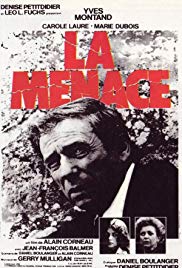
Alain Corneau’s La menace plays out a cleverly-conceived scheme – a protagonist (Yves Montand’s Henri Savin) implicated in two non-existent crimes: the first a suicide in which his lover is implicated through coincidence; the second an elaborate ruse he devises as a route to freedom, but which works all too well, bringing him down through vigilante justice. Given all the complications, the film has relatively little dialogue, focusing primarily on action, from large-scale stunts on mountain highways to endless small manipulations: the typing of a faked letter, self-inflicting incriminating scratches, manipulating the hands of a clock and so on, the irony being that the underlying motive usually differs from the kind of malign set-up we’re used to in genre movies. In truth, it’s hard to figure out why Savin goes down this road in the first place, but perhaps the premise is that of an ill-considered initial reaction that then inexorably leads to others. The film’s climax plays out in British Columbia, where Corneau appears to have a great time marshalling heavy vehicles (this at the height of CB radio culture) on wide-open roads, although it doesn’t say much for the morals and ethics of Canadian truckers. The use of Montand in such a context presumably evokes The Wages of Fear, a movie that of course is infinitely better-remembered than La menace: for all of Corneau’s skill, the film feels rather uninvolving, partly because it’s hard to believe in the relationship between Savin and the beautiful, much younger cipher played by Carole Laure. The film hints that the investigating detective may contain his own more complex depths, but that just peters out, as does an initial subplot relating to human trafficking. Overall, it feels like Corneau’s precision and the climactic investment in spectacle should have resulted in a better-known film, but on the other hand the fate of excessive calculation leading to oblivion is an apt mirroring of its central narrative.
Saturday, November 9, 2019
Blow Out (Brian De Palma, 1981)
Blow
Out may be Brian de Palma’s most artful
indulgence of his affinity for disreputable material: it opens on an overly
prolonged, loving evocation of the slasher genre which might have been designed
to make your heart sink, but ultimately finds in such material a terrible kind
of commemoration, a recorded truth which for all its grisly artifice holds
greater integrity than the machinations of political power. The film has a classic
set-up: while capturing night noises from a bridge, Jack (John Travolta), a
movie sound guy, witnesses a presidential candidate’s car leave the road and
fatally enter the water, but no one subsequently wants to hear about the gunshot recorded on the tape, nor about the woman (Nancy Allen) he pulled from the sinking
vehicle. A large part of the pleasure comes from the immersion in old-fashioned
tangibility, in physically handling film, marking frames with an X and so on;
this and the title provide an obvious echo of Antonioni’s Blow Up, but
there’s not much of the aspirationally sensuous about De Palma’s film, not much
feeling of a time and place that will one day be looked back at with mysterious
fondness. Still, the situation allows plenty of pleasing ambiguities: for instance
in how Jack becomes the only repository of and fighter for the truth, even
though he only got into the whole thing while gathering raw material for
cinematic lies. The movie has some of De Palma’s most striking uses of split
screen, and a bravura climactic chase sequence; the narrative is well-crafted,
winding to a most bitter and incomplete kind of closure. One might wish that
Allen’s character could have been conceived in slightly more mature terms, or
that the political cover-up didn’t have to involve a gloatingly sleazy assassin
and a series of sex killings, but at least the movie’s colourful misogyny is in
step with its overall cynicism.
Saturday, November 2, 2019
Old and New (Sergei Eisenstein and Grigoriy Aleksandrov, 1929)
Eisenstein’s and Aleksandrov’s The Old and the New (or The General Line) makes now for astonishing if somewhat strange viewing, both enveloping and alienating. Following the evolution of a collective farm and the peasant woman who keeps pushing it forward, the film may stick in the mind largely as a series of set-piece milestones, such as the acquisition of the first milk separator, the first bull, the first tractor – the film establishes the specific economic significance of each step, while also positioning them as a form of dream-like release, so that the first spurting of cream becomes a fountain, one tractor becomes a formation of dozens, and the bull’s potency becomes (through a staged marriage to a flower-bedecked cow) that of the community as a whole (a visit to a modern state farm is positioned almost as a science-fiction trip to a smoothly facilitating future). But the scheme also encompasses cautionary near-nightmare: the initial application for the tractor drowns in gleefully-depicted bureaucracy, and there’s a stark evocation of witchcraft. The production history spanned a shift in governing ideology, and this results now in a film that always feels to be pushing to escape its propagandistic shackles, without denying their existence (or, to some extent at least, their validity). Few films contain as many vivid close-ups of care-worn faces, and in that respect it’s deeply humanly connected, but at other times it barely feels human at all (the villains and obstructionists often register more fully than the agents of progress). If viewed as history, then it’s a monument to a time when industrialization could be regarded as a tribute to the capacity of the land rather than as a pillaging of it; when physical labour could be alleviated without heralding a descent into narcissism; but at the same time it feels unshackled from any time and place at all, excepting that created through pure cinema.
Saturday, October 26, 2019
Idaho Transfer (Peter Fonda, 1973)
Peter Fonda’s Idaho
Transfer is a super-high-concept time travel drama that generally doesn’t
feel like it: for much of the time, we could be watching Woodstock types dawdling
on their way to the next concert (indeed, the movie early on throws in two
secondary characters doing exactly that). The premise is a project to save mankind
by setting up a colony in the future, on the other side of a looming apocalyptic
event; the time travel technology (located in a secretive desert facility) necessitates
sitting on a low metal platform, taking off one’s pants and pushing a few
buttons, and doesn’t work for people over thirty (even for them, it eventually
transpires that it causes sterility, making the whole project largely
pointless). If that explanation seems absurdly high-level, it’s about as much
as the movie ever provides: the screenplay is refreshingly free of ringing
certainties, and the prevailing mood is that of watching figures in a barren
landscape, trying to roll with the punches (Antonioni’s Zabriskie Point
may come fleetingly to mind, but everything here is far less charged, including
erotically speaking [notwithstanding the frequently absent pants]). Much of the
“action” – such as the discovery of a mutated post-disaster civilization - occurs
offscreen, and Fonda takes some big narrative leaps, but the sense of emptiness
feels well-judged given the rather despairing premise, conveying a pervasive
sense of dissipating youthful promise. The movie saves its boldest stroke for
the very last scene, reconfiguring our sense of the world we’re watching (possibly
too much for comfort, but at least it’s striking) and throwing in some grisly
implications. It’s hardly a high-impact piece of work, not so much acted as just
embodied, and one almost wishes Fonda had pushed even further in that
direction, toward pure abstracted reverie. As it is though, it’s still mostly
satisfying, in a stubbornly self-absorbed kind of way.
Saturday, October 19, 2019
Something Different (Vera Chytilova, 1963)
Vera Chytilova’s Something Different delivers exactly that, most literally by switching back and forth between two contrasting narratives: one observing Eva, a gymnast in training for upcoming championships; the other following Vera, a housewife overwhelmed by her hyperactive young son and by domesticity in general. The two strands only occasionally explicit echo each other (Vera’s husband and Eva both criticized for reading the paper, him at the dinner table and her on the beam) but provide parallel studies in the difficulty of maintaining balance (in Eva’s case, literally as well as figuratively) and resisting subjugation. Eva’s position seems more privileged by virtue of her relative fame, and yet her coaches rail at her laziness, grab at her limbs and pull her into desired poses, scornfully dismiss her ideas and instincts, and at one point slap her across the face: her final performance liberates her from such direct control, while withholding any real sense of exultation. By comparison, the sequences with Vera are a frenetic pile-up of life problems, underlined by frequent arguments about money. She starts an affair with a man who pursues her in the street, but in large part it seems like another source of life clutter, another submission to an agenda primarily set by someone else; when a crisis hits at the end, she has no option but to cling onto what she has, however unsatisfying. The film’s last sequence, with Eva now coaching a young female athlete, suggests the possibility of calmer and more nurturing structures ahead, but the final note is questioning and reflective rather than in any way triumphant. Eva’s distinct place in society relative to Vera's correlates with a greater openness to cinematic invention as measured by camera angles, freeze frames and suchlike, but these also speak to her distance from the more typical life experience.
Saturday, October 12, 2019
Prince of the City (Sidney Lumet, 1981)
A viewer could be forgiven for finding much of Sidney Lumet’s Prince of the City rather flat – it’s stylistically restrained and businesslike, with few conventional dramatic highpoints: the casting of Treat Williams (who, in truth, doesn’t seem entirely equal to the role) might have been designed to thwart easy gratification. It eventually becomes clear though that this is a strategy, and a rather subtly executed one, channeling the growing realization of its protagonist, Danny Ciello, that in his play for heroism and expiation, he’s lost all autonomy and self-determination. The movie initially emphasizes his princeliness, at the centre of a smoothly functioning drug squad unit, racking up collars while regularly bending the rules and skimming off the spoils: he’s drawn to cooperate with a probe into police corruption, seeing it in part as another stage to strut upon, naively certain he controls his exposure and that of his partners. But the film ultimately comes down to a decision on whether to prosecute Ciello himself, staged by Lumet as a debate into the interplay of relative morality, idealism and pragmatism, the final determination on which may be little more than a coin flip; it’s intercut with a court proceeding where Ciello is raked over the coals, culminating in a question about whether his wife (Lindsay Crouse) was aware of his interactions with prostitutes. It’s notable that by then, she and his children have largely faded from the film, casting it as a study in escalating loneliness – an impression sealed by the very last moment, freezing on his face in the aftermath of yet another small humiliation. Again, you might feel that final blow should land a little harder, but maybe such criticism would undervalue Lumet’s finesse – why should we expect conventionally satisfying closure, when that’s so plainly denied to the character, if not to anyone who participates in the torturous justice system?
Saturday, October 5, 2019
Weekend at Dunkirk (Henri Verneuil, 1964)
Henri Verneuil’s 1964 Weekend at Dunkirk has (to a surprising extent) pictorial qualities to match Christopher Nolan’s more recent treatment of the evacuation, with a more personal and haunting overall narrative. It was much remarked how Nolan withheld some basic information about surrounding events for instance by omitting any glimpses of Churchill, but Verneuil does something very similar, dropping his protagonist Julien (Jean-Paul Belmondo) into the middle of the action, leaving no doubt about its momentous nature, but emphasizing Julien's confusion about what’s going on (the most salient point about the British operation is that they don’t want to take the French with them) and his indecision about how best to survive without succumbing to desertion or cowardice. Beneath all the terrific spectacle and impactful incident, there’s something close to lurking black comedy in how Julien keeps finding himself back at the same point on the beach, even as others leave in one way or another (to the point that he’s ultimately the last one left): his conversations with a priest add to the sense of moral inquiry. Julien embodies all the ambiguity of war, intuitively working to strike up a mutually respectful rapport (even, eventually, with an obstructive British officer), but reacting with as much skepticism to an individual who thinks too calculatingly of his own survival as to another who too aggressively brandishes his giant gun: the only soldiers he directly kills are French ones, to save a woman from being raped, but then her subsequent actions have him wondering almost immediately whether he did the right thing. The fact that Catherine Spaak would have second billing in a film about Dunkirk perhaps sums up the commercial friendliness that influences one’s view of Verneuil, but in the end her presence adds more than it detracts, speaking to his consistent ability to create unified, textured works.
Saturday, September 28, 2019
Diary of a Country Priest (Robert Bresson, 1950)
In a lesser film, the emphasis on writing in Robert
Bresson’s Diary of a Country Priest might seem over-emphatic, almost as
a negation of cinema: for a significant portion of screen time we see the words
on the pages of the priest’s journal and simultaneously hear them in his voice
over. In Bresson’s hands however, the repetition deepens our compassion for the
meticulous thoroughness of the protagonist’s struggle, while surely suggesting
a linkage between the man of God and the artist: each consecrated to his
interpretative process, to relentless self-examination, to a journey of
uncertain destination. The film’s ultimate tragedy is embodied by the priest’s
incapacity to craft the final entry, by the intrusion (however respectful) of
the voice of another, by the yielding of all imagery to that of the cross. The
film depicts the priest’s life as small and strained, doomed almost from the
start (there are hints of what we might now call fetal alcohol syndrome), but
with the capacity to acquire a kind of majesty (or grace, in the film’s terms)
if it were allowed to approach God expansively and openly, to rely as much on
intuition as on dogma and ritual. But the rural society to which he’s assigned
is parched and grudging and set in its ways, tolerant of the church as long as
it maintains its boundaries as an abstract pillar of continuity and order and
discipline, unable to countenance true questing or suffering. The film feels so
unerringly composed that later Bresson works may almost seem strained by
comparison (this is a purely relative assessment, I should emphasize). It also
encompasses one of the purest expressions of bliss in his work – a brief ride
on the back of a motorcycle ride that leaves the priest momentarily
exhilarated, certain he feels God’s hand in the experience (it’s a moment of surrender
that may bring to mind the older Bresson’s delight in For Your Eyes Only,
for its “cinematic writing”). Diary of a Country Priest is at once resolutely
tangible and specific and wondrously transcendent, an inexhaustible filmic
pilgrimage.
Wednesday, September 25, 2019
Un singe en hiver (Henri Verneuil, 1962)
Subscribe to:
Posts (Atom)


