Friday, April 17, 2020

The Nun (Jacques Rivette, 1966)


Although Jacques Rivette’s La religieuse focuses on a young nun fighting for her freedom, the film never seems to discount the possibility of devotion and God’s grace: the outrage lies in using religious institutions as a means of social control. The protagonist, Susanne, is pushed by her family into taking her vows because of financial and social considerations, the France of the time (around 1750) apparently allowing no practical alternative that they can perceive or tolerate: the bulk of the narrative follows her mistreatment at the hands of one vengeful superior, and her attempts to avoid the desirous advances of another. The film is most audacious in its final stretch, after she escapes with the assistance of an equally unhappy priest: it skips through subsequent events (perpetually in fear of being recaptured; reduced either to begging or else working in a series of menial or demeaning jobs) in fragmented fashion, suggesting that for all her unhappiness, the institution did provide a form of coherence that the outside world lacks. Of course, this only underlines the pervasive lack of alternatives for a woman who falls outside the prevailing structures of control and belief. Anna Karina is a perfect centre for the film, entirely convincing and moving in her essential goodness, driven not by inherent rebelliousness but by a sense of wrongness, that God sees through and is offended by her pretense, even as many of those around her offend against their vows in different ways. It’s hard to know how easily a viewer could attribute the film to Rivette, if he or she didn’t already know it's his, but among other things, the film evidences his affinity for theatre and performance, as for instance in the opening scene where she takes her vows before an audience, separated by a grill, and more broadly in the notion of God as the ultimate perceived spectator and judge of authenticity.

Friday, April 10, 2020

New York, New York (Martin Scorsese, 1977)
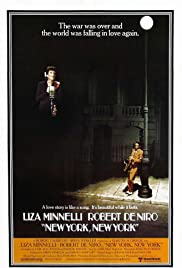

Martin Scorsese’s New York, New York is one of his most fascinatingly strange films, a meeting of varied artifices and evasions. Robert De Niro is Jimmy Doyle, a virtuoso saxophone player who resists the confines of the prevailing post-war swing band aesthetic, drawn to more experimental, improvisatory forms; Liza Minnelli is Francine Evans, a singer of more traditional instincts: their incredibly volatile relationship reflects the tensions of diverging desires and ambitions (they meet in the thick of VJ Day celebrations, placing the film in part as a parable of post-war reconstruction). Within the decade or so of the (deceptively conventional sounding) plot, Francine ends up as the bigger star, with a Hollywood and nightclub career that looks much like that of Minnelli’s mother Judy Garland; the film doesn’t emphasize what every viewer knows, that the mainstream will soon leave her behind (Minnelli herself was already at the end of her brief movie-starring heyday). De Niro’s performance is among his most extreme, a barrage of challenges and provocations (Jimmy’s treatment of Francine certainly constitutes some kind of abuse) that doesn’t feel like old Hollywood, but which is too stylized to fit comfortably into the new: coupled with the frequent artificiality of the film’s backdrops, it often feels like pure abstracted challenge. It’s grandly appropriate them that the last stretch of the film consists almost entirely of performances, primarily by Francine (and all absolute Minnelli classics), with her and Jimmy’s personal story coming to be defined by inarticulacy and absence (with echoes of Antonioni’s The Eclipse). Even before that, the movie has several moments that almost seem to pause, to separately observe Francine and Jimmy at moments of silent contemplation, as if insisting that it’s interested in inner lives, even as it represents an America steadily progressing deeper into obsession with image and projection.

Saturday, April 4, 2020

Mexican Bus Ride (Luis Bunuel, 1952)


Luis Bunuel was already in his early fifties when he made Mexican Bus Ride, and one can imagine an alternative history in which it would have been a sign of winding down, of easing into dawdling conviviality of the sort that characterizes the titular journey: the bus only gets going when it’s full, adhering to no fixed schedule – progress gets interrupted along the way by a flat tire, by being stuck in mud, by a woman giving birth, by driver fatigue, and finally by a detour to a birthday celebration. A bit of frustration gets expressed at all this, but for the most part the passengers take it in stride, the journey being as important as the destination, and efficiency being a rather suspect commodity (during the mudbound episode, a pair of oxen acquit themselves much more effectively than a modern tractor). The passenger at the centre of our attention is Oliverio, heading to find and bring back a lawyer to document his dying mother’s will, knowing that otherwise his scheming older brothers will manipulate her for their own self-interests – the urgency of the situation pulls him away from his wedding night, and exposes him to the relentless advances of a female passenger (to whom he seems to represent a pure sexual itch that she’s determined to scratch). A few sharp Bunuelian strokes dispel any potential sense of complacency: a vividly imagined dream sequence drawing on Oliverio’s faltering resistance to temptation; a willing no-strings-attached consummation in the midst of a storm; and a final few scenes in which he arrives back too late, but forges his mother’s mark on some documents for the sake of implementing her expressed wishes, before drawing his wife close and uttering a fiery statement of intent. The movie’s positioning of adultery as a galvanizing force and of manipulation of the dead as a morally righteous act still feels defiantly transgressive, a sign of a filmmaker with a startling journey still ahead.

Friday, March 27, 2020

A Guide for the Married Man (Gene Kelly, 1967)


Gene Kelly’s A Guide for the Married Man makes for mostly depressing viewing, if you regard the prospects for heterosexual marriage with even a scrap of romantic idealism. Paul Manning (Walter Matthau) is “happily” but aridly married and his thoughts drift to having an affair (perhaps with a neighbour; failing that just with anyone), egged on by his compulsively cheating neighbour Ed Stander (Robert Morse): the movie illustrates Ed’s advice on getting away with it with a series of sketches populated by “technical advisors” of the likes of Lucille Ball and Jack Benny. Some of the vignettes are moderately funny (although seldom very surprising), and at least the format provides an inherent degree of variety: Kelly’s direction is quite sprightly at times. But the society depicted here is a uniform existential wasteland in which a woman’s highest aspiration is to stay at home looking blandly beautiful and tending to her man and her children, all but extinguishing herself as a viable sexual being: for the husbands, it seems, the specific act of adultery is less significant than the prospective thrill of plotting to do it and the retrospective satisfaction of having gotten away with it (their lives being starved of any other compelling narratives). Everything is calculation and process, heavily aided by female gullibility and low expectations, enacted against a deadening materialistic backdrop: the ending in which Paul predictably “comes to his senses’ plays as fearful surrender more than happy awakening (Matthau in general seems rather depressed in the role, although that might be a form of commentary). It’s funny how many reviewers focus on the beauty of Inger Stevens in her role as Manning’s wife (“you have to wonder why Matthau would even consider adulterous behavior with a wife like Inger at home!”) as if this were a silly oversight of the film, rather than a proof of its toxicity.

Friday, March 20, 2020

Love on the Run (Francois Truffaut, 1979)
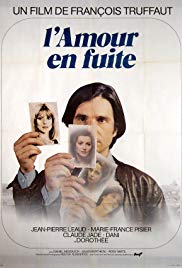

Francois Truffaut’s frequent return to the character of Antoine Doinel seems on its face as a sign of commitment and identification, rendering it rather strange then how the Doinel films are generally among the director’s lighter and less substantial works. Perhaps this means they should be seen instead as a reliable means of escape, and yet they’re surely too self-reflective for that, and to a degree too self-revealing: it doesn’t take much research to discover, for instance, that the scene near the end of Love on the Run where two former girlfriends share their experiences of Antoine is cast with two former girlfriends of Truffaut himself (Marie-France Pisier and Claude Jade). Of course, that might suggest the movies are substantially an ego trip, but if so, it’s an exercise carried with a disarming sense of helplessness. Love on the Run, the last in the series, deals with Antoine’s divorce and other problems, and dwells along the way on other tragedies – the death of a mother, that of a child – but may feel overall like the breeziest of them all, which again may seem either like a failure of seriousness or a beguiling ambiguity. Take, for instance, the closing scene, in which Doinel wins back his latest squeeze by telling her, in the record store where she works, how he fell in love with her, on the basis of a photograph, before he physically met her: she yields to the story, of course, but as we the audience have already seen him recite the same story as the basis for an intended novel, it hardly lands as an emotionally committed outpouring. Especially not as the film then presents a pair of customers asking for a particular new release which is, in fact, the title song of the movie we’re watching. So it’s all a game, oscillating between poles, likely to leave the viewer quietly charmed and content, and almost entirely uninformed.

Saturday, March 14, 2020

Girl 6 (Spike Lee, 1996)


Watched again at a time when questions of representation and inclusion only swirl more urgently, Spike Lee’s Girl 6 is as intriguing and evasive as ever, a film of finely seductive, sensuous presence (happily aided by a heavy Prince presence on the soundtrack), built on long-established absences. It follows a young actress, Judy (although we only learn that name in the final minutes), who out of economic necessity becomes a phone sex operator, where “Girl 6” is her ID; she starts to relish her popularity and her relationships with some recurring callers, putting her sense of boundaries at risk. Theresa Randle is sensational in the lead role, conveying all the character’s specific insecurities while evoking a more classical, timeless mystique; the movie includes imagined sequences in which she’s dropped into The Jeffersons, Foxy Brown, or Carmen Jones, as Dorothy Dandridge, each of these serving both as celebration and as an underlining of the limited coordinates of female black stardom. Dandridge seems to constitute a particular preoccupation – the kind of pioneering icon to which an actress might aspire, but whose career was hampered by cruel lack of possibilities - and by bookending the film with two auditions at which Judy is treated largely as a piece of flesh, Lee pointedly resists the sense of growth and evolution that often attends such stories. As with the somewhat related Bamboozled, an almost hallucinatory quality intercedes in the closing stretch, and the final shot could be taken as much as a portent of future anonymity than as one of triumph. Halle Berry briefly appears at herself, a few years before building on Dandridge’s status as the first black woman to be nominated for the best actress Oscar by becoming the first black woman to win it (and the only one to date) – it’s a coincidence that fittingly underlines the sense of confinement and restriction (as does Randle’s near-disappearance from movies for the last decade).

Saturday, March 7, 2020

Redes (Fred Zinnemann and Emilio Gomez Muriel, 1936)


Fred Zinnemann and Emilio Gomez Muriel’s Redes is a completely absorbing hour or so of cinema – persistently stunning as observation of (at least apparently) real, challenged lives against pictorially transfixing backdrops, emotionally stirring for its depiction of social injustice, while also limited by narrative artifice and the unwarranted promise of its climax. The film focuses on a poor fishing community on the coast of Mexico, where one of the men becomes radicalized after losing a child for lack of money to buy medicine; he focuses on how the profit from their efforts flows overwhelming to the single capital provider at the top of the social pyramid, with the workers perpetually settling for almost nothing. He inspires some of his colleagues while alienating others, but in the end, after further tragedy, they’re all united, and the film suggests they might constitute a figurative revolutionary wave, amassing to wash away an exploitatively complacent society. The portrayal of the fishermen’s plight (interesting to note as an aside that women are barely glimpsed in the film, let alone being allowed to speak) feels as righteously provocative now as it did then, despite the mostly clunky portrayal of the complacent local master and his conniving politician sidekick. Among the multiple fascinating contributors to the film, the involvement of Zinnemann as co-director, long before his mainstream, multiple Oscar-winning peak, stands out: as with much of his later work perhaps, one can point to aspects of Redes which appear brave and ground-breaking, and feel grateful for its overall achievement, while yet feeling willing to sacrifice some of its craft and calculation (even Silvestre Revueltas’ grandly imposed musical score) in return for a more truthful overall testimony. But perhaps it took the test of time, and the repeated triumph of predatory capitalism, for that failure to become as clear as it is now.

Friday, February 28, 2020

Kiss Me Goodbye (Robert Mulligan, 1982)


Robert Mulligan’s Kiss Me Goodbye is a strangely slack and disinterested film, one of those works in which no one and nothing seems to connect with anyone or anything else. Three years after the death of her choreographer husband Jolly (James Caan), Kay (Sally Field) returns to the house they shared together, intending now to occupy it with her fiancĂ©e Rupert (Jeff Bridges). She soon encounters Jolly’s ghost, visible and audible only to her, and adjusts to his presence with remarkable ease; Rupert of course thinks she’s nuts, but sort of plays along, to the extent of taking the ghost on a road trip and ordering for him in a restaurant. The concept of the ghost is thin indeed – Jolly is clearly tuned into some greater force in that he’s able to dredge up undisclosed facts about Rupert’s past, but nothing more is made of that power, and Kay doesn’t evidence a shred of curiosity in how he experiences their interactions, or in where he goes when he’s absent, or in much of anything (none of the actors are anywhere near their best). For a while she toys with the idea of maintaining two husbands, opening up some raunchily twisted possibility, but a scene where she tries to make love to Rupert while Jolly’s in the room plays as unsexily as anything you’ll ever see. The movie limps along through some slumbering set-ups (an attempted exorcism; a wrong notion that Jolly’s spirit may have gone to hide inside Kay's dog) and then ends in as offhanded a way as it started, with the vaguest of explanations for Jolly’s intervention. The movie is of almost no specific interest, but stands as one of many examples of a recurring Hollywod mystery, of how so many presumably somewhat discerning and skillful individuals can devote their energies to such a coldly meaningless, complacent undertaking.

Saturday, February 22, 2020

Spoiled Children (Bertrand Tavernier, 1977)


A largely forgotten early work by Bertrand Tavernier, Spoiled Children remains as interesting as any of his films for its artful collisions of themes and tones. The opening credits promise a boisterous culture clash, counterpointing a rollickingly performed song about the glories of old Paris with various scenes of the drab contemporary reality, but this is an immediate misdirection, evoking a zest that the modern world hardly accommodates. The focal point is a movie director, Bernard Rougerie (Michel Piccoli) who rents a second apartment away from his family, to work on his script in peace (the self-referentiality of this notion is underlined by references to Rougerie’s last film Deathwatch, which in reality would be the title of Tavernier’s next one), a notion rapidly challenged as he gets involved with the building’s tenant defense committee, formed to counter excessive rent increases imposed by the landlord (the film is very informative about relevant laws and practices), and in particular with one attractive young neighbor, Anne Torrini (Christine Pascal). Rougerie’s wife works with silent children, coaxing them into talking – this and the title underline the theme of personal and societal immaturity, of stumbling toward a coherent voice and identity: even as Rougerie’s movie starts to take shape, he finds himself critiqued by Anne for a lack of personal commitment, to their relationship, to anything. In summary this might sound a bit schematic, but Tavernier deftly navigates through contrasts and counterpoints, suggesting an ironic auto-critique even as his film amply justifies his chosen course.The final maxim – “If I die one day I want to meet death as I have met love” – may seem better suited to a more classically romantic film, especially when pasted over children playing in a grim-looking urban playground, but as such provides a final assertion of ambiguity and cross-pollination, of a directed voice that may still be heard over all our capitalistic injustices and challenges.

Saturday, February 15, 2020

Lady Oscar (Jacques Demy, 1979)


Lady Oscar is certainly one of Jacques Demy’s less prominent films, with a persistently displaced feeling about it: set in France during the decade or so leading up to the Revolution, but made in English with mostly Japanese money. It may sound in summary like a gender-bending swashbuckler - Oscar is born a woman but raised as a boy to satisfy her father’s desire for a male heir, becoming a personal guard to Marie Antoinette -  but doesn’t feel particularly queered: except for one scene in which she dances with and kisses another woman (entirely to demonstrate her resistance to an unwanted suitor), there’s no suggestion that Oscar is anything other than a slow-to-awaken heterosexual woman, whose awakening as a woman coincides with that as a socially aware citizen, coinciding further with the radicalization of the populace as a whole. Compared to the striking grubbiness of Demy’s Pied Piper, the film often feels overly antiseptic, consisting largely of stiff exchanges in fancy rooms, with a central character that’s as much observer as meaningful participant. At times, certainly, the distancing can be rather stimulating - to that point I couldn’t quite decide on the merits of Catriona MacColl’s well-spoken but largely blank lead performance – and Demy often seems as interested in secondary narratives of female deception and adaptation, including the Queen’s self-serving materialism and infidelity, and another character who lies her way from poverty into money, each instance adding fuel to the popular anger that sparks the Revolution. It’s certainly interesting how Oscar’s ultimate arrival at a sense of self is immediately followed by a kind of obliteration, as she suffers her greatest personal loss, while submerged in the jubilant crowd: as such Lady Oscar looks ahead to Demy’s often quietly tortured-seeming, much underrated late run of work, in which a musical number might be as likely to accompany suicide or incest as to articulate more conventional sentiments.

Friday, February 7, 2020

Law of the Border (Lutfi Akad, 1966)


The restored print of Lutfi Akad’s The Law of the Border starts by emphasizing the remaining flaws and shortcomings, noting that “the poor state of preservation of the only source available for restoration has irreversibly hindered the quality of the final outcome.” While no one should argue this benefits the film, the ragged quality of the viewing experience does rather accord with the scrappy nature of the underlying narrative, adding to a sense of authentic sociological engagement channeled through energetically genre-hugging set-ups (as has been pointed out, one might choose to engage with it as a displaced western, although that could be more limiting than helpful). The movie’s basic opposition is between a group of poor villagers who make their living by smuggling across the Syrian border, and the firm but sympathetic law enforcer who tries to shut them down without putting them in jail, brokering a deal for them to become sharecroppers (the term used in the subtitles) on a rich man’s land, and helping to persuade them to accommodate a school. Further conflicts erupt between outlaws, the details of which weren’t always entirely clear to me at least, but this generally functions as daring, almost poetic fragmentation (the movie has enough raw narrative material to fuel something of epic length, but dispenses with it all in barely more than 75 minutes). Much of what’s depicted seems almost divorced from any recognizable time and place, but the very clearly contemporary affect of the teacher in particular emphasizes that this isn’t some kind of romantic primitivism, but rather a simple function of poverty and deprivation: seen today, the film’s social charge is heavily retrospectively enhanced by the subsequent extraordinary life history of its star Yilmaz Guney. Overall, the film can’t be classed as a masterpiece, but it elicits a deep sense of respect.

Friday, January 31, 2020

Popeye (Robert Altman, 1980)


Robert Altman’s Popeye plays more like a self-absorbed, semi-penetrable mystery than a family entertainment (especially by today’s standards) – a lonely sailor turns up in a strange town, his conversation barely penetrable, finding little welcome among the eccentrically downtrodden inhabitants, who are over-taxed, often physically maligned by the local strongman, and apparently stuck in narrowly repetitive lives and behaviour patterns (although the community does include a gambling den and even an apparent brothel). His purpose is to find his long-lost father, and he eventually succeeds, although it barely seems to matter by then to either of them, his affections diverted onto a cruelly abandoned baby which he immediately takes on as his own, and via whom he rapidly acquires a sort of surrogate wife (that would be Olive Oyl), although there’s not a hint of what you’d call “chemistry” between them. They’re all put in peril by the evil Bluto, with Popeye discovering at the last minute the transformative powers of canned spinach, but little of this registers as a meaningful narrative. The movie’s great strengths are its tangibility, both in evoking the rickety all-in-it-togetherness of Sweethaven (which lives on as a tourist attraction in Malta) and in the physicality of the clowning, and of course its abundance of the texture we always prize in Altman – the sense of lives in motion, of a world that doesn’t stop at the edge of the frame. It just all seems rather strange, when what’s actually in the middle of the frame is so weird and unapproachable. Robin Williams’ performance seems largely directed at himself, no doubt as instructed; Harry Nilsson’s songs, somehow managing to be simultaneously negligible and memorable, perfectly suit the rest of the film. There was no sequel, but if there had been, I like to imagine they would have offered the job to Raul Ruiz…

Saturday, January 25, 2020

Teorema (Pier Paolo Pasolini, 1968)


The most exultant moments of Pasolini’s inexhaustible Theorem are its opening ones, plunging us into a news footage-type presentation of a rich man who’s given away his factory to the workers – an act of apparent progressive altruism that’s immediately analyzed as suspect, as stripping the workers of the possibility of a future revolution (the ultimate example, one may think, of a glass half empty). The film that follows confirms the skepticism though, leaving a heavy impression of the stickiness of the bourgeoisie: they may lose their bearings, their sanity, their morality, or even consciousness itself, but they persist at the centre of their stories, tarnishing the figurative and actual landscape they inhabit. It’s a sly joke, perhaps, that the medium of this unwinding should be the mysterious visitor played by Terence Stamp, and the popular summation of the film, highlighting his seduction of each member of that rich man’s family, makes the film sound much racier than it actually is (while it draws our attention repeatedly to the visitor’s crotch, it’s almost strenuously chaste in how it visualizes other sexual happenings, particularly by comparison with the unbound nudity of Pasolini’s later films). In comparison to the family’s solipsistic responses, the maid apparently perceives Stamp’s visitor as a medium of holy transformation, and retreats to her rural home where she demonstrates healing and levitational powers before willingly embracing death: the contrast may speak to the relative purity of the working class, but also to its passivity in the face of transformational possibilities. Although Stamp’s character may sound schematically conceived, he also has the film’s most playful, spontaneous-seeming moments, pointing to how the bourgeoisie’s failure is as much one of intimate self-understanding as societal stewardship. Ultimately, the rich man is reduced to wandering naked in a barren desert, stopping to emit a crazed, accusatory cry, perhaps speaking for his own plight, perhaps for that of us all.

Saturday, January 18, 2020

The Return of the Pink Panther (Blake Edwards, 1975)


Blake Edwards’ fascination with the Pink Panther universe (five films with Peter Sellers, three more after his death) almost carries the air of a stubborn, doomed quest toward revelation. Return of the Pink Panther, the third and arguably the best of them (and I realize many might question what that could possibly mean in this context) exemplifies the core narrative momentum: Jacques Clouseau is a fool of such magnitude that he causes physical laws to break down around him and induces madness in his superior, and yet he keeps rising in rank and popular esteem, regardless that (unlike Sellers’ late triumph in Being There) almost everyone seems to see him for the idiot he is (at several points in Return, the co-star Catherine Schell is seen barely suppressing laughter, as if we were watching outtakes). When at his best, Sellers almost makes the character coherent in his dignity: his absurd over-deliberation in some matters (his propensity for disguise and false names) combined with total blindness in others; his perpetually odd pronunciation suggesting some unspecified secret origin. The title animation suggests a bending of reality which also recurs around Clouseau (affecting, as the moment may dictate, other individuals, light bulbs, vacuum cleaners, the force of gravity etc.), while also possessing a jazzy hipness that he lacks, but often seems to aspire to. Edwards makes a game out of shifting the coordinates (casting Graham Stark, who played Clouseau’s colleague in an earlier installment, as a petty criminal here) while indulging his penchant for plush living on the one hand (Christopher Plummer, as the object of suspicion, mostly inhabits a different, more efficient universe than that of the rest of the film) and his affinity for something more merciless on the other. The series already feels a bit tired here (a trait that would rapidly escalate) but that only adds to the sense of strange, displaced destiny. Oh, and in case it’s not clear from all that, it does actually make me laugh.

Saturday, January 11, 2020

Rendez-vous (Andre Techine, 1985)


Andre Techine’s Rendez-Vous leaves us to chew over a citation from John’s Gospel: ““Very truly I tell you, unless a kernel of wheat falls to the ground and dies, it remains only a single seed. But if it dies, it produces many seeds.” The most obvious application is to Lambert Wilson’s Quentin, who throws himself under a car midway through the movie after staging a contest of sort for Nina’s (Juliette Binoche’s) affections – his death sets the stage for Nina to meet a respectable theatre director (Jean-Louis Trintignant) and to gravitate to serious acting work, playing Juliet, while also freeing herself of unhealthy attachments. In the end, she’s almost strenuously self-defined – the director leaves before the opening night curtain goes up, the other man who loved her seems to have cleared his head, and we never even see who is playing Romeo. It’s a strange and lurching journey to get to that point though, one marked by regular swerves in behaviour and focus, by return visits by Quentin from beyond the grave, and by a problematic objectification of Nina: a woman who initially uses her sexuality freely, but thereafter struggles to have her voice heard and her will respected (Binoche, as always, inhabits the role with complete commitment). The film often feels borderline nutty in its flirting with extremity, as if setting itself a challenge - the depiction of a public sex club, where the self-loathing Quentin exercises his notion of his art (this time with a different take on Romeo and Juliet), certainly contributes to this sense, even as it broadens the film’s notion of sexuality as display. Overall, it’s rather impressive that Techine makes it feel as coherent and unified as it does. Still, his later work would almost always be more accomplished, whether measured by the depth of its human investigations or by the allure of its structural mysteries.