Tuesday, February 28, 2023

Home Sweet Home (Mike Leigh, 1982)


Home Sweet Home is emblematic early-ish Mike Leigh, bitterly funny and appalling, inviting suspicions of condescension, but with too many flashes of desperate verisimilitude for any such charges to completely stick. A plot summary seems to align the film with randy workplace concoctions on the lines of On the Buses: postman Stan has an affair with the wife of one of his colleagues while being aggressively pursued by the wife of one of the others, things coming to a head when both women show up at his house at once. But Stan (Eric Richard) is no working-class Casanova, his appeal seeming mainly based in the contrast with the two inadequate husbands, and capable of awful self-serving coldness, as in the heartrending mini-portrait of his treatment of a woman he picks up at the launderette. His teenage daughter, Tina, has spent most of the time since her mother’s departure in foster care or group homes; Stan only reluctantly visits her, his inadequacy as a father pushing him into irritable taciturnity. It’s Tina who occupies the film’s final shot, suggesting she’s the most major casualty of the whole mess; a sly late pivot introduces a new social worker who bombards Stan with jargon while providing an ample window on his own bitter preoccupations. The title is ironic to a fault of course: as always, Leigh has an eerie capacity to create lived-in spaces and routines (how many cups of tea were offered and consumed in his work of this period?), while conveying how the frail economic predictability they provide is, as Sondheim might have put it, a daily little death. Tim Barker’s indelibly conceived Harold may be the saddest of the sad bunch, his wife snapping back at his most basic utterances, a stream of dumb jokes and disconnected utterances failing to disguise how he’s barely present in his own life, let alone anyone else’s.

Wednesday, February 22, 2023

Another Man, Another Chance (Claude Lelouch, 1977)


Claude Lelouch’s Another Man, Another Chance feels almost dizzyingly expansive in its opening stretches, switching between a low-key Western starring James Caan as David Williams, a veterinarian who starts a new life after his wife is murdered, and a drama set in a war-devastated Paris with Genevieve Bujold; when the Bujold character, Jeanne Leroy, and her photographer husband decide to emigrate to the US, the two strands gradually coalesce (some of the plot details are directly recycled from Lelouch's biggest success Un homme et une femme). The film contains some outstanding period feeling – I’ve seldom for instance seen the centrality to the community of the regular stagecoach route evoked so fully – and striking single takes, such as an early one showcasing Caan’s horseriding and roping skills; the muted colour pallet and low-key acting (with close-ups of the principals kept to an extreme minimum) all work well. But Lelouch also throws in a regular stream of oddities, from a disconnected prologue with Caan playing a descendant of his main character, through the soundtrack’s recurringly jarring use of the famous notes from Beethoven’s Fifth, to an ending so low-key that it almost feels as if they just ran out of celluloid. Still, overall, the film crafts a distinctive emotional space, basing the relationship between the two (as far as one can tell – there’s not much to go on) more in mutual logic (by that point for example, they’re both single parents) than passion; Bujold’s regular recurrence to her native language, and insistence on trying to teach it to her rapidly Americanizing daughter, suggests their relationship will be inherently defined in part by distance and loss (the final voice over tells us that she never achieved her dream of returning to Paris). Lelouch has remained true to his idiosyncratic instincts and their consequent mixed results: for instance, his late film The Best Years of a Life contains some unforgettable close observation of the aged Jean-Louis Trintignant and Anouk Aimee, within a slack overall scheme incorporating ill-judged fantasy inserts.

Wednesday, February 15, 2023

Man Hunt (Fritz Lang, 1941)


Fritz Lang’s 1941 film Man Hunt makes for strangely abstracted viewing now: the (still startling) footage of Adolf Hitler in the opening minutes signaling a project urgently grounded in real-life atrocities, and yet yielding a rather hermetic subsequent narrative (the film overall carries a far less striking sense of threat than the more fantastic Mabuse works). For sure, this partly speaks to Lang's core project, to dramatize one man’s evolution from partial fatuousness to life-consuming commitment: at the start, Walter Pidgeon’s crack game hunter Thorndike has the Fuhrer in his sights, but doesn’t take the shot, subsequently straining to convince his German captors (and perhaps himself) that he only did it for the sport of finding out whether it would have been possible. The Germans (mainly represented by George Sanders and John Carradine!) plan to manipulate him for propaganda purposes, but he escapes and makes his way to London, crossing paths with working-class Jerry (Joan Bennett) who rapidly falls for him and becomes an indispensable collaborator. While Bennett’s exaggerated accent and mannerisms may seem like objectively awful acting, the difference between her and the frequently flippant Thorndike does fuel one of the film’s key contrasts: between a society that facilitates such intuitive bonding across class lines and another that (at least in this telling) knows only cold calculation (inadvertently aided by some upper-class British cluelessness). The film is propelled by a series of spatially-confined set-pieces – on a ship, (most memorably) in the London underground, in a cave where the only means of escape has been blocked off – giving expression to that broad theme of the compression and hounding of freedom and possibility. It’s nowhere near to being Lang’s best work, but certainly adds to the sense of his films – even more than for most great directors –as constituting individual chapters in a sobering overall vision.

Wednesday, February 8, 2023

Full Moon in New York (Stanley Kwan, 1989)


Stanley Kwan’s absorbing Full Moon in New York is built around the friendship between three young women living in the big city, linked by common Asian heritage (Taiwan, Hong Kong, mainland China) but otherwise very different in their life experiences and aspirations. Ms. Lee (Maggie Cheung) spends some of the time working in her family’s restaurant, supplemented with various other deals and trades, prompting several discussions about the perceived risk of opening a Chinese restaurant anywhere other than in Chinatown, and about appetite for risk in general. Ms. Wang (Sylvia Chang) tries to make it as an actress, which at that time typically necessitates having to specifically explain her suitability, as an Asian woman, for a particular role. Mrs. Poon (Yat-Gam Chu) comes to America to be married while barely able to speak English – her husband treats her well, but won’t yield to her deep desire to bring her mother over, either ignoring the request, or rationalizing it away as an example of old thinking. In other ways though, old practices and expectations still apply, for instance in the notion of parents finding a suitable marriage match for their children (even applying to Ms. Lee, whose romantic relationships are with other women); Kwan’s view of New York is very much that of an outsider, filming the city mainly either through high-rise windows or in disembodied panning shots, and finding it to be imperfectly integrated.  Some of the film’s most delightful passages simple observe the women as they hang out together, messing about in the restaurant kitchen or chatting about such mundane matters as shaving their legs; Kwan presents such moments both as an assertion of individual identity and as formative experience. Of course, the act of formation, the balancing of self-discovery and assimilation never reaches an end point, perhaps rendering the film’s unresolved ending inevitable; even so, it’s among the relatively few films that one might certainly wish to have gone on for longer.

Wednesday, February 1, 2023

Broadcast News (James L. Brooks, 1987)


The problem with James L. Brooks’ Broadcast News, viewed nowadays, isn’t so much that it seems dated (how could it not?) but rather that the way in which it’s dated isn’t particularly instructive regarding the movie’s own time, or our own, or the transition between the two. Take for example the big ethical reveal that drives the final stretch: the discovery that the empathetic tears of on-the-rise reporter Tom Grunick as he listens to an interviewee in one of the stories that made his name were filmed afterwards and edited into the flow. The revelation hardly lands now as intended (did it ever?), both because from what’s shown in the film, it’s not believable that a crew of experienced news people wouldn’t have tuned into it at the time, and more broadly because compared to the subsequent travails and degradations of politics and culture, it just doesn’t seem like an important enough violation to change the direction of things (one wonders more generally about the plausibility of a Washington bureau where there’s almost no talk about politics). Still, William Hurt was arguably never better than in his perfect calibration of Grunick, possessed of almost supernatural on-screen ease, exactly smart enough to know his considerable limitations; Albert Brooks’ Aaron Altman, in contrast, ideally conveys someone possibly too smart for his own good, held back both personally and professionally by a missing X-factor. Holly Hunter’s Jane, the best-rounded professional of the three, is an object of admiration and desire for both, a device undermined by the film’s emotional shallowness and sexual timidity. Brooks allows rather too much padding, as in some pointless opening vignettes of the three leads as children, and the film doesn’t have much of what you might call cinematic writing, but of course it’s an amiably professional job, in much the way that network prime time once connoted.

Wednesday, January 25, 2023

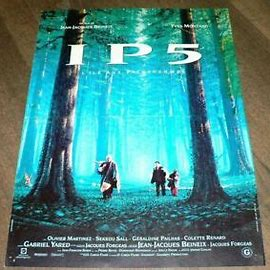
IP5: the Island of Pachyderms (Jean-Jacques Beineix, 1992)


In its strenuous bringing-together of disparate elements, Jean-Jacques Beineix’s IP5 may paradoxically seem to demonstrate a creative fountain too-rapidly running dry, forcing the director into attempting to find magic through near-random alchemy. In his last role (and therefore inherently quite moving, even if his character makes only limited sense), Yves Montand plays Leon Marcel, an escapee from the institution into which his relatives confined him, on a journey to close a romantic narrative left incomplete decades earlier. Olivier Martinez plays Tony, a virtuoso graffiti artist on the trail of Gloria, the woman he loves (Geraldine Pailhas), knowing only that she’s somewhere in Toulouse, accompanied by his much younger sidekick known as Jockey (Sekkou Sall), among other things a supposed mystically-gifted predictor of horse racing results and an ace car thief; it’s in the course of practicing the latter that they find Marcel asleep in a back seat and their trajectories eventually merge. Beineix’s sense of composition is evident throughout, and the clashing of aged gravity and contemporarily rooted multi-culturalism makes for some easily entertaining, if repetitive, dynamics. But the film ultimately seems arbitrary and pointless, weighed down by that tedious quasi-mysticism (Marcel appears to possess the divination skills that Jockey lasts, as well as being able to walk on water in one scene, and suchlike). For all the film’s professed belief in fated romance, it has little interest in its female characters: based on what’s shown, Gloria’s disinterest in Tony is visceral and well-founded, yet melts away based on no more than her succumbing to his willpower (or something like that). In such respects the film sporadically evokes Beineix’s earlier Moon in the Gutter, another rather heavy-going narrative built around another hard-to-buy romance, in that case though benefiting more fully from the director’s flair for imagery and mild subversion of expectations.

Wednesday, January 18, 2023

Four Friends (Arthur Penn, 1981)


Arthur Penn’s Four Friends starts with the arrival of young Danilo and his mother in America, after traveling from Yugoslavia to join the steel-worker father he’s hardly ever met; ten years later, in the early sixties, Danilo and his two best friends are giddy with music and their shared love for the same girl, Georgia, trying to push away the father’s insistence that college isn’t for the factory-bound likes of him. By the film’s end, some eight years later, Danilo will have made it to college, but hardly as part of a smooth upward trajectory; he’ll have gone from being so patriotic that (we’re told) he goes to football games just to sing the national anthem, to a more nuanced, fluid, sometimes pained view of the country and his place within it. The film’s title serves as a symbol of its evasiveness, of the difficulty of summing up even the simplest aspects of American life, in that after the first twenty minutes or so, two of the four friends are pushed to the sidelines of the narrative, receiving far less screen time than a fifth friend, Louie, who is Danilo’s college roommate. It’s through Louie that Danilo gains entry for a while into the milieu of the super-rich, an expedition that takes in some perversity-tinged dysfunction and then ends in grotesque tragedy; from there he goes to driving a New York cab, apparently embracing total personal disrepair, a pivot that brings to mind the audacious narrative and tonal shifts of Little Big Man, perhaps Penn’s greatest film. It comes to mind at the end too via a culminating remark that one day they may look back on all this and not remember a thing, echoing the earlier film’s resigned conclusion that sometimes the magic works and sometimes it doesn’t. By conventional measures Four Friends often stumbles, but then, how would a smoother film have been truer to such a fraught time and place?

Wednesday, January 11, 2023

Diary of a Chambermaid (Luis Bunuel, 1964)


Diary of a Chambermaid is yet another mesmerizingly well-controlled, implication-heavy Luis Bunuel masterpiece, and one of his most underrated works. Celestine (the ideal Jeanne Moreau) comes from Paris to take the titular job in the provinces, almost immediately pegging the woman of the house as a “cow,” and rapidly becoming an object of desire for almost every male in sight, the nature of those desires varying from an old man’s foot fetish to a co-employee’s plan of making her a partner in a business venture; she fairly rapidly quits, but then changes her mind after the brutal murder of a little girl of whom she was fond. The film evidences throughout Bunuel’s uncanny facility to electrify the cinematic space by heightening our sense of objects and relations, and is full of bitingly concise character studies; for instance, the husband (Michel Piccoli) is increasingly exposed as a desperate husk, all financial resources controlled by his wife, desperately searching for validation (when he finally gives up on Celestine and turns his attention to another, less self-assured servant, the poor woman’s quiet tears devastatingly drive home his calculating cruelty). Celestine ultimately finds a way to ascend within the local bourgeoisie, but then the final scene provides a classic Bunuelian swerve away from the main narrative, putting her machinations in vicious perspective: individual fortunes may rise and fall, but history meanwhile marches on, and the lascivious pleasure on one character’s face in the closing moments may be the film’s scariest image, seeming to look ahead to our own age of narcissistic strong men. For whatever reason, the film isn’t typically included in a summary of Bunuel’s greatest films (which admittedly is some pretty crowded territory), but it’s suffused in his unique mixture of ruthless elegance and cinematic grace, allowing us to cross off familiar Bunuelian targets while remaining constantly surprising, even startling.


Wednesday, January 4, 2023

Little Big Man (Arthur Penn, 1970)


Concluding Arthur Penn’s amazing peak period, Little Big Man is an indelibly daring and captivating work, immersed in American history and myth as both tragedy and farce, as an endlessly shifting, unreliable narrative. The framing device of narrator Jack Crabb, claiming to be 121 years old as he recounts his life and times into a visiting researcher’s tape recorder, alerts us to the possibility of tall tales: his story kicks off with being orphaned in a Pawnee raid and then raised by the Cheyenne (or “human beings” as they refer to themselves, in contrast to the “white men”), subsequently spending time as a gunfighter, an Army scout, a shopkeeper, a traveling confidence man, a deadbeat drunk, and more; the tenor of his life varies from outright farce to chilling bereftness, with Penn engineering some masterful tonal shifts, perfectly in tune with an ideally cast Dustin Hoffman. But however large and varied the canvas of Jack’s life, the underlying force is toward repetition and withdrawal: time and again, he finds himself back with the beleaguered Cheyenne, at the side of his adopted grandfather (Chief Dan George); time and again, characters that seemed gone from his life suddenly reappear, for better or for worse; however much America pushes outward and upward and burnishes its legend, the ultimate trajectory is toward settling, reduced mobility, calcified attitudes and forgone dreams. There’s no possibility of narrative or thematic closure - the film’s final observation is merely that “sometimes the magic works and sometimes it doesn’t” - and it withholds any sense of what Jack’s story can accomplish at this distance (no less now than then, one could endlessly debate the virtue of the ends to which the country deploys its distorted grasp of its own history). On the debit side, and like many works of its period, the film seems most dated now in its sexual politics, its women mostly conceived in one-note terms, the note of course being a sexual one.

Tuesday, December 27, 2022

Ten Days Wonder (Claude Chabrol, 1972)


Claude Chabrol’s adaptation of Ellery Queen’s Ten Days Wonder jettisons the detective character, repurposing the material as a fabulous meeting of cinematic universes: the opening scene, with Anthony Perkins’ character Charles waking up covered in blood in a mysterious hotel room clearly evokes Psycho, and the casting of Orson Welles as his enormously wealthy father Theo deepens the sense of a work drawing on Hollywood myth and shadow; in contrast, the other two principals, Marlene Jobert and Michel Piccoli, are firmly rooted in then-current French cinema. For once cast in something more than a cameo, Welles has a field day as Theo, a man whose desire for control is so great that life inside his enormous mansion (to which Piccoli’s character Paul accompanies Charles, hoping to aid his healing) exists as if stuck in his favourite year of 1925, with his family and staff dressing accordingly, living by the commensurate technological limitations and so on; his much younger wife (Jobert at her most fragile) originally came to live with him as a child, adding an element of murky sexuality. The denouement pushes the premise yet further, first to posit that Charles has essentially viewed Theo as being God, and then suggesting rather that the identification was Theo’s own; Welles’ theatrical gravitas (his fake nose often prominent) continually blurs the line between the scene-shaping will of the actor and that of the character. The film is most alluring and satisfying when at its most happily inventive, unveiling lurid secrets, unseen threats and inexplicable actions; the final explanation and accounting lands in rather hollow fashion. Not uncommonly, the fact of half the principals being dubbed (although it's a different half, depending on whether you watch the English- or the French-language version) introduces a sense of distance and artificiality; in this case though, that often seems to work for the better, emphasizing the conscious other-worldliness of events.

Wednesday, December 21, 2022

Saludos Amigos (Walt Disney Studios, 1942)


Any present-day viewing of Disney’s Saludos Amigos is likely to be preceded by a formal citing of the film’s “negative depictions and or mistreatment of people or cultures”, and accompanying acknowledgement of its harmful impact and of Disney’s commitment to learning from that. Indeed, the movie is not quite Song of the South (it’s still readily available for viewing after all), but carries a pervasive feeling of complacency and missed opportunity: the framing device has a group of studio artists heading off to South America for research and inspiration, but on the basis of what’s shown their interest is amply satiated by mere exotica and surfaces, and it’s a bit sad that one’s reaction to seeing (say) a strikingly colourful parrot would be to busy oneself with using it as the basis for a cigar-smoking caricature called Jose Carioca. The movie at least throws a load of local terminology at the viewer (albeit not of a kind that would have helped much in everyday life), especially in the sequence where Goofy is dropped into the role of a gaucho (bolas!). That’s probably the most straightforwardly enjoyable sequence; the least so is the tale of the little plane that could, which even allowing for anthropomorphic latitude is just too dumb to relate too (Poppa Plane and Mamma Plane?) Before that, Donald Duck visits Lake Titicaca, getting into trouble while traversing a rope bridge with his llama (admittedly, over-familiarity and repetition makes it easy to overstate the skill involved in such sequences). The film gives a big build-up to the final chapter, a for-a-while beguilingly lilting samba portrait of Brazil, even allocating the voice of the parrot a special voice credit, but it ultimately descends into more Donald-infused silliness. And after that the film abruptly ends, with no pretense of wrapping things up or of extracting some kind of overall message, without even an Adios. Oh well, maybe that was for the best…

Tuesday, December 13, 2022

Shamisen and Motorcycle (Masahiro Shinoda, 1961)


Masahiro Shinoda’s early feature is known in English both as Love New and Old and as Shamisen and Motorcycle – as it happens, a mash-up of both those titles might encompass the film’s meeting of romantic, generational and stylistic conflicts. The opening stretch holds every promise of a brash youth movie, defined by bright colours and lively exchanges and impulsive motorcycle adventures – an accident brings this to a halt, landing its teenage protagonist Hatsuko in hospital. She develops an affectionately spiky rapport with her genial doctor, Kuroyanagi; he in turn is an old flame of her widowed mother Toyoeda, a teacher of traditional “kouta” singing, with whom he soon starts a new relationship. An unusually strong-willed and pesky protagonist, Hatsuko is at best passive-aggressive in her reaction to this, and often downright hostile, ultimately forcing Kuroyanagi to withdraw from seeing her mother, a capitulation that ultimately serves no one’s interests. For all the movie’s evidence of a newly modernizing Japan, the legacy of the war (a key factor in keeping her mother and Kuroyanagi apart back then) remains prominent, and traditional class- and gender-based expectations shape actions and attitudes as much as they ever did, even if in different ways (for example, despite the culpability of Hatsuko’s boyfriend Fusao for her injuries, his wealthy parents look down on her and her mother, shunning them both in the hospital). It’s nicely summed up in the ending, in which Hatsuko gains a greater awareness of the complexity of things, then rapidly pivots into receiving a proposal from Fusao which is as much a directive as it is romantic, with a final shot as heavy with peril and the memory of past errors as with excited anticipation. The film certainly demonstrates, in somewhat embryonic form, Shinoda’s appealing stylistic and thematic range and curiosity, which would yield career peaks as diverse as Pale Flower and Silence.

Wednesday, December 7, 2022

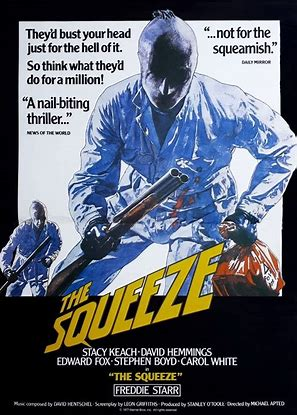
The Squeeze (Michael Apted, 1977)


Despite its beefy action credentials, Michael Apted’s The Squeeze frequently reminds you of the director’s roots as a documentarian (it belongs to the same year as his 21 Up), capturing lots of unpretentious social observation around the edges (I particularly enjoyed the café seen near the end, the menu offering up such items as a 45-pence steak salad). Much credit belongs to Stacy Keach’s playing of the lead in such an intriguingly low-key, preoccupied manner, his character Jim Nabboth often seeming on the verge of drifting away altogether (more social observation - at one such point, it takes a masseuse's “special relief” to snap him back into shape, the charge for that being six pounds). Nabboth is a former cop now in bad financial and personal shape (he claims to be thinking of “chimney restoration” as an appealing next career step), his wife Jill (Carol White) remarried to rich businessman Foreman (Edward Fox); Jill and the daughter she has with Foreman are kidnapped in the park (along with their dog, who doesn’t last long thereafter), the price of their release being for Foreman to cooperate in a million-pound robbery from his own company. The once in a lifetime cast includes David Hemmings (trailing no Blow-Up resonances whatsoever), Stephen Boyd having fun going full-on Irish in one of his last roles, and TV comedian Freddie Starr, a decade or so before tabloid allegations of eating a hamster. The movie makes for grubby-feeling viewing, devising a way to strip Nabboth naked and drop him in the street, and to force Jill into performing a strip tease for her kidnappers (a scene in which it seems painfully hard to separate the actress’ mixed feelings from those of the character); Nabboth’s ultimate foiling of the plan involves as cold-hearted a move as anything the villains have pulled. Still, Apted is pretty effective at observing all the nastiness without seeming merely manipulative about it.

Wednesday, November 30, 2022

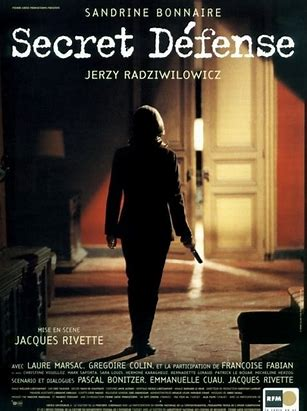
Secret defense (Jacques Rivette, 1998)


Near the start of Jacques Rivette’s Secret defense, Paul Rousseau (Gregoire Colin) tries to steal a gun from his sister Sylvie Rousseau (Sandrine Bonnaire); his target is the successful industrialist Walser, newly suspected by Paul of killing their father, at that time Walser’s boss, five years previously. It’s a classic Hitchcockian-type set-up, and Rivette often plays it straight enough that the packaging of my old DVD copy gamely tried to sell the film as a conventional thriller (“A father’s death…A daughter’s obsession…Revenge was the only answer”). But of course, the director also continually subverts any such genre expectations and norms: a train journey which might easily have been condensed into a few seconds or less of screen time extends over fifteen or twenty minutes; a key revelation about the dead father is delivered almost casually, during another train journey; and so on. The film has a sense of magnetic contraction, with all the characters being drawn toward Walser’s country estate, a location with which the Rousseau family has a long connection (and one of many such labyrinthine, figuratively haunted locations in Rivette’s work); there’s often a sense of narrative echo, with the father’s death recalling an earlier family tragedy along similar lines, and with one key character who departs from the narrative rapidly replaced for most purposes by a look-alike sister. Bonnaire’s often flinty, brittle performance speaks to the strain of things not confronted within or without (an amusing subplot involves a persistent suitor who she perpetually keeps at arm’s length, without ever actually extinguishing all hope); the “top secret” of the title refers as much to unexplored inner or cinematic possibilities as to the specific folds of the plot. But overall, without buying into those marketing excesses I cited, the film would indeed be a relatively accommodating entry point into Rivette’s stunning cinematic world.

Wednesday, November 23, 2022

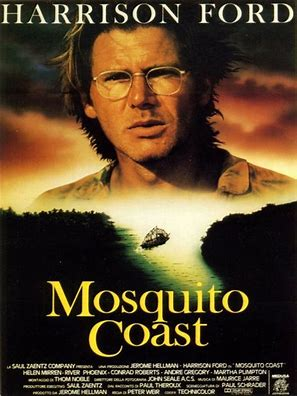
The Mosquito Coast (Peter Weir, 1986)


Peter Weir’s version of Paul Theroux’s The Mosquito Coast certainly supports a lively dialogue on its merits as literary adaptation, and on the wisdom of even having tried, while almost entirely failing on its own ambitious terms. Harrison Ford plays Allie Fox, a sporadically brilliant, quasi-tyrannical under-achiever whose disgust with the condition of America leads him to take off with his wife and four children to a remote part of South America, where he sets out to transform a broken-down jungle outpost into a high-functioning community reflecting his own principles. Taken at face value, the narrative presents us with a series of absurdities (all the less palatable for their white-saviorism); for example, arriving at their wretched destination with almost no initial resources on hand, the family systematically imposes the desired order, dominated by a massive, technologically adventurous ice-making machine, during all of which the four young kids don’t appear to age a single day. The film lacks the sense of obsession or immersion that might have allowed it to blast through such reservations (Werner Herzog is impossible to ignore as a reference point; Apocalypse Now comes to mind several times as well), and Ford, in theory an inspired piece of imaginative casting, seldom provides an appropriately charismatic (or even very engaged-seeming) focal point (the mostly unquestioning compliance of Fox’s wife also seems to require greater investigation than the book provides, when embodied in the form of Helen Mirren). Some aspects of the film do benefit a bit from hindsight; for instance, our greater attunement to climate change and sustainability now adds an extra charge to the dark irony of Allie’s icemaker ultimately becoming a source of environmental chaos. But overall, there’s very little the film does adequately, even failing to make much of the rich surrounding landscape in all its possibility and threat.