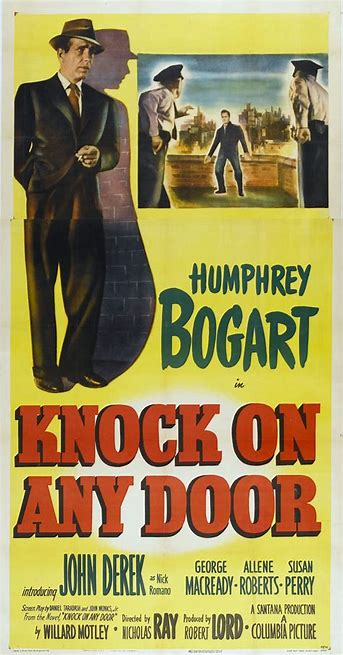
In Nicholas Ray’s Knock on Any Door, commercial attorney Andrew Morton (Humphrey Bogart) steps back into his criminal-law past to defend Nick Romano (John Derek), a young “hoodlum” accused of killing a police officer: much of the first half unfolds in flashback as Morton recounts for the jury his past experiences with Romano, and his own possible partial culpability for why the young man’s life went wrong; the second half focuses mainly on the trial itself. The rather ungainly structure and all that’s packed into it generates a feeling of Ray being hemmed in much of the time, finding limited room for visual invention or meaningful character exploration; it achieves a few grace notes at the end though, in a lonely overhead framing of Morton making his final argument, and in the very final, transcendence-tinged shot (no less striking for being rather absurd). John Derek’s Nick Romano is as thin a presence as everyone has always said, but Bogart is as fascinatingly shaded as always, and the diverse supporting cast accommodates Preston Sturges-like eccentricity, unrestrained excess, wild intensity, the soft-spoken loveliness of Allene Roberts as the girl with whom Romano falls in love, and a relatively prominent, naturalistic Black character, whose testimony sparks a courtroom blow-up over whether or not he would even have been allowed inside the bar where he claimed to be at the time of the murder. The film’s speechifying, however overdone, still connects at a time when large factions of mainstream America seem to be defined largely by drummed-up fear and paranoia; the revelation that Romano is actually guilty, despite Morton’s skilled argument for his innocence, speaks directly to the wearisome burden of maintaining one’s idealism. But overall, it’s instructive that a film so strenuously seeking to enhance our sense of ambiguity and perspective should end up being one of Ray’s most unilluminatingly straightforward.
Tuesday, April 25, 2023
Tuesday, April 18, 2023
The Beekeeper (Theo Angelopoulos, 1986)
Theo Angelopoulos’s
The Beekeeper feels rather strenuous at times, but it’s a quality rooted
in bottomlessly searching despair, for its central character and the world he
represents, and for the fate of the mode of cinema in which such an individual could
be the protagonist. Marcello Mastroianni (inherently deep in art cinema
resonance, but cast here in sternly withholding mode) plays Spyros, newly-retired
from his small-town schoolteacher position, attending his youngest daughter’s
wedding and then leaving behind his family (which in any event seems to be
barely held together) to focus on his beekeeping, depicted here as a nomadic vocation,
driving from one location to another, setting up and tending the hives for a while
and then packing it all up and moving on; along the way he gives a ride to a
young, unnamed woman, and their paths keep crossing thereafter, her attitude
toward him ranging from affectionate to contemptuous, sometimes almost simultaneously.
The film’s effective climax could hardly be more symbolic: Spyros and the woman
spend the night in a disused cinema likely slated for demolition, where she
undresses before him as if in sexual offering, but the resulting contact is
bizarre and suffused in alienation, apparently marking the end of the dance
between them; from there it’s a short journey to an final scene in which Spyros
reaches his tragic existential destination, powerfully conceived and haunting, but
less for an individual man’s fate than for that of a generation, its collective
memories, its relationship to homeland and tradition. Much of the film might
have been set decades ago; the film’s newest-looking locations are also among
its most desolately alienating (in this context, a passing reference to Dire
Straits’ Brothers in Arms seems weirdly out of place), defined by almost
empty, characterless roadside diners and the like, and by numerous shots of people
moving in expressionless, almost zombie-like manner.
Thursday, April 13, 2023
Les stances a Sophie (Moshe Mizrahi, 1971)
Moshe Mizrahi’s Les stances a Sophie
falls a little short of feminist classic status, but it’s a spikily enjoyable work
from start to finish, excellently drawing on Bernadette Lafont’s distinctive crossing
of slightly removed amusement with unerring seriousness of purpose. She plays Celine,
a low-overhead arty type, who in the film’s opening stretch meets and sort of
falls for businessman Philippe, accepting his marriage proposal in part because
of what she calls “gravitation.” She’s hardly suited to the world he inhabits (a
scene early in their marriage has him trying to drum the details of the coming evening’s
social commitment into her head while she’s entirely preoccupied with trying to
remember the previous night’s dream), but benefits from her friendship with Julia
(Bulle Ogier), wife of Philippe’s best friend Jean-Pierre, who shows her some
of the rich woman ropes (which, in one of the film’s less progressive notions, largely
seem to involve buying clothes); in turn, Celine’s greater appetite for sex
seems to help Julia out of her “semi-frigid” state, and the two eventually start
collaborating on a theory-informed study of gender relations. But the film thwarts
any expectations of a sexual free-for-all: in particular, Celine’s response to
a pass that Philippe makes on her is withering, and the exact nature of her close
relationship with Philippe’s sister is left unclear. Mizrahi has some fun with masculine
car obsessions and their dim view of female drivers, until the joke turns
bitterly sour, leading to an ending that delivers the expected note of
liberation and self-determination while weaving in some intriguing notes of
regret, abiding affection and male desolation. The film’s reputation is much bolstered
(in some quarters entirely constituted by) the score by The Art Ensemble of
Chicago, its only such feature-length assignment; their work soars and pivots
and counterpoints, bolstering the sense of investigative complexity.
Wednesday, April 5, 2023
Under the Blossoming Cherry Trees (Masahiro Shinoda, 1976)
The title of Masahiro Shinoda’s Under
the Blossoming Cherry Trees seems to promise a largely soothing experience,
and even after the warning in an opening voice over that such trees were
historically more to be feared than relished, it still often seems possible
that the film might ultimately find its way into such a register. But that’s just
one aspect of its continual capacity to surprise and misdirect, being at various
other times blackly comic, cartoonishly violent, mythically possessed, or (in
the extended relish with which it plunges into urban hustle and bustle) an
amused study of the gap between city and country. Ultimately this might all be
tied together as an extreme parable on the perils of getting what you wish for,
built around a mountain-dwelling bandit in ancient Japan who slaughters a group
of travelers from the city, sparing a woman he finds uniquely beautiful and
decreeing she’s to be his wife. The captive accepts her fate with strange
equanimity, while harassing him from the start and testing him with extreme demands,
including that he kill most of the multiple women he already has on hand;
eventually she persuades him to move to the city, where he slaughters dozens of
victims for the sake of feeding her growing obsession with disembodied heads. But
it’s hardly a sustainable way of life, and in the end they set off back to the
country, his excitement at going home causing him to disregard his usual
caution regarding the cherry trees, and their fate accordingly awaits them.
It’s a visually striking ending, but also an evasive one, potentially leaving
the viewer feeling rather abandoned. But then there’s a final shot of the trees,
certainly looping back to that opening warning, and perhaps commenting more
generally on how our modern-day traditions and rituals lack a sense of the past
complexity and turbulence from which they arose.
Wednesday, March 29, 2023
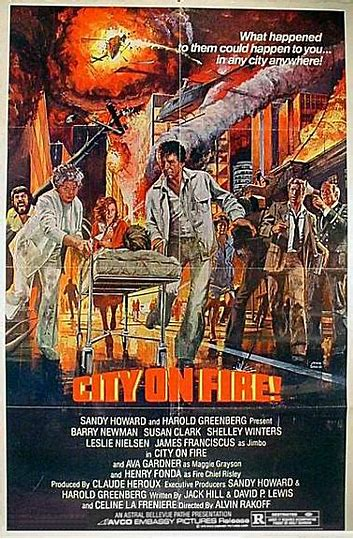
City on Fire (Alvin Rakoff, 1979)
Alvin Rakoff’s City on Fire is a particularly
grim addition to the 70’s run of disaster films, a relic of a time when audiences
were assumed capable, by some producers anyway, of being entertained by almost any old thing: it lacks the resources to convey the titular burning city
(unnamed here, but played by Montreal) with any kind of plausibility, but also,
more damagingly, doesn't have the creative energy and sense of adventure that
might have compensated for such a lack (or even made a virtue of it). Taking
the thing on its own wearily literal terms, weaknesses pile up: it fails in
every area of special effects, wastes time on trivial narrative devices while
seeming weirdly disengaged from what presumably ought to be interesting about the
whole thing (what would actually happen, if a city had 180 separate
fires going, as stated here at one point?), lacks much internal consistency (almost
as soon as the fire breaks out, we get a shot of an entire high-rise building
collapsing in flames, which doesn’t correlate at all with what follows) and allowing
no scope either for good acting or (again, perhaps more regrettably) for the
enjoyably bad kind. The plot, such as it is, has a disgruntled employee sabotaging
(with remarkable ease) an oil refinery located too close to the centre of town;
he subsequently hangs around the hospital which dominates the “action,” as does the mayor (Leslie Nielsen), who seems weirdly unconcerned
about keeping tabs on the big picture, a stalwart nurse (stalwart Shelley
Winters), irascible surgeon Barry Newman (what, you expected Paul?), and sundry
others. Henry Fonda as the fire chief barely leaves the situation room; even
more limitingly, Ava Gardner as an alcoholic local TV personality anchors the
coverage while never apparently talking to any other reporter, her broadcasts seeming
desolately stark and isolated. Nevertheless, we’re informed they were a
spectacular success, by some unclear measure.
Wednesday, March 22, 2023
The Left-Handed Woman (Peter Handke, 1977)
Haven’t you noticed, asks the closing
epigram of Peter Handke’s The Left-Handed Woman, that there is space
only for the one who brings space himself…? Acknowledging that the precision of
the subtitles may only extend so far, it’s an apt closure; the conversational
tone emphasizing the film’s investigative qualities, its questioning of the
interplay between inner and outer lives. The choice of “himself” could be puzzling
in this context, and yet the credits that follow identify Edith Clever’s protagonist
only as “die Frau,” even though the film itself does give her a name, Marianne;
her husband on the other hand is identified as “Bruno,” the same name as the
actor playing him, Bruno Ganz, seemingly setting out its own little puzzle
regarding the relative identifiability and tangibility of the two
character/actor presences. The film revolves around a German couple living in
Paris (summing up the pervasive sense of dislocation) – he returns from a
business trip to Finland professing his renewed joy in their relationship, to
which she soon responds by instigating a split; he moves out and she goes on
living in their house with their young son, gradually constructing a revised personal
and social equilibrium. Marianne talks very little (her first words come so far
into the film that one might have assumed her to be mute) and explains herself
less, demanding that we take her on her own terms, an act of feminist sympathy
which however does carry the offsetting effect of rendering her something of an
abstraction (her relationship with her main female friend Franziska is also one
of few words, although provides a key moment of validation when, after earlier
flailing to understand Marianne’s choices, Franziska finally allows that “now even
I want to be alone”). But it’s a satisfying film overall, with numerous secondary
mysteries including the brief presence of Gerard Depardieu, billed as “Mann mit
dem T-shirt,” which indeed sums up his contribution exactly.
Wednesday, March 15, 2023
Who's Who (Mike Leigh, 1979)
Mike Leigh’s Who’s Who isn’t the
best of his works for the BBC, often seeming rather ungainly and strained both
in its individual devices and in its contrasts and juxtapositions; still, Leigh
being Leigh, it still hits a generous number of targets. The film's central
character is Alan, an administrative worker at a London stockbroking firm, weirdly
obsessed with the world of nobility and titles from which he’s inherently
excluded, but of which he receives ample glimpses via the more highly-bred and
better-connected professionals at the workplace; these in turn divide between the
practiced if distant courtesy of the old school, and the crasser younger
generation who cross into sexually harassing the female staff and holding loud
obnoxious conversations in the office hallways. Unstable and pitiful as this
all is, the film sometimes seems to be carrying multiple regrets for a bygone
age in which these distinctions were better defined and more rigidly observed: Alan’s
delusional notion of self-elevation through osmosis (he bores everyone with his
knowledge of Royal family trivia; his other main hobby is writing requests for
signed photographs of celebrities) is somewhat pathetic, although, in a way,
indicative of the desire for greater affinity and transparency that’s
contributed to transforming the notion of Royalty in subsequent decades. It’s all
laid on a little thick at times though, and the film’s main set-pieces
(including a misfiring dinner party attended by two of the young stockbrokers,
at which for example the host chef ends up serving canned celery soup because the
guest who was supposed to bring the avocados didn’t show up) don’t entirely cohere.
At the end, although no doubt only temporarily, Alan succumbs to more
accessible pleasures, joining his colleague in watching through the window a rather creepy ongoing flirtation in a nearby building; in the
circumstances, this might actually constitute a healthier form of voyeurism?
Wednesday, March 8, 2023
Anna and the Wolves (Carlos Saura, 1973)
The title of Carlos Saura’s Anna and the
Wolves likely evokes a children’s story, a suggestion supported by the opening
shots of Anna (Geraldine Chaplin) arriving at the isolated mansion where she’s
to take care of three young girls, and the notion of playacting and invention that runs throughout the film. Any sense of innocence though is rapidly squashed
out: all three of the brothers who occupy the house have their eye (and often
hands) on Anna as soon as she arrives, and the roleplaying (including, over
time, that of Anna herself) becomes increasingly malevolent and perverse. Juan,
the only married brother, bombards her with lewd anonymous letters, raiding the
family stamp collection to make it appear that they come from around the world;
Jose maintains a private museum of military uniforms, guns and other
memorabilia; Fernando becomes increasingly mystic (he’s even seen levitating in
one impressionistic moment), retreating into a hermit’s cave and hardly eating,
for a while impressing Anna with his apparent lack of designs on her, until his
underlying perversion comes to light. The twistedness of course has deep roots:
the family matriarch, prone to sudden fits of collapsing which seem to be
largely strategic, maintains boxes of childhood mementos for each son, although
the labeling system is chaotic, and the contents include such items as a spiked
thimble that was used to stop one of them from sucking his thumb (we’re told it
lacerated his mouth for some five months).
Nevertheless, the film’s shocking ending clarifies that for all the
bourgeoisie’s dysfunction and internal dissention, it ultimately sticks
together in perpetuation of its interests, with outsiders paying a brutal price
(Anna’s fate, and an earlier sequence involving a buried doll, bring to mind
the masses of the Franco-era disappeared). Overall, the film belongs with The
Hunt and The Garden of Delights among the incisive peaks of Saura’s
major, generally under-screened period.
Tuesday, February 28, 2023
Home Sweet Home (Mike Leigh, 1982)
Home Sweet Home is emblematic early-ish Mike Leigh, bitterly funny and appalling,
inviting suspicions of condescension, but with too many flashes of desperate verisimilitude
for any such charges to completely stick. A plot summary seems to align the film
with randy workplace concoctions on the lines of On the Buses: postman
Stan has an affair with the wife of one of his colleagues while being
aggressively pursued by the wife of one of the others, things coming to a head
when both women show up at his house at once. But Stan (Eric Richard) is no
working-class Casanova, his appeal seeming mainly based in the contrast with the
two inadequate husbands, and capable of awful self-serving coldness, as in the heartrending
mini-portrait of his treatment of a woman he picks up at the launderette. His
teenage daughter, Tina, has spent most of the time since her mother’s departure
in foster care or group homes; Stan only reluctantly visits her, his inadequacy
as a father pushing him into irritable taciturnity. It’s Tina who occupies the
film’s final shot, suggesting she’s the most major casualty of the whole mess;
a sly late pivot introduces a new social worker who bombards Stan with jargon
while providing an ample window on his own bitter preoccupations. The title is ironic
to a fault of course: as always, Leigh has an eerie capacity to create lived-in
spaces and routines (how many cups of tea were offered and consumed in his work
of this period?), while conveying how the frail economic predictability they
provide is, as Sondheim might have put it, a daily little death. Tim Barker’s indelibly
conceived Harold may be the saddest of the sad bunch, his wife snapping back at
his most basic utterances, a stream of dumb jokes and disconnected utterances failing
to disguise how he’s barely present in his own life, let alone anyone else’s.
Wednesday, February 22, 2023
Another Man, Another Chance (Claude Lelouch, 1977)
Claude Lelouch’s Another Man, Another
Chance feels almost dizzyingly expansive in its opening stretches,
switching between a low-key Western starring James Caan as David Williams, a
veterinarian who starts a new life after his wife is murdered, and a drama set
in a war-devastated Paris with Genevieve Bujold; when the Bujold character,
Jeanne Leroy, and her photographer husband decide to emigrate to the US, the
two strands gradually coalesce (some of the plot details are directly recycled from Lelouch's biggest success Un homme et une femme). The film contains some outstanding period
feeling – I’ve seldom for instance seen the centrality to the community of the
regular stagecoach route evoked so fully – and striking single takes, such as
an early one showcasing Caan’s horseriding and roping skills; the muted colour
pallet and low-key acting (with close-ups of the principals kept to an extreme
minimum) all work well. But Lelouch also throws in a regular stream of
oddities, from a disconnected prologue with Caan playing a descendant of his
main character, through the soundtrack’s recurringly jarring use of the famous
notes from Beethoven’s Fifth, to an ending so low-key that it almost feels as
if they just ran out of celluloid. Still, overall, the film crafts a
distinctive emotional space, basing the relationship between the two (as far as
one can tell – there’s not much to go on) more in mutual logic (by that point
for example, they’re both single parents) than passion; Bujold’s regular
recurrence to her native language, and insistence on trying to teach it to her rapidly
Americanizing daughter, suggests their relationship will be inherently defined in
part by distance and loss (the final voice over tells us that she never
achieved her dream of returning to Paris). Lelouch has remained true to his
idiosyncratic instincts and their consequent mixed results: for instance, his
late film The Best Years of a Life contains some unforgettable close
observation of the aged Jean-Louis Trintignant and Anouk Aimee, within a slack
overall scheme incorporating ill-judged fantasy inserts.
Wednesday, February 15, 2023
Man Hunt (Fritz Lang, 1941)
Fritz Lang’s 1941 film Man Hunt makes
for strangely abstracted viewing now: the (still startling) footage of Adolf
Hitler in the opening minutes signaling a project urgently grounded in
real-life atrocities, and yet yielding a rather hermetic subsequent narrative (the
film overall carries a far less striking sense of threat than the more
fantastic Mabuse works). For sure, this partly speaks to Lang's core project, to dramatize one man’s evolution from partial fatuousness to
life-consuming commitment: at the start, Walter Pidgeon’s crack game hunter Thorndike
has the Fuhrer in his sights, but doesn’t take the shot, subsequently straining
to convince his German captors (and perhaps himself) that he only did it for
the sport of finding out whether it would have been possible. The Germans (mainly
represented by George Sanders and John Carradine!) plan to manipulate him for
propaganda purposes, but he escapes and makes his way to London, crossing paths
with working-class Jerry (Joan Bennett) who rapidly falls for him and becomes
an indispensable collaborator. While Bennett’s exaggerated accent and mannerisms
may seem like objectively awful acting, the difference between her and the
frequently flippant Thorndike does fuel one of the film’s key contrasts:
between a society that facilitates such intuitive bonding across class lines and
another that (at least in this telling) knows only cold calculation (inadvertently
aided by some upper-class British cluelessness). The film is propelled by a
series of spatially-confined set-pieces – on a ship, (most memorably) in the London underground, in a cave where the only means of escape has been blocked off – giving
expression to that broad theme of the compression and hounding of freedom and
possibility. It’s nowhere near to being Lang’s best work, but certainly adds to
the sense of his films – even more than for most great directors –as constituting
individual chapters in a sobering overall vision.
Wednesday, February 8, 2023
Full Moon in New York (Stanley Kwan, 1989)
Stanley Kwan’s absorbing Full Moon in New York is built around the friendship between three young women living in the big city, linked by common Asian heritage (Taiwan, Hong Kong, mainland China) but otherwise very different in their life experiences and aspirations. Ms. Lee (Maggie Cheung) spends some of the time working in her family’s restaurant, supplemented with various other deals and trades, prompting several discussions about the perceived risk of opening a Chinese restaurant anywhere other than in Chinatown, and about appetite for risk in general. Ms. Wang (Sylvia Chang) tries to make it as an actress, which at that time typically necessitates having to specifically explain her suitability, as an Asian woman, for a particular role. Mrs. Poon (Yat-Gam Chu) comes to America to be married while barely able to speak English – her husband treats her well, but won’t yield to her deep desire to bring her mother over, either ignoring the request, or rationalizing it away as an example of old thinking. In other ways though, old practices and expectations still apply, for instance in the notion of parents finding a suitable marriage match for their children (even applying to Ms. Lee, whose romantic relationships are with other women); Kwan’s view of New York is very much that of an outsider, filming the city mainly either through high-rise windows or in disembodied panning shots, and finding it to be imperfectly integrated. Some of the film’s most delightful passages simple observe the women as they hang out together, messing about in the restaurant kitchen or chatting about such mundane matters as shaving their legs; Kwan presents such moments both as an assertion of individual identity and as formative experience. Of course, the act of formation, the balancing of self-discovery and assimilation never reaches an end point, perhaps rendering the film’s unresolved ending inevitable; even so, it’s among the relatively few films that one might certainly wish to have gone on for longer.
Wednesday, February 1, 2023
Broadcast News (James L. Brooks, 1987)
The problem with James L. Brooks’ Broadcast
News, viewed nowadays, isn’t so much that it seems dated (how could it not?) but rather that the way in which it’s dated isn’t particularly instructive regarding the
movie’s own time, or our own, or the transition between the two. Take for
example the big ethical reveal that drives the final stretch: the discovery
that the empathetic tears of on-the-rise reporter Tom Grunick as he listens to
an interviewee in one of the stories that made his name were filmed afterwards
and edited into the flow. The revelation hardly lands now as intended (did it
ever?), both because from what’s shown in the film, it’s not believable that a
crew of experienced news people wouldn’t have tuned into it at the time, and more
broadly because compared to the subsequent travails and degradations of politics
and culture, it just doesn’t seem like an important enough violation to change
the direction of things (one wonders more generally about the plausibility of a
Washington bureau where there’s almost no talk about politics). Still, William
Hurt was arguably never better than in his perfect calibration of Grunick, possessed
of almost supernatural on-screen ease, exactly smart enough to know his considerable
limitations; Albert Brooks’ Aaron Altman, in contrast, ideally conveys someone
possibly too smart for his own good, held back both personally and
professionally by a missing X-factor. Holly Hunter’s Jane, the best-rounded professional
of the three, is an object of admiration and desire for both, a device undermined
by the film’s emotional shallowness and sexual timidity. Brooks allows rather
too much padding, as in some pointless opening vignettes of the three leads as
children, and the film doesn’t have much of what you might call cinematic
writing, but of course it’s an amiably professional job, in much the way that
network prime time once connoted.
Wednesday, January 25, 2023
IP5: the Island of Pachyderms (Jean-Jacques Beineix, 1992)
In its strenuous bringing-together of
disparate elements, Jean-Jacques Beineix’s IP5 may paradoxically seem to
demonstrate a creative fountain too-rapidly running dry, forcing the director
into attempting to find magic through near-random alchemy. In his last role
(and therefore inherently quite moving, even if his character makes only
limited sense), Yves Montand plays Leon Marcel, an escapee from the institution
into which his relatives confined him, on a journey to close a romantic
narrative left incomplete decades earlier. Olivier Martinez plays Tony, a
virtuoso graffiti artist on the trail of Gloria, the woman he loves (Geraldine
Pailhas), knowing only that she’s somewhere in Toulouse, accompanied by his
much younger sidekick known as Jockey (Sekkou Sall), among other things a
supposed mystically-gifted predictor of horse racing results and an ace car
thief; it’s in the course of practicing the latter that they find Marcel asleep
in a back seat and their trajectories eventually merge. Beineix’s sense of
composition is evident throughout, and the clashing of aged gravity and contemporarily
rooted multi-culturalism makes for some easily entertaining, if repetitive,
dynamics. But the film ultimately seems arbitrary and pointless, weighed down
by that tedious quasi-mysticism (Marcel appears to possess the divination
skills that Jockey lasts, as well as being able to walk on water in one scene,
and suchlike). For all the film’s professed belief in fated romance, it has little
interest in its female characters: based on what’s shown, Gloria’s disinterest
in Tony is visceral and well-founded, yet melts away based on no more than her succumbing
to his willpower (or something like that). In such respects the film
sporadically evokes Beineix’s earlier Moon in the Gutter, another rather
heavy-going narrative built around another hard-to-buy romance, in that case though
benefiting more fully from the director’s flair for imagery and mild subversion
of expectations.
Wednesday, January 18, 2023
Four Friends (Arthur Penn, 1981)
Arthur Penn’s Four Friends starts
with the arrival of young Danilo and his mother in America, after traveling from Yugoslavia to join the steel-worker father he’s hardly ever met; ten years
later, in the early sixties, Danilo and his two best friends are giddy with
music and their shared love for the same girl, Georgia, trying to push away the father’s insistence that college isn’t for the factory-bound likes of him. By
the film’s end, some eight years later, Danilo will have made it to college,
but hardly as part of a smooth upward trajectory; he’ll have gone from being so
patriotic that (we’re told) he goes to football games just to sing the national
anthem, to a more nuanced, fluid, sometimes pained view of the country and his place
within it. The film’s title serves as a symbol of its evasiveness, of the difficulty
of summing up even the simplest aspects of American life, in that after the
first twenty minutes or so, two of the four friends are pushed to the sidelines
of the narrative, receiving far less screen time than a fifth friend, Louie,
who is Danilo’s college roommate. It’s through Louie that Danilo gains entry
for a while into the milieu of the super-rich, an expedition that takes in some
perversity-tinged dysfunction and then ends in grotesque tragedy; from there he
goes to driving a New York cab, apparently embracing total personal disrepair,
a pivot that brings to mind the audacious narrative and tonal shifts of Little
Big Man, perhaps Penn’s greatest film. It comes to mind at the end too via a
culminating remark that one day they may look back on all this and not remember
a thing, echoing the earlier film’s resigned conclusion that sometimes the
magic works and sometimes it doesn’t. By conventional measures Four Friends
often stumbles, but then, how would a smoother film have been truer to such a fraught
time and place?