Wednesday, July 26, 2023

To You, From Me (Jang Sun-woo, 1994)


Jang Sun-woo’s seldom-seen To Me, From You gleefully assails just about every aspect of contemporary South Korea, finding almost no marker of propriety or achievement that can be taken at face value, no sexual coming together that isn’t toxic, transactional or otherwise doomed. A writer under a cloud for allegedly plagiarizing his prize-winning novel is visited by a younger woman who says she knows he’s innocent, because his narrative corresponded to a dream she had; they rapidly have sex, and then she moves in, seeming intent on boosting his flagging career (reduced to various corporate ghost jobs and other menial assignments) while also doing it with other men for a variety of strategic or intuitive reasons. The third main character is the writer’s drinking buddy, a bank clerk left impotent by his life’s one big love affair, and with little forward momentum of any other kind (none of the three characters are named, seemingly a mark less of symbolic universality than of their ultimate insignificance and malleability). The film is stylistically and narratively restless, allowing the viewer little chance of guessing at any point what’s coming next; it frequently cites writers and theorists (John Berger, Theodor Adorno…) and spends a surprising amount of time on analyzing and channeling Arthur Penn’s Bonnie and Clyde (seemingly the bank clerk’s favourite film, in part at least for the impotence angle); toward the end, it transitions for a while into animation, in a passage startling for its savage sexuality. The final (live-action) stretch has the trajectories of all three characters unexpectedly shifting, while offering little sense of permanence; two of them achieve celebrity with little effort, the other settles into subservience and seems all the happier for it, for now. So there’s some sort of message there about applied self-knowledge and integrity. Sort of…

Thursday, July 20, 2023

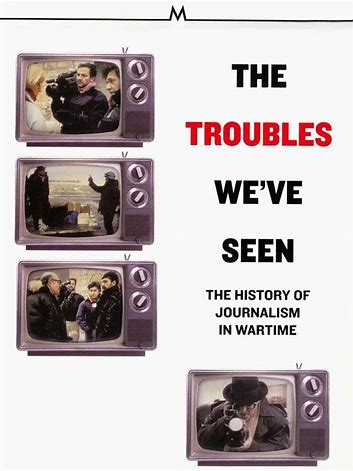
The Troubles We've Seen (Marcel Ophuls, 1994)


Marcel Ophuls’ tragically underseen The Troubles We’ve Seen is a marvelously provocative work, knowingly untidy and digressive and sometimes downright eccentric, but all the more stimulating and debate-sparking for that. The film is subtitled “A History of Journalism in Wartime,” but it's far less linear and comprehensive than this might suggest: the overwhelming focus is on the then-current war in Serbia, and on Sarajevo in particular, with other conflicts mentioned in more fragmented form along the way. Ophuls structures the first part primarily around his own trip to Sarajevo and his observations and interactions there; the second spends more time on various ethical and practical issues, such as whether warzone journalists should travel in armoured vehicles for their protection, or whether that would primarily serve to distance them from realities and to over-align them with the military. In often jarring ways, Ophuls contrasts the stark (although, as is acknowledged, not entirely fun-starved) realities of the war-reporting game with the comforts of life in Vienna and Venice (a short distance and a whole world away from Sarajevo), and the imagery of war with various snippets of classic Hollywood, from Hawks to Holiday Inn. The film’s opening point (made eloquently by Philippe Noiret of all people) draws a comparison between Bosnia and WW2, and the degree to which moral and strategic failure can be attributed to lack of information; watched in 2023, comparable, desperately acute parallels between what’s shown and debated and the current situation in Ukraine arise at every turn. Which is to say that however dated the film may seem in some of its particulars (and, to some, further distanced by the relative focus on French TV personalities), it speaks no less strongly to the eternal issue of how to engage (that is, as something other than mere compliant, capitalism-friendly consumer) with media assertions on what we need and deserve to know.

Wednesday, July 12, 2023

Her Brother (Kon Ichikawa, 1960)


It’s oddly appropriate that the title of Kon Ichikawa’s film Brother has alternatively been rendered in English as both Her Brother and Younger Brother, summing up the film’s elegantly evasive nature, the difficulty of establishing the intended perspective on what’s shown. The opening stretch suggests no such difficulty: Gen and her younger brother Hekiro in their different ways struggle to cope with the stepmother, a pious Christian who endlessly cites her medical ailments to justify doing almost nothing around the house; their father, a subdued writer, is silent for so far into the film that one starts to assume he’ll never speak at all. An early, chilling scene has Gen wrongly accused of shoplifting, shoved around and even threatened with a whip by the store manager before being released with the thinnest of apologies; it’s Hekiro though who actually steals, for which he’s expelled from the Christian school (a mere prank, he says, to which the adults overreacted). From there the film evolves into something more wayward and unpredictable, with strange characters and potential subplots (particularly involving men with an eye on Gen) popping up and then exiting the narrative; Hekiko’s behaviour becomes even more wild and impulsive (and the film’s depiction of these actions correspondingly fragmented), often with financial consequences for the family, all of which comes to a sudden fault when a persistent cough turns out to be tuberculosis. All of this often carries the sense of a darkly velvety mystery which can’t quite be solved, a sense which carries right to the final shot, when the family dynamics appear to have shifted once more, in a way beyond our capacity to analyze. Overall, the film may not showcase Ichikawa’s restless experimental streak as consistently and strikingly as, say, An Actor’s Revenge (or, less happily, the insipid and barely watchable Being Two Isn’t Easy), but it lingers in one’s mind almost as effectively.

Wednesday, July 5, 2023

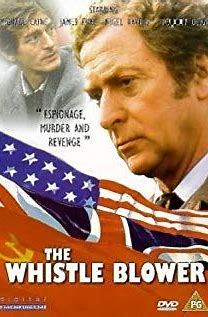
The Whistle Blower (Simon Langton, 1986)


Simon Langton’s The Whistle Blower plays rather flatly for a film that involves several state-orchestrated murders and cites pending apocalypse as a key part of its motivation, but still provides adequate diversion and stimulation overall. Michael Caine plays Frank, father of Bob (Nigel Havers), a Russian expert toiling away for British intelligence, toying with quitting but then finding something that renews his interest, that is before he’s found dead in what may or may not be a suicide. The film is a periodically interesting time capsule, bookended by a London Remembrance Day ceremony providing glimpses of Margaret Thatcher and other dignitaries; there are several references to hard economic times, with Frank counseling his son on the folly of quitting a steady job, and to Britain’s utter dependence on the United States, given that (as one high ranking functionary puts it) a nuclear war with Russia is assessed to be a pending near-certainty. There’s not much razzle-dazzle to how things unwind though: Frank gets the name of one key contact through the mildest outburst of aggression, then in turn extracts the necessary information from that contact simply by filling him up with booze, and reaches his ultimate object (John Gielgud) by turning up on the doorstep and being welcomed in. Caine gives one of those performances where you’re not sure how hard he cares or is trying (I mean that as a compliment); the rest of the cast mostly only briefly registers, although Barry Foster gives the drunk scene his all. But for a film in which a journalist and other innocent individuals are cold-bloodedly eliminated for the sake of political calculation (and the perpetrators calmly express their willingness to throw in a young woman and her child, if that's what it takes for Frank to yield), while guilty but well-connected men are shielded from consequences, the narrative and moral sophistication fall short of what should have been required.

Wednesday, June 28, 2023

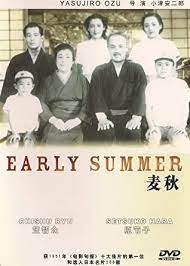
Early Summer (Yasujiro Ozu, 1951)


At least at the time of writing, the subtitling of Criterion’s version of Ozu’s Early Summer contains an intriguing error, taking a reference to its key character Noriko’s enthusiasm for “Hepburn” to refer to Audrey (who wasn’t even yet famous when the film was made) rather than the longer-established Katharine. Whereas the “Audrey” interpretation would have seemed to connote no more than “style icon” fandom, the corrected “Katharine” version carries more complex connotations, suggesting a reference point in an ongoing project of self-determination, and at least a flavour of greater sexual ambivalence. Accordingly, Noriko (Setsuo Hara) is a happily single 28-year-old woman, intrigued by marriage as a discussion point with her friends, but showing little personal desire to end her own status. When, despite all this, the pressure to marry becomes insurmountable, Noriko confounds everyone by choosing a man who hadn’t even asked her, without even discussing it with him, leaving it to his mother to tell him the news. He’s doesn’t appear again in the film, not even through numerous scenes where Noriko discusses her choice with family and friends and prepares for her departure; the other man who wants to marry her, her family’s preferred choice, is never seen at all. Ozu’s quiet radicalism in this respect doesn’t diminish over time; for example, it’s still a challenge to prevailing discourse when Noriko won’t even acknowledge to her best friend that what she feels for her future husband is love, preferring to use terms like “trust.” In so many physical and figurative respects, the film is defined by absences as much as presences (including a brother who never returned from the war and has never been officially pronounced dead), and at the end, so calmly that it’s almost shocking, the tight-knit family of the opening scenes has become dispersed, happy hubbub replaced by a quiet both soothing and deadly. Overall, it’s one of Ozu’s fullest works, formally and thematically inexhaustible throughout.

Wednesday, June 21, 2023

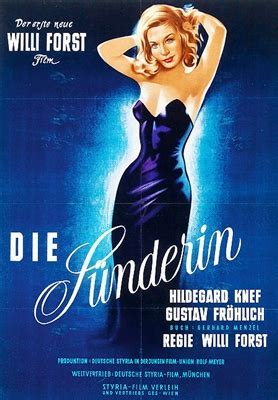
The Sinner (Willi Forst, 1951)


A moderate scandal in its day, Willi Forst’s The Sinner doesn’t leave much of an impact now, although one may enjoy registering the various points of bygone envelope-pushing: a brief nude scene; a wild party which manages to convey a passing sense of recklessness despite everyone having their clothes on; the fairly non-judgmental portrayal of a woman, Marina (Hildegard Knef), working a world of men for her own financial advantage. Marina’s life of sinning, which includes sleeping for profit with a besotted stepbrother whom she hates, and consorting indifferently with Nazi soldiers during the war and American ones thereafter, comes mostly to an end when she falls in love with a troubled painter, Alexander (not entirely though – for instance, during a phase when Alexander’s work isn’t selling, she helps things along by having sex with an art dealer). Alexander’s profession fuels a few expressionist highlights, such as the arty juxtapositions of his head against titillating extracts from his work, but Gustav Frohlich’s dull performance makes the character’s artistic identity, and the attraction between him and Marina, more mysterious than seems to be intended; the disappointing ending merely suggests that while Marina may at one time have been defined by her sinning, she now finds definition only in Alexander’s eyes and work, to the point of seeing no worthwhile existence without him. Among other weaknesses, the film has an overly busy structure, tiresomely navigating between past and present as it attempts to place Marina’s current actions in context, while its over-reliance on her voice-over (which accounts for well over half of all words spoken in the film) imposes a recurring tonal similarity. And while, as noted, the film doesn’t entirely deny Germany’s then-recent past (it also includes a brief appearance by some Gestapo agents), the absence of much perspective in this regard doesn't age too well either.

Thursday, June 15, 2023

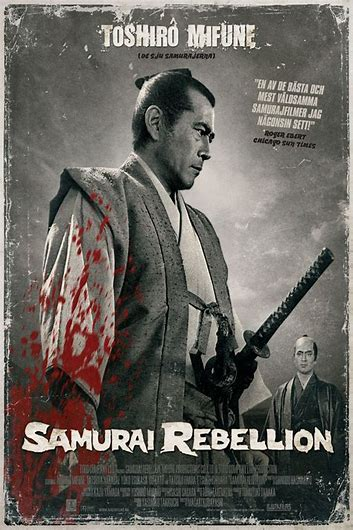
Samurai Rebellion (Masaki Kobayashi, 1967)

Masaki Kobayashi’s Samurai Rebellion may sound in outline like a rather distanced and hermetic project: a family of soldiers in the 1770’s, dutifully occupying its designated place within the clan, is leaned on to betray its morality and instincts for the sake of a whim of the clan lord, insisting that the family’s oldest son should marry his discarded mistress; then later, after having accepted and even prospered from the consequences of that, is asked to bend again when the whims reverse themselves, and the clan lord wants her back. The film resonates now as a study of the distorting workings of privilege and self-entitlement; time and again, concepts of honour and propriety and simple human decency are shown to be hopelessly malleable, the infrastructure that supposedly supports their workings incapable of standing up to one man’s lust and ego (hello there, Republicans!). Toshiro Mifune is at his most resonantly moving as the family head Isaburo, long weighed down by an unhappy marriage but now energized by his oldest son’s happy one and by becoming a doting grandfather, finding liberation in looming disaster (even declaring, as things close in, that he’s never felt so alive). The film is finely sculptured throughout, with any number of stunning individual shots, wringing a high quotient of nuance and feeling from the genre’s non-naturalistic conventions. The satisfying ending culminates in a fatally wounded Isaburo lamenting that he’s failed in his one remaining goal, to ensure that the story of what happened would be told; the fact that it is being told by virtue of the film’s existence provides a stray note of hope among the absurd loss and desolation. Certainly there’s a rather lost in time quality to the film – a few shots aside, it might as easily have been made in 1947 as in 1967 – but overall, that enhances its searching grandeur.

Wednesday, June 7, 2023

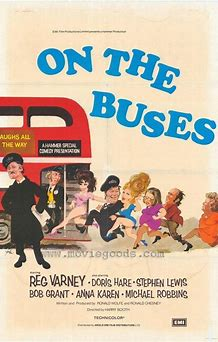
On the Buses (Harry Booth, 1971)


This spin-off from a British TV sitcom of the time has to be seen to be believed, which isn’t the same as saying it has to be seen; when I saw the film it was preceded by a warning from the broadcaster citing its outdated cultural attitudes, and that's just for starters. Stan and Jack, driver and conductor on a double-decker bus, are primally threatened when their employer tackles a staff shortage by employing a group of women drivers; the threat is both financial (no more overtime), and sexual (as conductors, women are “available,” but as drivers they’re not). When the women thwart the initial predictions by being basically capable, Stan and Jack set out to undermine them through such devices as planting spiders under their seats and spiking their tea with diuretics. Like so many sex-crazed British movies of the period, the film’s visual unsubtlety hurts the eyes (no “painting with light” here!), and the subtext is drably miserable: at an unspecified advanced age (the actor Reg Varney was in his mid-50’s) Stan lives with his mother, his married sister and her miserable husband in cramped quarters, their finances so unstable that when the overtime gets cut back they have to let go of the washing machine; the devotion to getting a bit of “crumpet” can only sustain its mechanical single-mindedness because it’s basically all there is to keep these wretched people going. The movie lacks any shred of basic human decency and warmth, seeming particularly brutal in its treatment of Stan’s sister Olive, presented as being slow-witted to the point of near-dysfunction, although Stephen Lewis’ portrayal of the put-upon inspector Blake approaches something oddly touching in its pathos. Several of the actors barely found work again after the series (and two further spin-off films) went off the air, a fate which gives their unrestrained excesses a rather macabre undertone, the one respect in which the film might reflect the broader tradition of the originating Hammer Studios…

Tuesday, May 30, 2023

Muriel ou Le temps d’un retour (Alain Resnais, 1963)


Alain Resnais’ Muriel will probably seem disorienting at a first viewing, at times dawdling and at others jarringly jumping around, the events shown on screen often seeming less significant than others that are frequently referred to, its ending unresolved and cryptic. But with repeated viewing, these characteristics come to seem central to its astounding interweaving of form and content, and evocation of history and memory; it feels less like watching a film than moving around inside it, always aware that to look in one place is to miss what’s happening in another. The plot has Delphine Seyrig’s Helene reconnecting with her old wartime lover Alphonse after many years, during which she was married and widowed and now lives with her stepson, dealing in antiques out of her home (a perfect representation of a life highly conditioned by memories, if not necessarily one’s own). The stepson, Bernard, refers to a fiancĂ©e, Muriel, who appears not actually to exist; we later learn that during his wartime service, the same name was used to denote a woman subjected to military atrocity, an event which continues to haunt him. But it seems it wasn’t that woman's real name either (the real Muriel in the film isn’t even seen, being merely the subject of a briefly overheard cry in the street), and likewise almost every aspect of Alphonse’s past and present is unreliable, a characteristic reflected in the film’s unstable-seeming, pliable form, and in its small-town setting, damaged during the war and now uncertainly evolving (one of its key landmarks is a brutalist-looking casino which appears to wreak havoc with Helene’s finances). The ending, coming in the wake of some abrupt realigning of the lives we’ve been watching, follows a previously unseen character arriving in town and wandering alone through Helene’s space, providing a strangely appropriate sense of rebalancing even as it withholds conventional closure. Overall, a must-see (and, as noted, once won’t likely do).

Thursday, May 25, 2023

A Warm December (Sidney Poitier, 1973)


In Sidney Poitier’s A Warm December, the star/director plays Matt Younger, a widowed American doctor on vacation in London with his young daughter; he falls in love with Catherine Oswandu (Ester Anderson), the mover-and-shaker niece of the “Republic of Torunda’s” Ambassador to Britain, eventually learning that she has fatal sickle-cell anemia, and only a few years to live. The film’s main virtue, and not a negligible one, is its very Blackness: race is never cited as an issue in any context, and it incorporates several diverse scenes of Black music and culture (ranging from Miriam Makeba to an odd open-air scene in which Younger and Catherine play records for a group of rural white kids, as their elders look on in mostly bemused fashion). Much else about it is disappointing or confounding though. The initial scenes, for whatever reason, have a cloak-and-dagger feel about them, shrouding the purpose of Younger’s trip in some mystery, and presenting Catherine as a stylishly mysterious figure with a host of ethnically diverse people on her trail; that all peters out, the film then becoming mostly defined by repetitive soppiness (aided by a generally excruciating music score, drawing not at all on the best of Black culture) with Catherine’s entourage and duties and mercurial nature repeatedly thwarting Younger’s plans and dreams. In truth though, given Poitier’s predominantly bland performance, it’s hard to know why the guy keeps at it, and the film doesn’t make the most of Anderson’s vivid presence; Yvette Curtis is intriguingly stoic as Younger’s daughter, although the film treats her as little more than a plot device. The ending might be read as an endorsement of prioritizing nation-building pragmatism over personal desire, but if so that’s mostly botched too. Still, for all its flaws, the film is notable as the high point of Poitier’s directorial ambition; following its failure he stuck entirely to comedy (well, and Fast Forward…)

Wednesday, May 17, 2023

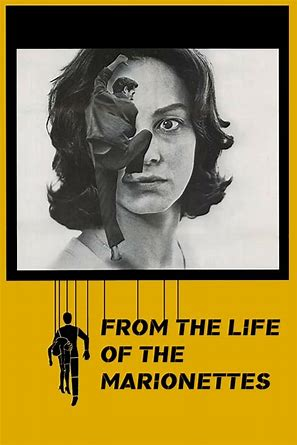
From the Life of the Marionettes (Ingmar Bergman, 1980)


From the Life of the Marionettes is one of Ingmar Bergman’s most chilling films, infiltrated with a loathing and pessimism that feel all-consuming: it was made during Bergman’s German exile from Sweden, a period of great acknowledged personal difficulty, in which the film feels helplessly suffused. It certainly feels like a deliberate stifling of any lightness we might detect in his work, with for example a protagonist called Egerman harking back to Smiles of a Summer Night (and with another famous actress prominent in the structure), except that the smiles here are heavy with malice and/or calculation, and the “little night music” becomes a deadening disco-inflected grind; the film’s cheerless interiors generally preclude any sense of day or night or any other index of the natural world. It starts with Egerman’s murder of a prostitute, then goes back in dossier-like fashion to place the event in a kind of context: we learn early on that he was plagued by fantasies of killing his wife Katarina, with the doctor in whom he confides these thoughts promptly summoning Katarina to his office, and then making sexual moves on her (which seemingly come close to succeeding); almost every subsequent scene provides a further moral or ethical or behavioral transgression or atrocity or mark of trauma. It perhaps follows that Egerman can gain a measure of control over his deadeningly repetitive, joyless life only by embracing the extremity of depravity, placing himself beyond the pale; the murder and his subsequent life in prison, removed from any knowledge of what’s going on outside, are the film’s only sections in colour, contrasting with the forcefully drab black and white of everything else. The film is highly artificial, its single-mindedness sometimes verging on parody; it causes you to worry for the state of mind of its maker (or would do, if not for one’s knowledge that Bergman’s next work was Fanny and Alexander), and for your own.

Wednesday, May 10, 2023

Darling Lili (Blake Edwards, 1970)


As a major Blake Edwards fan, I’ve long felt I’m missing something with Darling Lili; a recent reviewing didn’t really remedy that. The film certainly has some of Edwards’ most sophisticated play with image and identity, right from the initial emergence of Lili from a black screen to sing the haunted, almost disembodied “Whistling in the Dark” number. Given the plot of a beloved English singer who’s also a German spy; with moments that appear to explicitly channel Mary Poppins and The Sound of Music and which look ahead to later works like “10” and “Victor/Victoria,” its use of Julie Andrews’ star image is unusually multi-layered. And yet, the film’s machinations often feel unduly heavy and joyless, not least due to Andrews herself, who here as in several films to come hardly seems to justify her husband/director’s faith in her. Even allowing that the opaqueness is part of the point, Lili is a confounding blank; every time I see the film, I expect it to be revealed that she was actually a double agent all along, or at least that there’s more to it than I’ve previously grasped. Her relationship with an American ace, Larrabee, evolves from spycraft to real reciprocated love, but as embodied by Rock Hudson, the character remains strangely formal and distant; the Clouseau-type sight gags, in the form of a sozzled colleague of Larrabee’s and two French policemen on Lili’s trail, aren’t too well integrated; the film is likely to leave you puzzled on a number of other narrative and thematic fronts. It’s true that these and other criticisms could be repositioned as evidence of a slyly elusive intelligence, but where I’ll happily rush to point out what people overlook in (say) S.O.B. or even The Man Who Loved Women, I’ve never felt capable of making the effort for Darling Lili. Oh well, can’t win them all…  

Thursday, May 4, 2023

The Last Adventure (Robert Enrico, 1967)


Robert Enrico’s Les aventuriers is a consistently fresh and unpredictable pleasure, its surprises spanning the film’s tone, pacing, narrative construction, the behaviour of its characters and, well, just about everything. As if in response to a write-this-if-you-can challenge, it starts with a woman (Laetitia, played by Joanna Shimkus) rummaging through a scrap yard; she soon crosses paths with the owner Roland (Lino Ventura) and his best friend/collaborator/fellow dreamer Manu (Alain Delon), the three soon coming to form a loose trio (the film establishes the deep importance of these connections while gently side-stepping conventional sexual competitiveness). After a string of failed passion projects, they take off to the Congo in search of a stash of treasure located underwater on a crashed plane; this time they achieve their goal, but at a wrenching human cost which directs and underlies their activities on returning to France. The film evokes the great human dynamics of Howard Hawks: the three principals have a sense of each other that allows bumps and breaks to be traversed, whereas a fourth participant who joins the group for a while in the Congo (Serge Reggiani) is consistently shown to be in small or large ways suspect, and is ultimately cast out, despite having tried to do the right thing. It’s typical of the film though that it allows Reggiani’s unnamed character a late reappearance which establishes his basic moral fortitude; such moments seem rooted in a pervasive curiosity which has the two men digging into Laetitia’s humble origins, and to some degree assuming her life trajectory as their own, with time for charming diversions such as a visit to a rinky-dinky small-town museum, in which we get to examine just about every stuffed animal and rusty artifact. The climax delivers all the scenic action the adventure genre demands, but without any ultimate sense of exultation, ending on another note of bitter loss and existential arbitrariness.

Tuesday, April 25, 2023

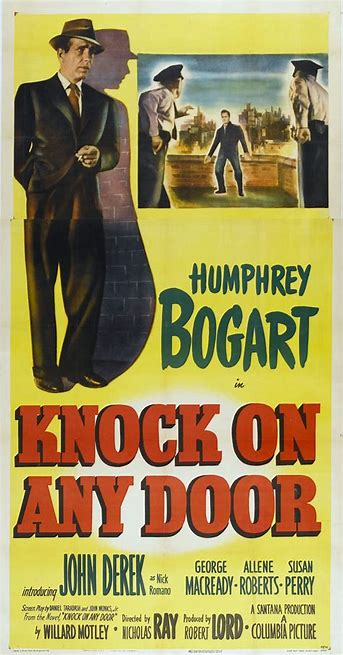
Knock on Any Door (Nicholas Ray, 1949)


In Nicholas Ray’s Knock on Any Door, commercial attorney Andrew Morton (Humphrey Bogart) steps back into his criminal-law past to defend Nick Romano (John Derek), a young “hoodlum” accused of killing a police officer: much of the first half unfolds in flashback as Morton recounts for the jury his past experiences with Romano, and his own possible partial culpability for why the young man’s life went wrong; the second half focuses mainly on the trial itself. The rather ungainly structure and all that’s packed into it generates a feeling of Ray being hemmed in much of the time, finding limited room for visual invention or meaningful character exploration; it achieves a few grace notes at the end though, in a lonely overhead framing of Morton making his final argument, and in the very final, transcendence-tinged shot (no less striking for being rather absurd). John Derek’s Nick Romano is as thin a presence as everyone has always said, but Bogart is as fascinatingly shaded as always, and the diverse supporting cast accommodates Preston Sturges-like eccentricity, unrestrained excess, wild intensity, the soft-spoken loveliness of Allene Roberts as the girl with whom Romano falls in love, and a relatively prominent, naturalistic Black character, whose testimony sparks a courtroom blow-up over whether or not he would even have been allowed inside the bar where he claimed to be at the time of the murder. The film’s speechifying, however overdone, still connects at a time when large factions of mainstream America seem to be defined largely by drummed-up fear and paranoia; the revelation that Romano is actually guilty, despite Morton’s skilled argument for his innocence, speaks directly to the wearisome burden of maintaining one’s idealism. But overall, it’s instructive that a film so strenuously seeking to enhance our sense of ambiguity and perspective should end up being one of Ray’s most unilluminatingly straightforward.

Tuesday, April 18, 2023

The Beekeeper (Theo Angelopoulos, 1986)


Theo Angelopoulos’s The Beekeeper feels rather strenuous at times, but it’s a quality rooted in bottomlessly searching despair, for its central character and the world he represents, and for the fate of the mode of cinema in which such an individual could be the protagonist. Marcello Mastroianni (inherently deep in art cinema resonance, but cast here in sternly withholding mode) plays Spyros, newly-retired from his small-town schoolteacher position, attending his youngest daughter’s wedding and then leaving behind his family (which in any event seems to be barely held together) to focus on his beekeeping, depicted here as a nomadic vocation, driving from one location to another, setting up and tending the hives for a while and then packing it all up and moving on; along the way he gives a ride to a young, unnamed woman, and their paths keep crossing thereafter, her attitude toward him ranging from affectionate to contemptuous, sometimes almost simultaneously. The film’s effective climax could hardly be more symbolic: Spyros and the woman spend the night in a disused cinema likely slated for demolition, where she undresses before him as if in sexual offering, but the resulting contact is bizarre and suffused in alienation, apparently marking the end of the dance between them; from there it’s a short journey to an final scene in which Spyros reaches his tragic existential destination, powerfully conceived and haunting, but less for an individual man’s fate than for that of a generation, its collective memories, its relationship to homeland and tradition. Much of the film might have been set decades ago; the film’s newest-looking locations are also among its most desolately alienating (in this context, a passing reference to Dire Straits’ Brothers in Arms seems weirdly out of place), defined by almost empty, characterless roadside diners and the like, and by numerous shots of people moving in expressionless, almost zombie-like manner.