Tuesday, September 26, 2023

Don't Cheat, Darling! (Joachim Hasler, 1973)


I don’t know how many musicals came out of 1970’s East Germany, but Joachim Hasler’s Don’t Cheat, Darling! confirms that the total is more than zero. There are even fleeting moments, as dozens of brightly-dressed performers sing and dance in the picturesque, cobbled-street town of “Sonnenthal,” in which Jacques Demy’s sublime The Young Girls of Rochefort comes to mind, although Hasler can’t approach the choreographic finesse and cinematic grace of Demy’s film, and the songs (lots of strenuous odes to collective happiness) mostly evoke Eurovision (or on occasion perhaps, Man of La Mancha) more than Michel Legrand. Don't Cheat, Darling! is hardly a biting critique of the governing regime, but the narrative is explicitly premised on an infrastructure of extensive central planning and intervention and constant resource constraints, albeit that the film’s characters treat this mainly with good-natured exasperation, or as a challenge to be creatively overcome. The main medium of that is soccer; the accomplished Dr. Barbara Schwalbe arrives to take up a new administrative post, finding that the bus she arrived on and the apartment that should have accompanied the job are both being commandeered for the benefit of the local team. By the end of the film, just about every special interest group in town claims to have formed its own competing and equally entitled squad, and things end on a general note of renewal and optimism, although some of the narrative’s cumbersomely-articulated details escaped me. In common with the more drably crowd-pleasing British cinema of the period, the film suggests that just about every character has sex more or less constantly on their minds, given the lack of anything else to think about (excepting the character preoccupied with his pet rabbits, which might just be a variation on the same thing). although matters remain highly decorous - a late suggestion that two characters actually spent the night together comes as a mild shock!

Wednesday, September 20, 2023

The Last Days of Dolwyn (Emlyn Williams, 1949)


In The Last Days of Dolwyn, the only film directed by Welsh playwright Emlyn Williams, he casts himself as Rob, returning to a picturesque village of his youth with the object of buying up all the property rights and flooding the place, thus facilitating the most cost-effective flow of water from the nearby dam across the border to England. The locals are offered a new life in Liverpool, only a hundred miles away, but far beyond the experience of most; it’s telling that they seem to lack the inner or financial resources to consider any alternatives, like moving to another, closer village. The ultimate plot mechanics, depending on a cruel twist of fate, are rather unproductively melodramatic (not helped by Williams’ own egregious over-acting), but the film does tap into a broader authenticity, aided by large amounts of untranslated Welsh-language dialogue (the village’s dominant tongue, with some of its inhabitants barely functional in English). The film is notable for Richard Burton in his first screen role, also often speaking Welsh (although much of his time on screen is squandered on a pointless romance) and an early appearance by future Oscar-winner Hugh Griffith, who would seldom be as restrained in his later roles. And the estimable Edith Evans, playing the mother of Burton’s character, is quite touching at times, never more than in a scene where she visits the local gentry to plead her case, and is simply unable to process that a grand-looking house could be burdened by debt, such that its inhabitants would possibly describe themselves as functionally poor. For all its flaws and limitations, the film conveys the tragedy of forced migration, the loss of sense of place and belonging and community; it’s a theme that takes on renewed charge in the era of climate disruption (as the bill comes due, you might say, for so much reckless intervention into peacefully sustainable lives.)

Saturday, September 16, 2023

Marriage in the Shadows (Kurt Maetzig, 1947)


The historical importance of Kurt Maetzig’s Marriage in the Shadows flows helplessly from the time and place of its making; a German film from 1947 dealing with the country’s then-very recent history of anti-Semitism, explicitly positing that those who went along with the Nazi project should face a subsequent moral reckoning. Assessed ungenerously, the film is an early exemplar of the (at worst) implicitly Holocaust denying strand of cinema that pushes the collective experience of the six million into the background, focusing on an individual narrative of relative privilege (albeit here of a short-lived kind). But the film has more than enough social and emotional authenticity and immediacy to surmount its narrative and cinematic limitations. It focuses on a group of actors, starting off in 1933 in flirtatious mode with the beautiful Jewish actress Elisabeth juggling several potential suitors, most of them assuming that the ascendant Nazism will either peter out or that their status as actors will somehow shield them from its worst impacts; eventually. Elisabeth marries the non-Jewish Hans, not her first choice, but seemingly providing some stability and protection. The relationship deepens, but eventually it’s clear that Elisabeth will be deported, and Hans fatally poisons her and then himself (the closing titles cites the actor Joachim Gottchalk, who died with his Jewish wife and son in 1941, and whose history the film draws on in several respects). With few exceptions (such as a late passage subjectively depicting Elisabeth’s overwhelmed mental state) the film is stylistically unremarkable, but it effectively enough conveys a horror greater than the characters’ capacity to comprehend it; even several years into the war, Hans is fatally naïve regarding his ability to protect Elisabeth, and another character deludes himself that he’s doing some good within the system, whatever the evidence to the contrary. Depressing contemporary resonances and parallels are, of course, all too easy to identify.

Wednesday, September 6, 2023

The Heartbreak Kid (Elaine May, 1972)


In the opening minutes of Elaine May’s The Heartbreak Kid, Charles Grodin’s Lenny and Jeannie Berlin’s Lila meet, court, get married, and set off to drive from New York to Florida on their honeymoon; by the time they reach their destination he’s already tired of her, and a few days later has resolved to get out of the marriage, his mind now set on being with Kelly (Cybill Shepherd), there on vacation from Minnesota with her parents. It’s all as funny as anyone could wish for, with uniformly spot-on performances, the actors seeming perfectly in sync with May’s exactingly deadpan style. The underlying dynamics are satisfyingly hard to pin down: a summary of the trajectory may make it sound like a triumph of the male go-getter, the replacement female object of desire merely submitting to inevitability, but Shepherd’s sustained sense of amused knowingness (and the fact of Kelly being the initial pursuer, appearing to Lenny on the beach as if torn from the sun) complicates that reading. As does the ending, at Lenny’s second wedding celebration, his goal achieved, but with little apparent exultation, Kelly waiting on the side as he immerses himself into conversations about business and opportunity (he grandiosely claims to want to do something that involves giving back to the land, as opposed to his current role in selling sports equipment, but this objective seems capable of being easily jettisoned). The film certainly represents a kind of triumph for WASP capitalism – his second wedding is a much more conventionally lavish affair than his first; Kelly’s well-to-do family embodies a certain kind of aspirational living – but at the possible cost of losing his soul (as annoying as Lila may be to him, his interactions with her are real and textured where those with Kelly are sculptured and artificial). The resonances are terrific, and yet The Heartbreak Kid may be the most relatively straightforward of May’s four films, which is really saying something about the other three.

Wednesday, August 30, 2023

Blind Spot (Claudia von Alemann, 1981)


Claudia von Alemann’s Blind Spot is a small, quiet film, almost seeming designed to be overlooked (it might as well have been so designed, given its lowly place in the conventional canon) but capable of permanently shifting one’s inner paradigms. A young German woman, Elisabeth, comes to Lyon to carry out research on the real-life 19th century writer and activist Flora Tristan,  focused less on traditional archival methods than on walking in Tristan’s footsteps, seeing what she might have seen, hearing what she might have heard, thereby moving toward a new form of identification and understanding. It’s a sometimes draining project (she comments that she can’t even find a bakery that’s open, let alone tap the depths of Tristan’s experiences) and in any case unclear what output might result from it; part of the film’s point is that it couldn’t possibly be clear, because a feminist history requires a comprehensive renewal, encompassing everything from the nature of the inquiry (Elisabeth somewhat randomly finds herself listening to first-person testimony on Lyon’s persecution of the Jews during WW2) to how one defines and engages with eventual discovery (equally randomly meeting a woman who makes collages out of newspaper headlines as an way of better perceiving the inter-related totality of what’s reported). The project is personal as well as professional: it appears that Elisabeth has left her job, and her relationship with her partner and daughter is uncertain (there are a couple of hints that she may be pregnant); she briefly makes out with a stranger (and there are several moments when the film makes us aware of the male gaze upon her) but it doesn’t appear to lead anywhere. The film concludes, unexpectedly, in two very different kinds of musical outburst; the ending is tinged with frustration, failure, but also a kind of acceptance and reclamation of self, even a sense of transcendence, in which the viewer may gratefully share.

Wednesday, August 23, 2023

A Cottage on Dartmoor (Anthony Asquith, 1929)


Anthony Asquith’s 1929 film A Cottage on Dartmoor is as skillfully varied an entertainment as any silent film, placing elements of bustlingly orchestrated social comedy within a starkly tense thriller. It may be true that one responds to individual moments more than to the film in its totality - it lacks (say) the intensity and broader implication of Lang’s best silent work, or the sustained poetry of Murnau's, and the ultimate narrative trajectory is unremarkable – but this caveat emerges more in retrospect than while watching and submitting to the film. At the start, we follow Joe, an escaped prisoner, making his way over the moor to a lonely house containing a woman and her young child; she recognizes him and calls out his name, and we’re immediately in the busy beauty salon where they once worked together, tracing the events that brought them to their sorry place, setting up an ultimate sorry ending. Throughout, Asquith keeps intertitles to a minimum, trusting on the audience’s engagement with the evocative power of images: to randomly pick from countless examples, when an ebullient Joe chatters away to a customer, Asquith juxtaposes images of cricket and racing and other conversational fodder with shots of the bored customer; later on, with Joe now disconsolate and unable to engage with a garrulous client, the device is reversed (this being the Britain of the time, cricket is a constant). An extended sequence in a movie theater is a tour de force, depicting a varied crowd taking in a sound film preceded by a Harold Lloyd silent (nicely indicated by a couple of kids noting another attendee’s resemblance to Lloyd and arguing over whether or not it’s him up there on the screen), the talkie's novelty summed up by shots of the live accompanists now killing time by drinking and playing cards, the camera taking in a rich range of audience reactions, all punctuated by flashes of Joe’s jealous, uncomprehending, furious inner life, the overall effect quite thrilling.

Friday, August 18, 2023

La signora di tutti (Max Ophuls, 1934)


One of the most lastingly elegant and piercing films of its era, Max Ophuls’ La signora di tutti fully realizes the tragically ironic paradox implicit in its title, that if the signora belongs to all, she belongs to no one, least of all to herself. Isa Miranda, perfectly embodying the character’s journey from exploited innocence to doomed fatalism, plays Gaby, early in the film expelled from school after a scandal where a professor killed himself over her (we don’t see the professor, and it seems clear that she did little or nothing to encourage him, the first in the film’s succession of doomed romantic imbalances). She’s invited to a party by a young man, Roberto, who might be the potential love of her life, all the more so after his disabled mother also becomes fond of her, and then largely dependent on her. But Roberto’s financier father also falls for her, messing things up, leading to family tragedy and his financial ruin; she flees and eventually becomes a movie star, without of course finding the happiness to match the image. Roberto briefly reenters her life and she starts to think there may be a way back for them, but it turns out he’s married her estranged sister instead; however, he tells her, he’ll still see her, onscreen in her latest film, once it reaches them. Of course, despite Ophuls’ satirical approach to the film industry’s calculations and mercantilism, his feeling for the medium is peerless, alert to the entire visual possibilities of the narrative space, deeply attuned to emotional fragility and longing. But even as this lends the film a sense of expansive possibility, there’s a persistent offsetting gravity, a sense that nothing can ever be entirely consigned to the past. In this regard too, Gaby’s allure is that of cinema itself, in a film that speaks deeply to its moment, and barely any less to our own.

Wednesday, August 16, 2023

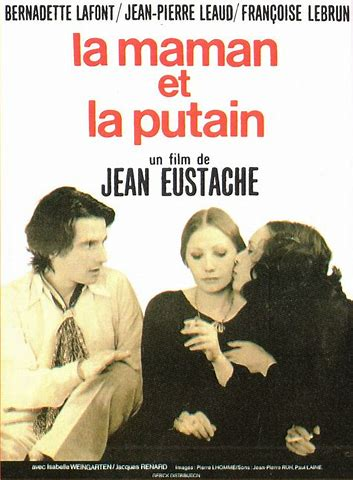
La mamain et la putain (Jean Eustache, 1973)


Much as Jean Eustache’s La maman et la putain leaves you staggering and drained, there’s a distinctly aspirational strand to the film: its protagonist Alexandre (Jean-Pierre Leaud) lives a life, albeit a low-budget, low-possession one, free of conventional constraints, with no job or apparent source of income, yet usually with sufficient money to meet the needs of the moment; he exercises his wits as he sees fit, with life providing ample material (he meets an old friend in a café and a few days later sees her picture in the paper as a wanted murderer); he lives with one woman, Marie (Bernadette Lafont), who allows him much latitude in sexual and other matters, and pursues another, Veronika (Francoise Lebrun), eventually ending up in bed with both of them. It’s inevitable that this structure would hardly feel built to last, but it’s unclear what can replace it: at times he seems preoccupied with marriage (however unpromising the putative match), at others with the past, even in its least savoury form (such as his and a friend’s mutual interest in a book about Nazism); the sense of personal energy lacking any applied momentum creates a rather unique, unsettling sense of stasis and draining, and it’s not coincidental that Veronika, almost always clad in flowing black, has a certain vampiric quality. The haunting aspects of Lebrun’s performance are entirely human though: open about her promiscuity, often seeming detached from her own behaviour, at other times hollowed out by it, culminating in an astounding, soul-tearing monologue positing in part that sex means nothing unless it’s to have a baby, a view partly complementary to those expressed by Alexandre, but he’s also earlier suggested that abortion providers are the Robin Hood of our age, and the final images of the two together, possibly on the edge of formal union, are contorted with pessimism. In this respect and countless others, one feels newly pummeled and penetrated by the film on each reviewing.

Wednesday, August 9, 2023

One Flew Over the Cuckoo's Nest (Milos Forman, 1975)


Milos Forman’s One Flew Over the Cuckoo’s Nest remains grandly entertaining viewing, with a pumped-up tonal unity that certainly wasn’t inevitable for such a project. With that stipulated, a detailed consideration of the film tends to turn into a pile of objections (some of them, admittedly, clearer now than they might have been at the time). It’s not necessarily a drawback if the conception of the institution shaken up by Jack Nicholson’s Randle McMurphy seems based in vaguely grotesque theatre more than clinical fidelity (it’s telling that the subsequent highpoints for many of the actors came either in horror or comedy), even if one never gains a coherent sense of how the place actually works. But within those parameters, the details of many of the characterizations still leaves one uneasy, such as McMurphy’s girlfriend (if that’s the right word), perpetually available to do his bidding, including having sex with other men. Nicholson’s best actor award seems as inevitable as it must have then, even if the performance is dotted with signs of pending excess and self-caricature; Louise Fletcher’s Oscar for best actress though must be one of the most generous in the history of the awards, her role as Nurse Ratched clearly a supporting one (if the distinction means anything at all) both in terms of screen time, and more importantly within the film’s structure and emphases. The central theme of the institutional stifling of an uproariously non-conforming individual still drives the film, but the mechanics of the ending leave one uneasy (the sadistic take-down of Brad Dourif’s forelorn character; the tasteless rush of pleasure presumably intended to accompany McMurphy’s subsequent murderous lunge at Ratched; the lumbering final image of freedom, with Will Sampson’s “Chief” smashing through the window and running into the sunset). Still, despite these and other caveats, you mostly submit to the film’s defiant, propulsive grandeur.

Wednesday, August 2, 2023

Les granges brulees (Jean Chapot, 1973)


Jean Chapot’s Les granges brulees revolves around an investigation of murder in a rural community, located close to a struggling family farm overseen by long-married couple Paul and Rose; an investigating judge, Larcher (Alain Delon), turns up from the city, installing himself in a local inn and slowly working to crack local codes of silence and suspicions. Given that Larcher’s approach seems to consist largely of showing up at the farm and hanging around Rose, the film often evokes one of those episodes of Columbo where the detective seems to many observers irrationally (but ultimately correctly) fixated on a single suspect. Of course, those interactions were defined largely by garrulousness, whereas Delon’s Larcher barely has as much dialogue in the whole movie as Columbo might have had in a single scene; the actor’s performance is an absolute master class in steely, unblinking silence, and as Simone Signoret embodies Rose with equal self-containment, it’s tempting to read the whole thing primarily as an exercise in juxtaposing complementing, distilled star images. Although the film is set in the then-present, it often seems lost in time: there are many references to WW2 and its legacy, and “the city” is referred to as if to some unattainable dream; as if confirming the extent to which the community resists any kind of outside influence, the mystery’s ultimate resolution comes out of nowhere, from a source unrelated to Larcher’s investigation. While the film suggests that the judge nevertheless feels strangely informed and elevated by the experience, the film provides only a slight indication of what form this takes: in the closing moments, Rose demonstrates an utter certainty that he won’t follow up on a crime committed by one of her sons, for the sake of closure and some broader sense of equilibrium. It seems likely that she’s correct, but the film provides no space for celebration on this point, nor on any other.

Wednesday, July 26, 2023

To You, From Me (Jang Sun-woo, 1994)


Jang Sun-woo’s seldom-seen To Me, From You gleefully assails just about every aspect of contemporary South Korea, finding almost no marker of propriety or achievement that can be taken at face value, no sexual coming together that isn’t toxic, transactional or otherwise doomed. A writer under a cloud for allegedly plagiarizing his prize-winning novel is visited by a younger woman who says she knows he’s innocent, because his narrative corresponded to a dream she had; they rapidly have sex, and then she moves in, seeming intent on boosting his flagging career (reduced to various corporate ghost jobs and other menial assignments) while also doing it with other men for a variety of strategic or intuitive reasons. The third main character is the writer’s drinking buddy, a bank clerk left impotent by his life’s one big love affair, and with little forward momentum of any other kind (none of the three characters are named, seemingly a mark less of symbolic universality than of their ultimate insignificance and malleability). The film is stylistically and narratively restless, allowing the viewer little chance of guessing at any point what’s coming next; it frequently cites writers and theorists (John Berger, Theodor Adorno…) and spends a surprising amount of time on analyzing and channeling Arthur Penn’s Bonnie and Clyde (seemingly the bank clerk’s favourite film, in part at least for the impotence angle); toward the end, it transitions for a while into animation, in a passage startling for its savage sexuality. The final (live-action) stretch has the trajectories of all three characters unexpectedly shifting, while offering little sense of permanence; two of them achieve celebrity with little effort, the other settles into subservience and seems all the happier for it, for now. So there’s some sort of message there about applied self-knowledge and integrity. Sort of…

Thursday, July 20, 2023

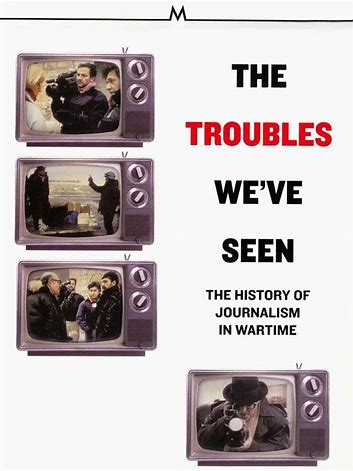
The Troubles We've Seen (Marcel Ophuls, 1994)


Marcel Ophuls’ tragically underseen The Troubles We’ve Seen is a marvelously provocative work, knowingly untidy and digressive and sometimes downright eccentric, but all the more stimulating and debate-sparking for that. The film is subtitled “A History of Journalism in Wartime,” but it's far less linear and comprehensive than this might suggest: the overwhelming focus is on the then-current war in Serbia, and on Sarajevo in particular, with other conflicts mentioned in more fragmented form along the way. Ophuls structures the first part primarily around his own trip to Sarajevo and his observations and interactions there; the second spends more time on various ethical and practical issues, such as whether warzone journalists should travel in armoured vehicles for their protection, or whether that would primarily serve to distance them from realities and to over-align them with the military. In often jarring ways, Ophuls contrasts the stark (although, as is acknowledged, not entirely fun-starved) realities of the war-reporting game with the comforts of life in Vienna and Venice (a short distance and a whole world away from Sarajevo), and the imagery of war with various snippets of classic Hollywood, from Hawks to Holiday Inn. The film’s opening point (made eloquently by Philippe Noiret of all people) draws a comparison between Bosnia and WW2, and the degree to which moral and strategic failure can be attributed to lack of information; watched in 2023, comparable, desperately acute parallels between what’s shown and debated and the current situation in Ukraine arise at every turn. Which is to say that however dated the film may seem in some of its particulars (and, to some, further distanced by the relative focus on French TV personalities), it speaks no less strongly to the eternal issue of how to engage (that is, as something other than mere compliant, capitalism-friendly consumer) with media assertions on what we need and deserve to know.

Wednesday, July 12, 2023

Her Brother (Kon Ichikawa, 1960)


It’s oddly appropriate that the title of Kon Ichikawa’s film Brother has alternatively been rendered in English as both Her Brother and Younger Brother, summing up the film’s elegantly evasive nature, the difficulty of establishing the intended perspective on what’s shown. The opening stretch suggests no such difficulty: Gen and her younger brother Hekiro in their different ways struggle to cope with the stepmother, a pious Christian who endlessly cites her medical ailments to justify doing almost nothing around the house; their father, a subdued writer, is silent for so far into the film that one starts to assume he’ll never speak at all. An early, chilling scene has Gen wrongly accused of shoplifting, shoved around and even threatened with a whip by the store manager before being released with the thinnest of apologies; it’s Hekiro though who actually steals, for which he’s expelled from the Christian school (a mere prank, he says, to which the adults overreacted). From there the film evolves into something more wayward and unpredictable, with strange characters and potential subplots (particularly involving men with an eye on Gen) popping up and then exiting the narrative; Hekiko’s behaviour becomes even more wild and impulsive (and the film’s depiction of these actions correspondingly fragmented), often with financial consequences for the family, all of which comes to a sudden fault when a persistent cough turns out to be tuberculosis. All of this often carries the sense of a darkly velvety mystery which can’t quite be solved, a sense which carries right to the final shot, when the family dynamics appear to have shifted once more, in a way beyond our capacity to analyze. Overall, the film may not showcase Ichikawa’s restless experimental streak as consistently and strikingly as, say, An Actor’s Revenge (or, less happily, the insipid and barely watchable Being Two Isn’t Easy), but it lingers in one’s mind almost as effectively.

Wednesday, July 5, 2023

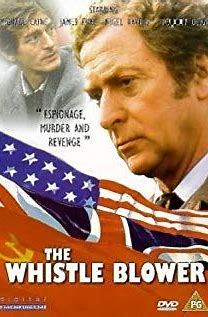
The Whistle Blower (Simon Langton, 1986)


Simon Langton’s The Whistle Blower plays rather flatly for a film that involves several state-orchestrated murders and cites pending apocalypse as a key part of its motivation, but still provides adequate diversion and stimulation overall. Michael Caine plays Frank, father of Bob (Nigel Havers), a Russian expert toiling away for British intelligence, toying with quitting but then finding something that renews his interest, that is before he’s found dead in what may or may not be a suicide. The film is a periodically interesting time capsule, bookended by a London Remembrance Day ceremony providing glimpses of Margaret Thatcher and other dignitaries; there are several references to hard economic times, with Frank counseling his son on the folly of quitting a steady job, and to Britain’s utter dependence on the United States, given that (as one high ranking functionary puts it) a nuclear war with Russia is assessed to be a pending near-certainty. There’s not much razzle-dazzle to how things unwind though: Frank gets the name of one key contact through the mildest outburst of aggression, then in turn extracts the necessary information from that contact simply by filling him up with booze, and reaches his ultimate object (John Gielgud) by turning up on the doorstep and being welcomed in. Caine gives one of those performances where you’re not sure how hard he cares or is trying (I mean that as a compliment); the rest of the cast mostly only briefly registers, although Barry Foster gives the drunk scene his all. But for a film in which a journalist and other innocent individuals are cold-bloodedly eliminated for the sake of political calculation (and the perpetrators calmly express their willingness to throw in a young woman and her child, if that's what it takes for Frank to yield), while guilty but well-connected men are shielded from consequences, the narrative and moral sophistication fall short of what should have been required.

Wednesday, June 28, 2023

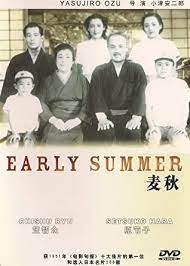
Early Summer (Yasujiro Ozu, 1951)


At least at the time of writing, the subtitling of Criterion’s version of Ozu’s Early Summer contains an intriguing error, taking a reference to its key character Noriko’s enthusiasm for “Hepburn” to refer to Audrey (who wasn’t even yet famous when the film was made) rather than the longer-established Katharine. Whereas the “Audrey” interpretation would have seemed to connote no more than “style icon” fandom, the corrected “Katharine” version carries more complex connotations, suggesting a reference point in an ongoing project of self-determination, and at least a flavour of greater sexual ambivalence. Accordingly, Noriko (Setsuo Hara) is a happily single 28-year-old woman, intrigued by marriage as a discussion point with her friends, but showing little personal desire to end her own status. When, despite all this, the pressure to marry becomes insurmountable, Noriko confounds everyone by choosing a man who hadn’t even asked her, without even discussing it with him, leaving it to his mother to tell him the news. He’s doesn’t appear again in the film, not even through numerous scenes where Noriko discusses her choice with family and friends and prepares for her departure; the other man who wants to marry her, her family’s preferred choice, is never seen at all. Ozu’s quiet radicalism in this respect doesn’t diminish over time; for example, it’s still a challenge to prevailing discourse when Noriko won’t even acknowledge to her best friend that what she feels for her future husband is love, preferring to use terms like “trust.” In so many physical and figurative respects, the film is defined by absences as much as presences (including a brother who never returned from the war and has never been officially pronounced dead), and at the end, so calmly that it’s almost shocking, the tight-knit family of the opening scenes has become dispersed, happy hubbub replaced by a quiet both soothing and deadly. Overall, it’s one of Ozu’s fullest works, formally and thematically inexhaustible throughout.