Wednesday, December 13, 2023
Crime of Love (Luigi Comencini, 1974)
Luigi Comencini’s unhelpfully titled Crime of Love is single-minded to a fault, but makes a walloping cumulative impact, rooted in fine personal and social detail. Nullo and Carmela (Giuliano Gemma and Stefania Sandrelli) both work at an emblematically awful Milanese factory, its employees mired in mind-numbingly repetitive tasks while often enveloped in toxic fumes; the mutual attraction is plain, but held back by Carmela’s mercurial nature, based in a mixture of strategy and instinct and in the inherent impossibility of her situation. She’s from Sicily, living with the rest of her family in a single room seemingly filled mainly with beds; Nullo’s home in a more modern building, although also shared with parents and siblings, appears luxurious by comparison (plastic covering still on the couch; a fish tank); he’s an anarchist who rejects the idea of a church wedding whereas she can’t imagine anything else. And yet, she frequently demonstrates the inclination and capacity to be freer and more self-defined: she swings from not wanting him to enter her house because she’s there alone to being the one who shortly afterwards initiates sex (and mentions that she’s been on the pill ever since they met); she sets the tone and direction of things far more than he does, to his perpetual bemusement it seems. The film sometimes evokes Antonioni, depicting a world from which one could only possibly feel alienated (when she talks about wanting to go somewhere sunny, Nullo takes her to a swimming spot of his youth, now a polluted cesspit surrounded by garbage and dead birds), but Comencini’s intentions are more straightforward, with Carmela ultimately a victim of just about everything there is to be a victim of (when her brother beats her up for coming home late and gives her a black eye, she tells people that Nullo did it, because that seems more respectable, and indeed earns him praise from some co-workers). The film ends on a startling act of protest, but one that barely registers, compared to the persuasively draining chronicle that precedes it.
Wednesday, December 6, 2023
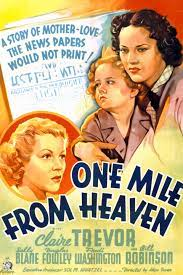
One Mile from Heaven (Allan Dwan, 1937)
About as eventfully varied
as any 67-minute movie you’ll ever see, Allan Dwan’s One Mile from Heaven has
Claire Trevor as Tex, a reporter who takes an unplanned trip to Harlem and then
starts fixating on Sunny, the Shirley Temple-lookalike daughter of Flora, a
Black mother (Fredi Washington). Tex instigates a juvenile court proceeding to
investigate Sunny’s parentage, and the newspaper coverage of the case triggers
a long-dormant history involving a convict father and a now well-connected
mother who believed her child to be dead. The film is a fascinating melange of the
progressive and patronizing: to take just a couple of examples, the Black community
exhibits a distinct lack of rancour toward Tex’s meddling, accepting her
actions mainly as the natural excesses of a newspaper woman and downplaying the obvious
element of race-based prurience; the narrative ultimately works its way to a
sort of proposed co-parenting arrangement, but one in which Flora will plainly
only be marginalized over time, given the vast disparity in economic power and
social connection. The film generally views Black culture in terms of prettified
otherness: the depiction of Harlem, with its teeming streets and hoards of kids
running outside to watch the dancing neighbourhood policeman (Bill Robinson), seems
to place it as close to toytown as to heaven (Washington’s inherent dignity and
gravity make her a general exception to such trivialization). Still, Dwan
avoids the worst potential pitfalls, and at times appears to be grasping for
something genuinely and idealistically radical; Robinson’s dance numbers are
valuable on their own terms, and if it’s hard to see his persona as that of a
beat cop, it's notable that he’s not merely a comic relief, but is treated as a
credible and considerate moderating presence. On top of all that, the film
includes strands of screwball comedy (mainly involving Tex continually getting
the best of rival reporters) and of gangster melodrama, all melded together
with no-nonsense efficiency and know-how.
Wednesday, November 29, 2023
A Question of Silence (Marleen Gorris, 1982)
Marleen Gorris’ A Question of Silence
remains a classic of political feminist cinema, endlessly stimulating and
debatable for all its inevitably dated trappings: three women, strangers to
each other and with little in common, spontaneously join together in brutally
killing the male owner of a clothing store; another woman, a psychiatrist, is
assigned to prepare a report for the court, and is unable to provide the
expected conclusion, that the women were insane (at least by some measure). This
isn’t a vigilante movie based in a whipped-up sense of righteous revenge (the
women aren’t violently abused by their partners for instance); the injustices
and imbalances underlying their actions are more subtle and systemic, rooted in
the basic structures and assumptions of work and family, sometimes seeming to
verge on the supernatural, particularly in the depiction of four other women
who witness the murder, and thereafter seem to be joined in some silent form of
communion (the sense of other-worldly possession bolstered by the highly
of-the-moment synthesizer score). Such devices may seem a bit overly emphatic
at times, but they’re a vital element of the prevailing sense of otherness, of
a text which can’t be contained by prevailing patriarchal norms and
expectations. It follows that the question of motive is never resolved (and
indeed is rendered almost comically inadequate, an attempt to impose an easy
narrative on an action which inherently resists that); a suggestion by the
prosecutor that the crime should be assessed no differently from, say, a murder
of a female shop assistant by three men strikes the women as so clueless that only
laughter can follow, rendering the proceedings morally void, if not legally so.
Inevitably, Gorris doesn’t arrive at a tidy conclusion, her film’s ending
suggesting further new alliances ahead, an ongoing need for breakage and
disruption.
Wednesday, November 22, 2023
Joe Hill (Bo Widerberg, 1971)
Bo Widerberg’s Joe Hill follows the
history of the real-life early 20th-century activist from his
arrival in America as a Swedish immigrant, through early struggles in New York,
through years of itinerant labour and increasing involvement in the workers’
rights movement, to his shocking death by firing squad after a murder conviction.
The film has some wonderful, light-footed passages, at its strongest when
channeling formative, unstructured experiences and realizations, such as his
stumbling into song as a way of getting his message across (Hill is apparently
reliably credited as the source of the phrase “pie in the sky’). It skimps
though on setting out the arc and substance of his political journey, allowing
a few isolated sequences to represent a complex whole, and spending relatively disproportionate
time on the trial and its aftermath (although the contrast between the state’s
painstaking management of execution protocols and its indifference to matters
of infinitely greater social importance is well-made). Like Widerberg’s Adalen
31, the film feels less radical than its subject might demand; potential
anger and righteousness somewhat defused by a sensitivity to the unpredictable
nature of experience and influence, to the unreliability of memory and
history in prioritizing events. Joe Hill acknowledges the possibility
that a martyred Hill might be worth more to the movement than a live one, but
doesn’t attempt to provide any broader perspective on the validity of that
judgment; the final scenes show the organization making strategic use of his
ashes, but also hints at how quickly hearts and minds move on. Widerberg’s curiosity
and openness are among his most appealing qualities, even if they might suggest
a lack of rigour and focus; in this case, at the very least, his approach
results in a very personal engagement with history and myth, leaving ample space
for competing versions of Hill’s story and significance (an implied invitation
not yet taken up by other filmmakers though).
Tuesday, November 14, 2023
The Last Tycoon (Elia Kazan, 1976)
The closing moments of Elia Kazan’s The
Last Tycoon suggest that the film was intended all along as a romantic valorization of the "dream factory" aspect of Hollywood lore: its
doomed 30’s studio head protagonist Monroe Stahr seeming on the verge of being
eased out, for the first time addressing the camera directly to reprise a story he improvised
earlier in the movie as inspiration for a bogged-down writer, except that now we understand
it as an expression of lost love, followed by a final walk into the literal and
figurative darkness. It’s an ending that extends the film’s two main strands –
Stahr’s bullheaded approach to running things, perpetually making expensive
creative decisions which no one else in the more money-minded executive suite sees the need for,
and his longing for a woman who can ultimately never be his – but it carries far too little charge, given the strangely still and displaced quality of much
that precedes it, the sense of a film joylessly located outside both history
and myth. In theory at least, Kazan must have been better placed than most to probingly
recreate the studio system’s uniquely epoch-defining mixture of glory and
corruption, but his work here is dutiful and passionless, neither pleasurably
nostalgic nor gleefully eviscerating. Similarly, Robert De Niro is at his most quietly
withholding as Stahr – as with Kazan’s direction, it’s often hard to determine
what he had in mind – but the film at least provides a good source of trivia
questions and degrees-of-Bacon type connections: yes, it’s true, De Niro did indeed
once act with Dana Andrews and Ray Milland. Jack Nicholson shows up late in the
film as a union organizer, but he’s yet another oddly ineffectual presence, a theoretically
crackerjack meeting of two of the decade’s defining actors coming across as a
chore that they both just had to plod through.
Wednesday, November 8, 2023
Perceval le Gallois (Eric Rohmer, 1978)
In itself, it would be mainly of academic interest that the
apparent peculiarities of Eric Rohmer’s Perceval le Gallois can be
explained by his emphasis on fidelity to the tone and content of Chretien de
Troyes’ 12th-century source material, but Rohmer’s choices here also
resonate fascinatingly against the main body of his work. For example, the
film’s second half contains a startling narrative switch, abruptly putting
aside the story we’ve followed to that point (the young Perceval leaves his
home to become a knight, gradually accumulating in knowledge and understanding)
to follow that of another knight, Gawain, who’s been only a secondary character
to that point; later on, at what might seem to be just as arbitrary a point, it
switches back. In this context, the device promotes a heightened reflection on
the artificial and conditioned nature of all narrative coherence; when the film
then culminates with an enactment of Christ’s crucifixion, there’s a feeling of
all narrative, of all creation, deriving from Western civilization’s core
origin story, underlining the sense of humility and fidelity that marks the
entire enterprise. The film is in part a heightened version of the behavioral
and ethical puzzles that mark Rohmer’s contemporary work: Perceval is initially
a near-blank slate, who at the start of the film sees a knight for the first
time and peppers him with basic questions; later on when a wise man advises him
not to talk too much, he takes the advice too far, missing out on
opportunities, and even unknowingly committing grave sins. Rohmer’s chosen
style beautifully supports the project, emphasizing artifice and immediacy, the
act of storytelling (with the characters, for example, often describing their
own actions) as prominent as the story being told. And it’s delightful how his reversion
to an ancient text carries the sense of a personal rebirth, with the cast containing
several young performers (Pascale Ogier, Arielle Dombasle, Marie Riviere) who he
would use more prominently in later, modern-day works.
Wednesday, November 1, 2023
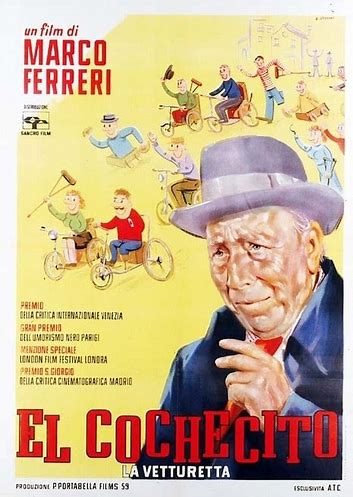
El cochecito (Marco Ferreri, 1960)
Marco Ferreri’s El cochecito lives
up to its reputation, its perspective on the community of the differently-abled
still seeming radically matter-of-fact and quasi-aspirational. A retired
bureaucrat, Don Anselmo, visits an old friend who now gets around in a
motorized wheelchair, and who gives him a ride on it when Anselmo can’t find a
taxi; it leads to other get-togethers and contacts and diversions (presented in
enjoyably garrulous, lived-in manner) and to Anselmo desiring such an
item for himself, regardless that it’s beyond his means, and that
he doesn’t actually need it. The desire becomes a near-fixation, and yet
appears more rational than his family’s strident opposition to it (this aspect
of the film aligns well with modern Uber-aligned notions of choice and autonomy),
in particular as he actually wants to get out and experience people and places, an
ambition seemingly beyond the scope of his relatives’ closeted thinking. Threatened with
being committed to an asylum, Anselmo takes a desperate step to get what he
wants, his awareness of his transgression made clear in a startling, long-held
close-up, in which Ferreri temporarily seems to yield to the evocative powers
of his lead actor, Jose Isbert. The final scene (in the full original version
that is; the film was reportedly available for years only in bowdlerized form) allows
him a final taste of freedom, and although it’s clear that a severe reckoning
lies ahead, Anselmo’s final remark has a resigned lightness to it, suggesting
that from his hemmed-in point of view, his liberation, however brief, was worth
it at almost any logistical and moral price. The film allows occasional
glimpses of the later more expansive Ferreri (for example, Anselmo enjoys an
indulgent lunch that presages La Grande Bouffe), but on the whole
occupies its own stylistic and tonal space within his oeuvre, no less enjoyably
for that.
Wednesday, October 25, 2023
Starship Troopers (Paul Verhoeven, 1997)
Paul
Verhoeven’s Starship Troopers is an exemplary action-fantasy, frame
after frame overflowing with compositional exactitude and beyond-the-call-of-duty
detail; there’s never a moment of apparent corner-cutting, of Verhoeven’s
immense focus and willpower even momentarily faltering. If it’s generally
viewed (despite major defenders) as lying outside the top drawer of modern
genre classics, that’s partly because of the relative blandness of the
foreground, relying on somewhat blandly attractive leads put through
conventional narrative arcs of self-discovery. But that’s also the source of
some of the film’s most mind-boggling resonances: the sense of young and
inexperienced recruits thrown into situations for which they’re barely prepared
(and which, in some cases, they have little rational chance of surviving)
suggests that the war of the future, however technologically advanced, will demonstrate little moral or ethical advance on our brutal past (modern-day debates about
the propriety of drone warfare are beyond the movie’s scope). Even more
remarkable is the evocation of Fascism, most explicitly in the scientist
character played by Neil Patrick Harris (!), strutting around in black leather and
justifying any amount of human loss for the sake of strategic advancement, focused
specifically on sinister scientific experiments, all of this ultimately
presented as positive and virtuous, and intertwining with a bracing notion of
“citizenship” as something that’s no longer a matter of birthright, but that
has to be earned through various forms of service, most prominently the
military kind. The film concludes on a note of interim rather than total
success, which seems here less like laying the ground for sequels (although of
course it does that too) than leaving the viewer somewhat off-balance, with
every indication that the splashy celebration of military triumph will be paid
for in part with wrongs and atrocities elsewhere, daring us not to succumb to
the momentary sense of triumph.
Wednesday, October 18, 2023
Love Unto Waste (Stanley Kwan, 1986)
The 1986 Love unto Waste, the second film by Hong
Kong’s great and mostly underappreciated Stanley Kwan, sounds conventional in
its outline, but becomes steadily more evasive and unreadable as it goes on, the
implications of its title only fully coming into focus at the very end. Tony
Cheung (Tony Leung Chiu-wai) is first seen getting flamboyantly drunk at his
birthday party, vomiting over young model Billie (Irene Wan), whom he
nevertheless rapidly ends up dating, and through her becoming part of a quartet
which also includes the actress Liu (Elaine Jin) and singer Chiu (Tsai Chin).
When Chiu is brutally murdered in her apartment, detective Lan (Chow Yun Fat)
enters the orbit of the remaining trio, his methods flamboyantly eccentric and
unfocused (he cites Columbo as an inspiration), but rapidly seeming more
interested in hanging out with them than in solving the case. The film continually
muses on matters of cultural identity and self-definition, with the characters
debating the meaning of a particular word, or how best to express a certain
thought (it’s likely that even more subtlety than usual is lost in the subtitling
here), all of which intertwines with the work in progress of their personal and
professional identities; when the trio takes Chiu’s ashes to her family in Taiwan,
and into a milieu where two of them don’t speak the language, the existential investigation
almost entirely displaces the criminal one. The film ends far from where it
began, both narratively and tonally, with the group having dispersed, and a key
character visiting another who’s now dying from cancer, the two summing up their
achievements and finding them wanting, marked by too much wasted time and
possibility. It’s an ending that puts the film’s moments of joy – karaoke and drinking
and laughing and smoking and flirting and cooking (a chicken inside a pig’s
stomach!) – in poignant, haunting perspective.
Wednesday, October 11, 2023
Tale of Cinema (Hong Sang-soo, 2005)
Entirely by coincidence, I watched Hong
Sang-soo’s Tale of Cinema the day after the “Joan is Afraid” episode of Black
Mirror, a juxtaposition which made Hong’s film seem, if not prophetic, then
at least beautifully attuned to art/life paradoxes which take on a new edge in
an era of CGI, AI, quantum computers, 24-hour connectivity, and whatever else you
want to blame. Of course, Hong’s film contains nothing which obviously
constitutes “special effects” (the English title at least evokes Eric Rohmer,
which doesn’t seem too out of place tonally speaking), but halfway through it
provides a purely cinematic thrill, when one realizes that everything we’ve
watched up to that point represents a film that has just been viewed by Dongsoo, the protagonist of the film’s
second half, and which he later claims was largely based on his own
experiences. He spots the actress from the film in the street, and follows her
as she revisits one of the locations; later on they go drinking together, and things
develop somewhat as they did in the movie in which she starred, although
eventually art and life inevitably diverge. It’s beautifully ambiguous whether
Dongsoo’s claim about the past is entirely or partially true, and in turn
whether he’s trying to ape what he saw in the film, or reliving a past
experience, or finding something unlocked in himself, or some combination of
all three; as such the film elegantly expresses the complexity of our
interaction with movies. It wouldn’t have been a great surprise if Hong had
rebooted a second time; the final note though warns against the allure of such
rabbit holes, emphasizing the importance of thinking, of rationality, of
applied intent. And indeed, it’s the kind of film that in its unpreachily
graceful but detailed way makes you want to reexamine yourself and your
coordinates, and to change them for the better.
Thursday, October 5, 2023
The Conversation (Francis Coppola, 1974)
The details of Francis
Coppola’s 1974 film The Conversation may be superficially dated (even at the time, a competitor throws barbs at Gene Hackman’s Harry Caul for using outmoded
equipment), but the themes of lost control and corroded sense of self remain
enormously resonant in an age of online identity theft and accelerated AI. Caul
is a professional surveillance expert, engaged by a corporate director to record
an open-air conversation between the director’s wife and another man,
achieved by synthesizing the recordings from several different microphones;
as he works on polishing the tape, he becomes ambivalent about completing the
assignment, partly because of past occasions when his work triggered unforeseen
and violent outcomes. The film feels overly schematic in some ways, such as the
strenuous artificiality surrounding its conception of “the director” and his
sinister assistant, but this must be offset against the sensationally detailed
and layered conception of Caul, a marvelous amalgamation of paranoia, Catholic guilt,
ego, fear, and underserved desires. If the film stands as one of the key works
of the 70’s, it’s partly because it feels to be in, indeed, a conversation with
the surrounding culture: an extended scene of late night shenanigans evokes
Cassavetes, some of its more baroque moments evoke De Palma, the presence of
Harrison Ford as the assistant seems like a harbinger of new populist waves to
come, and so on. Not unusually for its period, the film’s perspective on women
is limited, viewing them primarily as appendages to a world of male intrigue,
defined largely by sexual availability; even here though, Coppola strikes some productively
mysterious notes, suggesting that Harry doesn’t entirely grasp their agenda, or
the full extent of what they know about him. Indeed, the narrative ultimately
turns on the fundamental likelihood of the self-assured biter, even the most
powerful biter (even entire societies of them) eventually becoming the
painfully bitten…
Tuesday, September 26, 2023
Don't Cheat, Darling! (Joachim Hasler, 1973)
I don’t know how many musicals came out of 1970’s
East Germany, but Joachim Hasler’s Don’t Cheat, Darling! confirms that
the total is more than zero. There are even fleeting moments, as
dozens of brightly-dressed performers sing and dance in the picturesque,
cobbled-street town of “Sonnenthal,” in which Jacques Demy’s sublime The
Young Girls of Rochefort comes to mind, although Hasler can’t approach the
choreographic finesse and cinematic grace of Demy’s film, and the songs (lots
of strenuous odes to collective happiness) mostly evoke Eurovision (or on
occasion perhaps, Man of La Mancha) more than Michel Legrand. Don't Cheat, Darling! is
hardly a biting critique of the governing regime, but the narrative is
explicitly premised on an infrastructure of extensive central planning and intervention
and constant resource constraints, albeit that the film’s characters treat this
mainly with good-natured exasperation, or as a challenge to be creatively overcome.
The main medium of that is soccer; the accomplished Dr. Barbara Schwalbe
arrives to take up a new administrative post, finding that the bus she arrived
on and the apartment that should have accompanied the job are both being commandeered
for the benefit of the local team. By the end of the film, just about every special
interest group in town claims to have formed its own competing and equally
entitled squad, and things end on a general note of renewal and optimism,
although some of the narrative’s cumbersomely-articulated details escaped me.
In common with the more drably crowd-pleasing British cinema of the period, the
film suggests that just about every character has sex more or less constantly on
their minds, given the lack of anything else to think about (excepting the
character preoccupied with his pet rabbits, which might just be a variation on
the same thing). although matters remain highly decorous - a late suggestion
that two characters actually spent the night together comes as a mild shock!
Wednesday, September 20, 2023
The Last Days of Dolwyn (Emlyn Williams, 1949)
In The Last Days of Dolwyn, the only film directed by Welsh playwright Emlyn Williams, he casts himself as Rob, returning to a picturesque village of his youth with the object of buying up all the property rights and flooding the place, thus facilitating the most cost-effective flow of water from the nearby dam across the border to England. The locals are offered a new life in Liverpool, only a hundred miles away, but far beyond the experience of most; it’s telling that they seem to lack the inner or financial resources to consider any alternatives, like moving to another, closer village. The ultimate plot mechanics, depending on a cruel twist of fate, are rather unproductively melodramatic (not helped by Williams’ own egregious over-acting), but the film does tap into a broader authenticity, aided by large amounts of untranslated Welsh-language dialogue (the village’s dominant tongue, with some of its inhabitants barely functional in English). The film is notable for Richard Burton in his first screen role, also often speaking Welsh (although much of his time on screen is squandered on a pointless romance) and an early appearance by future Oscar-winner Hugh Griffith, who would seldom be as restrained in his later roles. And the estimable Edith Evans, playing the mother of Burton’s character, is quite touching at times, never more than in a scene where she visits the local gentry to plead her case, and is simply unable to process that a grand-looking house could be burdened by debt, such that its inhabitants would possibly describe themselves as functionally poor. For all its flaws and limitations, the film conveys the tragedy of forced migration, the loss of sense of place and belonging and community; it’s a theme that takes on renewed charge in the era of climate disruption (as the bill comes due, you might say, for so much reckless intervention into peacefully sustainable lives.)
Saturday, September 16, 2023
Marriage in the Shadows (Kurt Maetzig, 1947)
The historical importance of Kurt Maetzig’s
Marriage in the Shadows flows helplessly from the time and place of its
making; a German film from 1947 dealing with the country’s then-very recent
history of anti-Semitism, explicitly positing that those who went along with
the Nazi project should face a subsequent moral reckoning. Assessed
ungenerously, the film is an early exemplar of the (at worst) implicitly
Holocaust denying strand of cinema that pushes the collective experience of the
six million into the background, focusing on an individual narrative of
relative privilege (albeit here of a short-lived kind). But the film has more
than enough social and emotional authenticity and immediacy to surmount its narrative
and cinematic limitations. It focuses on a group of actors, starting off in 1933
in flirtatious mode with the beautiful Jewish actress Elisabeth juggling
several potential suitors, most of them assuming that the ascendant Nazism will
either peter out or that their status as actors will somehow shield them from
its worst impacts; eventually. Elisabeth marries the non-Jewish Hans, not her
first choice, but seemingly providing some stability and protection. The
relationship deepens, but eventually it’s clear that Elisabeth will be
deported, and Hans fatally poisons her and then himself (the closing titles
cites the actor Joachim Gottchalk, who died with his Jewish wife and son in
1941, and whose history the film draws on in several respects). With few
exceptions (such as a late passage subjectively depicting Elisabeth’s overwhelmed
mental state) the film is stylistically unremarkable, but it effectively enough
conveys a horror greater than the characters’ capacity to comprehend it; even several
years into the war, Hans is fatally naïve regarding his ability to protect
Elisabeth, and another character deludes himself that he’s doing some good
within the system, whatever the evidence to the contrary. Depressing contemporary
resonances and parallels are, of course, all too easy to identify.
Wednesday, September 6, 2023
The Heartbreak Kid (Elaine May, 1972)
In the opening minutes of Elaine May’s The
Heartbreak Kid, Charles Grodin’s Lenny and Jeannie Berlin’s Lila meet,
court, get married, and set off to drive from New York to Florida on their honeymoon;
by the time they reach their destination he’s already tired of her, and a few
days later has resolved to get out of the marriage, his mind now set on being
with Kelly (Cybill Shepherd), there on vacation from Minnesota with her parents. It’s
all as funny as anyone could wish for, with uniformly spot-on performances, the
actors seeming perfectly in sync with May’s exactingly deadpan style. The
underlying dynamics are satisfyingly hard to pin down: a summary of the
trajectory may make it sound like a triumph of the male go-getter, the replacement
female object of desire merely submitting to inevitability, but Shepherd’s
sustained sense of amused knowingness (and the fact of Kelly being the initial
pursuer, appearing to Lenny on the beach as if torn from the sun) complicates
that reading. As does the ending, at Lenny’s second wedding celebration, his goal
achieved, but with little apparent exultation, Kelly waiting on the side as he
immerses himself into conversations about business and opportunity (he grandiosely
claims to want to do something that involves giving back to the land, as
opposed to his current role in selling sports equipment, but this objective
seems capable of being easily jettisoned). The film certainly represents a kind
of triumph for WASP capitalism – his second wedding is a much more
conventionally lavish affair than his first; Kelly’s well-to-do family embodies
a certain kind of aspirational living – but at the possible cost of losing his
soul (as annoying as Lila may be to him, his interactions with her are real and
textured where those with Kelly are sculptured and artificial). The resonances are terrific, and yet The Heartbreak Kid may be the most relatively
straightforward of May’s four films, which is really saying something about the
other three.