Saturday, December 15, 2012

Buckets and Blood


(originally published in The Outreach Connection in February 2008)

I’ve been lucky enough to see Stephen Sondheim’s Sweeney Todd: the Demon Barber of Fleet Street twice on stage, most recently just a couple of months ago. At the risk of over-reacting to recent experiences, I think that second production will stand in my memory as one of the most overwhelming live experiences I’ve witnessed. Director John Doyle comprehensively reimagined the material so that the actors also play all the instruments, generating a unique theatrical rush. I would need to see it several times more to fully appreciate how the production’s incredible technical sophistication nevertheless managed (against the starkest of sets) to create such a darkly vivid evocation of the fictional space; sadly, it’s long gone now, so I can only hope my memory is a good custodian of it.

Sweeney Todd


The new film version, directed by Tim Burton, obviously doesn’t take the same approach at all, and I admit I had some trepidation about the choice of director. But it turns out better than we could likely have expected: not in the John Doyle class, but a more than honorable recording for posterity. If you don’t know, Sondheim’s musical (so grim that it spooked many of the audience members around us when we saw it on stage) is the story of that murderous barber Todd, returning to 19th century London from a prison sentence imposed by a corrupt judge, and hell-bent on revenge. His collaborator, Mrs. Lovett, is the self-proclaimed baker of “the worst pies in London,” who sees an opportunity to spice up her ingredients as Sweeney starts to rack up the body count (what would one do with fresh meat otherwise?)

The film is about half an hour shorter than the stage version, but it’s the most careful and well-judged pruning job imaginable, leaving Sondheim’s work substantially intact. Burton matches this with an extraordinarily restrained approach that brings out all the material’s morose intensity – there are only a few moments when the camera slips its tight leash. The lead roles are played by Johnny Depp and Helena Bonham-Carter, risky in that neither is a trained singer, and they’re both younger (or at least seem like it) than normal for these roles. This too ultimately works out terrifically. Made up to look almost like brother and sister, both with one foot in Addams Family territory, they bring to it an undertone of blinded vulnerability. One misses the relish that some of the songs had on stage, but even when you don’t completely like Burton’s choices here, you can respect the scrupulousness behind them.

I’d say this is the best filmed stage musical of the last few years. Rent and The Producers were emptily headed literal transcriptions, whereas Chicago and Dreamgirls were fussy and overdone. None of the four was slightly interesting as a piece of cinema. Burton’s on the other hand is diverting right down to the texture of the (copious) blood, which reminded me of Jean-Luc Godard’s remark about the blood in Pierrot le Fou being “not blood, but red.” There are few movies where you more clearly register the rare appearances of yellow, or bright blue; and when they do appear, they represent dreams just waiting to be quashed.

Sweeney Todd has some of the most beautiful songs I know – Pretty Women and Not While I’m Around, for example – and gains much of its unique tension from the extreme thematic pressure that’s placed on these sentiments (if you’ve only heard Pretty Women out of context, on Barbra Streisand’s Broadway Album for example, it’s impossible to imagine the circumstances under which it’s sung). I never thought Burton would stick so close to the playbook on all these; if you love the material, you can’t help but feel considerable gratitude. 

The Bucket List


And now we travel over to the other side of the quality spectrum, not quite all the way over, but far enough into the gloom that the sophistication of a Tim Burton seems like something yet to be invented. In this zone that time forgot, we find Rob Reiner’s new film The Bucket List, appropriately named in that Reiner directs pretty much as if loading up a bucket. Yeah, I imagine him saying, just put the camera over there somewhere; light it any way you like guys; Jack, that was great; Morgan, that was great; time for lunch yet?

The movie’s selling point is the bringing together of two screen icons (not that I imagine anyone felt deprived by it not having happened earlier): Nicholson and Freeman, playing two terminal cancer patients, one an unfulfilled multi-millionaire (is there any other kind in such movies?), the other a family man who let his dreams get away. Fusing Nicholson’s cash and Freeman’s positive attitude, they construct a list of things to do before they die (or kick the bucket, as the title has it), ranging from skydiving to visiting the Pyramids, to some simpler but less easily attained loose ends.

It’s a crazily old-fashioned thing, not least of all in the assumption on how little it takes to entertain an audience; it’s been a while since I came across such slack, under-developed material. Early on, their sorry circumstances are moderately affecting in a Hollywood kind of way, but once they start driving around racetracks and climbing the Himalayas (and in this regard at least the technicians did all they could to sell the illusion, although it was a hopeless task), it quickly becomes a silly bore. The closing scenes in particular play as if Reiner had given up and gone home, and it’s debatable how fully the two stars ever showed up in the first place. As Godard might have said, it is not blood in the bucket, but brown.

Juno


The new kings of comedy are of course the ubiquitous (and to my mind overrated) Judd Apatow and now the makers of Juno, which has been conquering every critic and box office in its path. The biggest beneficiaries are screenwriter Diablo Cody and lead actress Ellen Page. Cody’s dialogue is so consistently strange and sparky that it’s like watching a dramatized guidebook to a whole new subculture. Page handles it with a fast-talking ease evoking a modern Jean Arthur or Irene Dunne. It makes for an extremely diverting movie.

There’s some subtle and rather moving plotting in there too, revolving around a feisty teenager, pregnant from her one sexual encounter with her boyfriend (Michael Cera) who decides to give the baby up for adoption to a yuppie couple (Jennifer Garner is also very fine, in a more traditional vein, as the wife). Unlike many, I don’t see Juno as one of the year’s best – it doesn’t achieve the artistic alchemy of amounting to more than the sum of its parts. But they’re very astute and classy parts, and the movie never postures in the vein of (say) Wes Anderson’s horrible The Darjeeling Limited. I will say though that “This is one doodle that can’t be undid, homeskillet” is just about my least favourite line of the year, and should have been given the razor.

Favourites of 2012

I didn’t cover the territory thoroughly enough to extend an opinion on the year’s ten best films, but here are ten I admired very much. Happy holidays!

Compliance (Craig Zobel)
In this terrifically executed provocation, a manager at an Ohio fast food outlet is manipulated into detaining an employee on suspicion of theft, not suspecting that the unseen police officer on the other end of the line is just a sick prankster, exploiting inherent human gullibility and submissiveness. It works well enough as an effectively creepy thriller, but Zobel’s real intent is to position the film more as a social phenomenon (one based closely on documented real-life cases), with almost limitless metaphorical potential, broadly speaking to a wider capitulation in America culture.

Damsels in Distress (Whit Stillman)
Stillman’s first film in fourteen years seems to evidence his regret at the time he’s lost, underneath a proud and slightly cranky defiance. It takes place on a college campus, in more or less the present day, with hardly a person over thirty in the mix: for a director who’s somehow found himself hitting sixty, that might be viewed as charming and progressive, or as a sign of denial. The film is considerably strange, and – let’s say – distant from the pressing issues of our times; although I don’t think it’s as strong as his previous works, I was just damn happy to have him back.

A Dangerous Method (David Cronenberg)
David Cronenberg’s A Dangerous Method – depicting some episodes from the birth of psychoanalysis, and the souring of the relationship between Freud and Jung - superficially seems like an anomalous project for him, even for the more “respectable” latter day Cronenberg, but on greater reflection it might be the masterpiece he’s been inching toward for almost forty years: astonishingly tightly controlled and one of the most gripping films of ideas in a long time. It’s thrillingly complex and overflowing with implication and nuance, ultimately surveying a battle over the creation of meaning, taking place at a time when the world was up for grabs.

The Deep Blue Sea (Terence Davies)
Davies’ first narrative feature film since 2000, set in the early fifties, focuses with intense compassion on a woman (mesmerizingly played by Rachel Weisz) who’s left her husband, a senior judge and knight of the realm, to live in threadbare circumstances with her lover, despite knowing he doesn’t truly return her feelings; at the same time, Davies is also preoccupied more broadly with post-WW2 dissatisfaction and displacement. Throughout the film, in a way that’s rare now, you feel a vital guiding presence alongside the camera, totally immersed in the act of creation, working closely and humanely with his collaborators.

Holy Motors (Leos Carax)
The most necessary film I saw this year, even if it’s born out of a melancholy skepticism that we’re entering a time when little or nothing about cinema will reach that bar. It follows Mr. Oscar, played by Denis Lavant, as he’s driven around Paris in a white stretch limo on a series of mysterious appointments, each of which involves assuming a different character and – in general terms - enacting a “scene.” The film has the death of cinema written all over it – Carax has barely been able to work in the last twenty years (triumphant returns after long absences are obviously a feature of this list) - but as he stares into the jaws of apathy and defeat, he finds scintillating proof of life, creating more exhilarating moments than you can process.

The Master (Paul Anderson)
The range of responses to Anderson’s fascinating and rewarding film – loosely inspired by the origins of Scientology, and more broadly by America’s post-war confusions and its long history of homegrown religions and cults, sexual gurus and motivational speakers - was unusually stimulating, often hailing it as a masterpiece while leaving it unclear what people actually admired. Indeed, Anderson has crafted a kind of metaphysical quicksand, in which it’s hard to distinguish truth from lies, dreams from reality, black from white; in part though, it seems to me about the firming up of the modern concept of ego, in all its deluded, decaying hypocrisy.

Moonrise Kingdom (Wes Anderson)
In the past, I’ve said that Anderson’s familiar style “has the effect of draining the flavour from everything he looks at,” but I don’t feel that way anymore – maybe because of his ever more exquisite skill at refining his invented environments, or maybe because of reflecting on how much cinema owes to its dreamers. In this jewel of a movie, carrying a rather moving sense of melancholy and regret, an orphaned pre-teen boy runs away from his scout group to hike across some old Indian trails with his soul mate, various scouts and adults on their trail. You wouldn’t want to change a single frame of it.

Once Upon a Time in Anatolia (Nuri Bilge Ceylan)        
Ceylan’s deliberately paced saga of a police investigation – built around a witness who’s confessed to burying a body but is then unable to find it – sometimes feels early on like it might just end up in the middle of the arty “slow cinema” pack, but it pays off strongly with an unpredictable and strangely satisfying final act, one which actually makes something of the somewhat over-familiar theme of the arbitrariness of fate, of how reality and storytelling become intertwined. Along the way the film packs in a huge amount of local information, sensitizing us both to the sustaining and transient aspects of community.

Take this Waltz (Sarah Polley)
I was very surprised how Polley’s Toronto-set chronicle of a marriage and a love affair played in my mind afterwards. It seems to me an astonishing advance from her previous film Away with Her – like comparing a short story to a big overflowing, sensuous mixed-media narrative installation. There’s a risk in there too, that at times the film starts to seem like a series of evasions -  for example, at the main points where anger seems warranted, Polley cuts around it, or looks away. But how often, Cronenberg aside, does a Canadian filmmaker even demand to be gently critiqued in the highest terms?

Weekend (Andrew Haigh)
Haigh’s film didn’t even open here, to our city’s shame, but it’s available on DVD. It’s a British film about a short-lived love affair between two men, carried along by terrific, unforced interactions and observations, not to mention large quantities of sex and drug-taking. It might at various points be seen as a modern gloss on David Lean’s Brief Encounter, even including the use of a railway station as a defining location, but to the extent it has its contrivances, they’re deployed here for radically different purposes than we’re used to, to examine how being gay continues to demand a degree of conscious self-examination and positioning that being straight, the default state, just doesn’t.

Thanks for reading, and see you in 2o13.

Putting it together


(originally published in The Outreach Connection in August 2005)
 
I wish I knew more about what film editors do. I have a basic sense of what the job involves, and I’ve read enough stories of potential disasters rescued in the editing suite to broadly understand its centrality to the filmmaking process. Some of these stories suggest that once in a while, the editor might be a truer author of a film than its credited director. In others though, it seems that the editor plays more of a technical support role. This may be no more than the variation you see in any walk of life – in my own workplace, for example, some managers use their administrative assistants for everything under the sun, while others are more self-sufficient and barely need them at all. But for me at least, cinema makes such things inherently more mysterious and beguiling.


Thelma Schoonmaker

This year’s Oscar for editing went to Thelma Schoonmaker for The Aviator. The other nominees were Ray, Million Dollar Baby, Finding Neverland and Collateral. Four of those five were also nominated for best film, suggesting that high-quality editing is somehow undistinguishable from high-quality work overall (the one substitution, Collateral for Sideways, puts a high-functioning machine, something that feels clearly “assembled,” over a quieter, more invisibly flowing work). In case this seems like a fluke, last year was a three out of five correlation. But if the best film is the work that best reflects the “overall” achievement of its many makers, this suggests that good editing is merely a proxy for good overall achievement. On the other hand, the five initial nominees are selected by the Academy’s editors’ branch, and they (if anyone can) should be able to figure out strong individual work when they see it. Or are the nominations influenced by individual popularity, affability, and other extraneous factors?

When Schoonmaker accepted her award, she thanked the film’s director Martin Scorsese and said he made her work easy because “You think like an editor when you shoot.” Meaning, I think, that Scorsese doesn’t just shoot every angle that occurs to him and dump endless cans of film on her desk with no idea of how they should be assembled – on the set, he has a sense in his head of how the finished creation will look. Presumably, with his legendary efficiency, Clint Eastwood is much the same. To us outsiders it might seem weird that anyone would do it any differently, that this degree of economy and coordination wouldn’t be a minimum requirement for the job. But if it were, then Scorsese wouldn’t stand out for it. John Ford was famous for doing the same thing, and I’ve seen that described as his way of thwarting the studios’ meddling tendencies. Alfred Hitchcock was so famously confident about how sequences would translate to the screen that he dirccted the odd scene from the back of his car. Other directors grab lots of “coverage” from multiple angles, figuring that they’ll find the scene in the editing room. I’m sure that both these approaches may at times yield either masterpieces or duds, but the Ford/Scorsese approach seems (at least superficially) to speak of greater command.


Andre Bazin

Some schools of film theory see editing as an intrusion that prevents film from attaining its potential as a realistic medium. This way of thinking places its greatest value on the single shot, and the use of camera movement and focus to create complexity of relationships and meaning within the frame. Andre Bazin noted that editing creates "a meaning not objectively present in the images but derived purely from their juxtaposition”; he took the opinion that the film image should be evaluated "according not to what it adds to reality but to what it reveals of it." In Bazin’s case this view bore an ideological spirituality, rooted in the French tradition of Personalism and its emphasis on spiritual fulfillment and an integrated harmonious universe.

Even now I find long takes incredibly exciting, although if anything, it works against the ideology I described - by drawing attention to its coordinated prowess, it can actually seem more manipulative of reality than a “conventionally” edited sequence. I expect this only illustrates the fallacy of thinking about film as a realistic medium in the first place. Of course, it looks realistic – those are real people up there, caught in actions that they once really carried out. But with the choice to film one person rather than another, to choose one angle rather than another, aesthetic subjectivity enters, and if we think it is ever vanquished, I think that merely reflects the power of certain conventions. Bazin acknowledged this in other writings, stating "realism in art can only be achieved in one way - through artifice."

Conventional notions of great editing tend to emphasize the sweat factor. Collateral and City of God are both logistical challenges, with numerous complex set pieces and narrative balls kept up in the air. The editing Oscar often goes to a film like Raiders of the Lost Ark or Star Wars, reflecting a view that editing something sprawling and fast-moving must be much harder than editing something small and deliberate. And yet this seems to undervalue the small epiphanies that come from intimacies. Needless to say, no Jean-Luc Godard film or other piece of radical montage has ever been nominated for the editing Oscar, and yet these may be (almost self-evidently) more imaginative and challenging uses of the medium’s building blocks than even a well-made drama. I suppose the Academy would say that the Godard style of editing, privileging meaning and stimulation over tidiness and unobtrusive flow, is simply a different kind of ball game.


Annie Hall

And yet there’s something almost paradigmatically thrilling about the idea of creating meaning and resonance out of pieces of film bearing no inherent relationship to one another. There’s no doubt that the moment in 2001: a Space Odyssey, when the film cuts from the primitive man’s bone thrown into the air, to a spaceship thousands of years later, is Kubrick’s conception rather than his editor’s, and it can be regarded as pretentious or strenuous. But it sums up cinema’s astonishing reach.

Ultimately though, the difference between good and bad editing though may come down to much less than that. In his terrifically entertaining memoir When the Shooting Stops...the Cutting Begins,  editor Ralph Rosenblum describes how the scene in Annie Hall where Woody Allen sneezes on the cocaine attracted a much greater laugh than anyone expected, so that in preview screenings the opening dialogue from the next scene was drowned out by laughter. To solve that problem, the editor added in more and more static reaction time at the end of the cocaine scene. It’s about fixing a problem, but inextricably bound to the film’s aesthetic impact. Just a few frames may make the difference between poignancy and mawkishness; comic elegance and something we recoil from for being shoved in our faces; revelation and obviousness. When this is well executed we don’t even notice, and the accomplished editor would surely be proud of that.

Virtuoso of chaos


I really wish I liked David O. Russell’s new film Silver Linings Playbook as much as The New York Times’ Manohla Dargis did. Stamping it in her opening sentence as a film that “does almost everything right,” she goes on to talk about Russell as “a virtuoso of chaos, (with) supreme command over a movie that regularly feels as if it’s teetering on the edge of hysteria, in respect to the characters and director both...Like a singer who quavers tauntingly, thrillingly close to going off-key, Mr. Russell never loses control. Watching him pull back from the brink can be a delight.” Actually, something similar might be said of Dargis’ review, a wonderful mini-essay, even if potentially over the top (it cites both Robert Frost and Samuel Beckett): as I read it, I was completely persuaded of Silver Linings Playbook’s greatness. Until I remembered that I’d actually seen the picture, and didn’t actually agree much at all.

Silver Linings Playbook

Bradley Cooper plays Pat Solitano, returning to his parents’ house in Philadelphia after eight months in a mental institution, consumed by the desire to reunite with his wife Nicki, despite a restraining order and the obstacles of their past history. A neighbour, Tiffany (Jennifer Lawrence, in the film’s most varied and resourceful performance) tells him she can get a letter to Nicki, but demands in return that he train with her to be her partner in a local dance contest; he eventually goes along, and as their partnership slowly gels, the human mess around them (anxious parents, a close friend also trying to claw his way out of institutions, another who admits to feeling crushed by his outwardly picture-book life) may also stumble to some shaky equilibrium.

It’s not hard to see why actors are drawn to working with Russell: he actually gives them something to act – crackling dialogue, largely free of conventionally writerly ponderousness; exchanges and moods that zig and zag; multi-faceted human choreography. But this undoubted skill ultimately only makes the film more intensely disappointing. The first half comes to seem increasingly monotonous – just one shouting match after another: as Dargis says, the film may not go off the cliff edge, but you increasingly wonder why we’re always standing so close to the cliff edge in the first place. The second half calms down, but becomes increasingly dependent on unconvincing set pieces involving the dance contest, and Eagles games, and a quasi-mystical melding of the two. When it reaches the inevitable happy ending, it feels largely like something the film collapses into, as if out of exhaustion.

The movie (which won the People’s Choice award at this year’s Toronto festival) is certainly more satisfying than not, and I never found it actively off-putting in the way of Russell’s last film The Fighter, which I could hardly stand watching at times. But just as The Fighter had the sense of being created by a bunch of rich people flattering themselves on doing something important, Silver Linings Playbook feels like a movie where no one ever forgot they got to go back to the hotel at night. In contrast, at various points I found myself thinking of the French director Arnaud Desplechin, whose most recent film A Christmas Tale  has some similarities with Russell’s movie – a dysfunctional family congregating around a big house, a seriously challenging son, and more.

Russell and Desplechin

But Desplechin by comparison makes Russell feel like someone relentlessly pedaling a bike that’s nailed to the spot – the volume of doublings and contrasts and echoes and conflicts in his film is almost beyond processing, but always feels like the natural expression of a fully-formed, thrillingly expansive worldview. And to cite a small yet meaningful example - when Desplechin’s characters discuss a book, as they often do, there’s no doubt they’ve read the book. Silver Linings Playbook also cites literature a few times, but only in terms that might have been skimmed off a Wikipedia summary. Overall, being a virtuoso of chaos (if we concede the title) obviously isn’t a negligible achievement, but it threatens to severely limit how far your films can ultimately travel (Dargis refers to Russell’s “belief in joyous, transporting cinema,” but I think that’s mainly true in the sense that if you shove people into a deep hole, it’s joyous even just to watch them claw their way back to the surface). Desplechin has as keen a sense of our earthly chains, but also possesses a much more fully evolved sense of transcendent possibility, and navigates gorgeously between the two.

It may seem odd to spend so much time reviewing Silver Linings Playbook by writing about a completely different filmmaker (although I guess it’s not the first time I’ve done that). But every two hours we spend watching a film is two hours we’re not spending on another one. Dargis’ image of Russell as a singer who threatens to go off-key evokes the fun of watching something like American Idol, and I guess it’s a fact that a lot of people would rather watch talented amateurs than accomplished professionals. But isn’t that just another sign of our collective comfort with mediocrity?

Skyfall

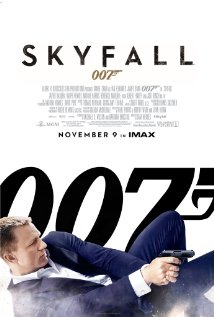
I’ve written here before about the wonderful moment on the DVD of Robert Bresson’s L’Argent, where the old master praises the early 80’s Bond film For Your Eyes Only for its “cinematic writing,” an assessment seemingly only explicable by assuming Bresson had hardly ever seen a mainstream action movie, and was able to view it with a purity of spirit denied the rest of us. I thought about this again as I watched the new Bond, Skyfall, which is certainly much more ably cinematically written than its hopelessly messy predecessor Quantum of Solace (which felt more like paint hurled against a wall), and sometimes approaches a rather beautiful abstraction, as in the nighttime lights and reflections of a sequence in Shanghai, or the opening chase sequence’s gorgeously precise excesses. Taken as a whole, director Sam Mendes restores something here of the series’ classic essence, but this only shows how meaningless that essence has become. The plot (about Bond on the trail of a master criminal seemingly intent on destroying British covert operations in general, and spymaster M in particular) turns on large doses of pain and brooding, and posits that we have more to fear now from the chaotic shadows cast by anguish and personal trauma than from grand schemes to take over the world; unfortunately though, everything about Bond is coded for a time when power relations (including, of course, those of the sexual kind) carried greater certainty. Still, there’s a lot to enjoy in there, not least of course the usual virtuosity of chaos.

Sunday, December 9, 2012

American masters


(originally published in The Outreach Connection in December 2007)
 
Joel and Ethan Coen’s No Country for Old Men is one of the year’s most acclaimed movies. A. O. Scott in The New York Times referred to “the deep satisfaction that comes from witnessing the nearly perfect execution of a difficult task,” and as I write, the picture is the favourite to win the best picture Oscar on a “Gurus of Gold” web site. And I can see that – it’s extraordinarily precise and sustained.

No Country for Old Men


Based on a novel by Cormac McCarthy, it has some of the most striking dialogue of the year, perfectly delivered by an ideal cast. It also makes memorable use of silence and space, from wide-open Texas landscapes to claustrophobically menacing motel rooms. The Coens’ famous imagination and flair is evident throughout, in their approach to character, in their editing and staging choices – as the film goes on, their assurance shows in choices that no other directors would likely make.

Did anyone fail to see a “but” arriving at the end of that? Yeah, I don’t really like the film that much. The litmus test for me might be the character of Anton Chigurh, played by Javier Bardem. He's a dedicated sociopathic killer, racking up over a dozen bodies I think in the movie’s course, while on the trail of some $2 million in missing money. His quarry is Llewellyn Moss (Josh Brolin), a regular trailer park guy who happened on the scene of a bloody shoot-out and made off with the spoils (not realizing that the bag containing the money also hides an electronic locator). Tommy Lee Jones is the local sheriff, appalled at the evil that men do and doubting his own capacity to stand much more of it.

Bardem is another emerging Oscar favourite – like Anthony Hopkins in The Silence of the Lambs, he creates a wildly distinctive variation on conventional nightmares. But Chigurh doesn’t evolve one iota from his first scene to his last. He starts off like the worst thing you’ve ever seen, and the main thesis on the character is that he goes on that way, long after any conventional sleazebag would have called it a day (there’s some entertaining, and quite persuasive, argument on the web that Chigurh is ultimately best viewed as supernatural).

This is amusing in the blackest of ways, but I wonder how excited anyone should get over so abstract a concept. As I’ve said before, hitmen, serial killers and their ilk are the most over-represented profession in movies, and I have trouble taking seriously any director who still traffics in this stuff. As a current contrast, Philip Seymour Hoffman in Sidney Lumet’s Before the Devil Knows You’re Dead becomes almost as monstrous, but he doesn’t start out that way, and his trajectory (within the parameters of movie conventions) is fascinating as a moral tale on the price of hubris. 

Going Downhill


No Country for Old Men of course doesn’t just create this terrible individual for the hell of it. Near the end, Jones and another sheriff ruminate on coarsening times (it’s set in 1980), on kids with “bones through their noses”: it started going downhill, says Jones, when people stopped saying “sir” and “ma’am.” This, for sure, is a valid theme for great filmmakers – not that we’d be better off going back to those traditional modes, but certainly the gulf between the glitzy surface of modern culture and the underlying trends and exposures is frightening, and it’s continuing to escalate no matter how many “green issues” of glossy magazines we’re presented with.

However, the prevalence of small-town bloodbaths triggered by single-minded psychos is a singularly unhelpful way of getting at this theme. The film never flags as a narrative machine, but becomes increasingly repetitive and borderline boring as anything more than that. Jones’ mournfulness is well-played, but starts to feel like an affectation, and the movie keeps adding on more and more scenes that seem like endings, as if caught in some kind of existential headlights. I came out with respectful admiration, but limited enthusiasm, and even that’s dwindled over the twenty-four hours since then.

I’ve been in this place with the Coens before. I’ve seen all the movies, but I’m not sure I’ve seen any of them more than once (maybe Fargo, but I don’t think the repeat investment paid off) and I’m straining to cite one truly interesting or provocative thing I ever learned from any of them. I guess maybe I learned a bit about how people talk in Minnesota, so that’s something.

I’m Not There


Todd Haynes is another much-admired American director, although his reputation is more of a niche thing. His new I’m Not There isn’t calculated to change that – it’s as deliberate a head-scratcher as anyone’s come up with recently. A meditation on the life of Bob Dylan, represented by six different actors playing different versions (or evocations) of the man at different points in his life (or different extrapolations of his myth), poetically intertwined and juxtaposed.

It’s quite stunningly achieved. It’s not hard to grasp the basic point, that Dylan the man is the least significant thing about “Dylan” the influence – after forty five years in the eye of popular culture, he’s spawned more images and impacts and shifts and consequences than can ever be pulled back together. Dylan isn’t black of course, and isn’t a reincarnation of Billy The Kid and so forth, but those influences live in his immense historical footprint; at once playful and highly rigorous, Haynes’ film is like unwrapping DNA, throwing in some viruses and filigree, and throwing it into a display case where it continually half-reassembles itself while half -mutating into something else.

This movie is also tipped for an acting Oscar, for Cate Blanchett’s work as Dylan in his Don’t Look Back period. It’s a fine performance, but I got into the concept enough to wish it had gone a step further, with Blanchett simply portraying Dylan as a woman. No matter. Haynes executes this project with enormous panache – it’s immensely visually and tonally varied (from pseudo documentary to utter poetic association), a constant tumble of allusion and connection. Sometimes it’s a bit gimmicky of course, but even when you don’t understand some of Haynes’ choices – such as the relative time devoted to the marital squabbling of Heath Ledger’s incarnation and his French wife – they’re intriguingly executed and thematically provocative within the overall scheme.

Of course, I suppose you could say that the nature of celebrity is even more over-examined in movies than the nature of evil – and that’s true, but not in this way. The Coens could make a nuanced and distinctive movie about Bob Dylan, no doubt, but at its heart would be someone doing a really good impersonation of him for two hours, with maybe a secondary character (perhaps played by Tommy Lee Jones) delivering beautifully written, soulful elegies about the meaning of it all. I’d go to see it, and afterwards I’d shrug and move on.

Study of greatness


Writing in The New York Times about Steven Spielberg’s Lincoln, David Brooks said: “The movie portrays the nobility of politics in exactly the right way. It shows that you can do more good in politics than in any other sphere. You can end slavery, open opportunity and fight poverty. But you can achieve these things only if you are willing to stain your own character in order to serve others — if you are willing to bamboozle, trim, compromise and be slippery and hypocritical…The challenge of politics lies precisely in the marriage of high vision and low cunning.”

Lincoln and Ford

Now, I saw Lincoln in the same week that Toronto Mayor Rob Ford was booted out of office (I know, I know, it’s the ultimate bastardization of good taste to cite Abraham Lincoln and Rob Ford in the same sentence) and I couldn’t help engaging in the absurdist mental exercise of applying Brooks’ comments to our wretched, uh, leader (given the ongoing appeal process, I can’t quite yet commit to saying ex-leader, much as I’d like to). Ford is certainly a hypocritical bamboozler of stained character, but the issue of “willingness” is beside the point – he’s driven entirely by his narrow, gloatingly ignorant instincts, which some see as a mark of authenticity.

I suppose he’s sincere about “respect for taxpayers,” insofar as he perceives the phrase (there’s little evidence that Ford’s understanding of common terms corresponds to that of normally literate people), but he lacks any useful sense of political power as a commodity that can be shaped and managed and deployed. What most offends about his obsession with his football team is that he honestly thinks it’s virtuous to spend a big chunk of his time on that tiny number of “kids,” even though he’s sought and obtained power over and responsibility for the well-being of several million people: it sums up a failure of perception and applied morality that, in his circumstances, makes him simply odious.

Equality in all things

 Anyway, Lincoln focuses on the President’s efforts, early in his second term, with the Civil War in its death throes, to pass his proposed 13th Amendment to the Constitution, formally abolishing slavery. With Senate approval already obtained, success or failure comes down to the House of Representatives, and specifically on winning over a number of the lame-duck Democrats who initially oppose the bill. Some of the Amendment’s supporters do so as a matter of principle, others because they see it as a lever to ending the war; some advocate waiting for peacetime, but Lincoln believes the issue of slavery must be settled before post-war reconstruction. This mass of conflicting motives and perspectives creates the backdrop for what Brooks describes, where achieving this worthiest of goals depends on a wide array of tricks and tactics, some of them only ethical with reference to a calculation of the ends justifying the means.

One of the film’s key moments in this regard comes when a key ally of Lincoln’s stands up on the House floor to deny his deeply-held belief in racial equality, knowing that the bill’s success depends on sticking to softer rhetoric. “I do not hold in equality in all things, only in equality before the law,” he repeats, and when his opponents accuse him of lying, he explodes at them, asking (in volcanically colourful terms) how he could possibly believe in the equality of all things, when faced with people who constitute the lowest possible examples of mankind. In such scenes, Lincoln is simultaneously at its most entertaining and most morally complex, illustrating the murky nature of expressed “truth” and its intertwining with strategy and positioning. Some have found the film somewhat boring, but I was riveted by it throughout.  

As you can see though, and in common it seems with many political commentators, I’m taken by it largely for its effectiveness as a critical reference point for our own times. That’s not necessarily a major qualification – there seems to me little point in watching any movie about the past, except insofar as it may in some way inform our present. But as a study of Abraham Lincoln, the film seems constantly hampered by Spielberg’s adherence to the Great Man approach to history. True, he largely avoids the epic trappings of battlefields and grand vistas – one of the film’s most appealing qualities is its intimacy, its depiction of a Presidency much more closely rooted in the streets and the people than we’ll ever see again. But the film frequently feels more interested in creating handsomely iconic moments than in trying to convey the texture of a real time and place. As Jonathan Rosenbaum put it: “Surely Lincoln and his cohorts didn’t experience their everyday surroundings as if they were silhouettes in a pretentiously underlighted art movie, but this Lincoln and these cohorts do.” Also, I’ve almost never mentioned a film’s music in any of my articles here, but the fact that I was distractingly aware at several points of John Williams’ score for Lincoln didn’t work to the film’s benefit.

Terrible things

For similar reasons, I’m a bit less sure about Daniel Day-Lewis’ performance as Lincoln than the consensus (which has basically already given him the Oscar) would have it. Day-Lewis certainly seems like the Lincoln we’ve always been waiting to see on the screen, but did the real man really behave as if Doris Kearns Goodwin was lying in wait at every moment? In this regard I’d agree with Rosenbaum again that “Spielberg’s storytelling gifts…often depend on a ruthless catering to what we already think we know about a given subject.” At various points I wished the film had been made instead by someone with a greater relish for chaos and productive myth, like the late Robert Altman: it would  no doubt have been odder and harder to follow, but would also have been less of a pre-judged tribute, more of a true exploration.
Still, the film is much stronger than Spielberg’s entirely pointless version of War Horse, full of fascinating moments, and conveying something viscerally compelling about the darkness at the heart of America in those times, and the despair in Lincoln’s own heart. “We’ve made it possible for one another to do terrible things,” he says to General Grant near the end, expressing Brooks’ point at its extreme, how leadership requires embracing cruelty far beyond the parameters of normal life. Obama has seen the film, and views it, according to his press secretary as “both an excellent movie and a vivid reminder that our 16th president was not just a brilliant orator and statesman but a masterful politician.” Going back to the terrible things we’ve done, one might counsel Rob Ford to see the film, and yet there seems little chance of him being able to follow it even on a cursory level, let alone extracting any higher insight from it.


Sunday, December 2, 2012

Men in Trouble


(originally published in The Outreach Connection in April 2007)
 
Mike Binder’s Reign over Me is a big shambling mass of 9/11 survivor guilt, mixed in with multiple brands of new age male neurosis and sloppy fantasy; it’s always watchable but never completely persuasive. Don Cheadle plays Johnson, a dentist, coasting along with his wife and two daughters. He runs into his old college roommate Charlie, played by Adam Sandler, a man who dropped from sight after his wife and three girls were killed on one of the planes. Charlie’s so out of it that he doesn’t even recognize his former best friend (or claims not to at least – the character’s psychological state varies a bit depending on the demands of individual scenes); he spends his time in a regressive (although well-financed) state of adolescent self-absorption, playing video games, collecting vinyl and jamming in a band, watching movies and riding around town on a motor scooter. Johnson gets through to him and rapidly starts spending more and more of his time in “Charlie world,” which creates friction at home. But Charlie is plainly unstable – sometimes he explodes in anger and his heart is emptier than he can bear. Johnson must lead him back, if he can only coax Charlie to confront his pain.

Earthly Tragedy


The film presents a rich, enveloping vision of New York, and seems most comfortable when it’s just about guys hanging out together. Binder confines Jada Pinkett Smith, as Johnson’s wife, to the role of brittle ball buster, but throws in alternate diversions that seem like the stuff of late night dreams – Saffron Burrows as a woman obsessed with the dentist, and Liv Tyler as a gentle psychiatrist. Burrows’ character seems almost as screwed up as Sandler’s, but Binder doesn’t take much care with her, creating the distinct impression that grand, dramatic suffering is a male enclave (there’s barely a person in the film who’s not hurting in one way or another though). Johnson’s languishing too of course, and Charlie motivates him to be more assertive to his condescending partners, and in the end to better focus on things at home.

Like Binder’s last release The Upside of Anger (which had Joan Allen as a mother of four daughters, also going off the deep end after her husband abandons her), Reign over Me has epic ambition, but sometimes faltering execution – both films feel at times as if the director merely shoots anything that passes through his head. That does give them a distinctive, sometimes affecting contour – the new film feels like honest testimony of some kind, even if its broader applicability seems inherently questionable. Sandler is fairly effective, but his character seems unmoored to any earthly tragedy, let alone 9/11: he’s a creation of the Id, a variation on the holy fool, spawning from the popular culture with which he crams his existence.

I Think I Love My Wife


In search for alternate points of entry into the battered modern male psyche, Chris Rock reaches back into Eric Rohmer’s movie from the early 70’s, Love in the Afternoon (also known as Chloe in the Afternoon). Now called I Think I Love my Wife, in its bare bones it’s a surprisingly faithful adaptation, as restlessly married businessman Rock runs into the sexy ex-girlfriend of an old buddy, and starts to hang out with her way more than he should, imperiling both his home and work life, even though nothing actually happens. Kerry Washington’s Nicki is an outstandingly plausible piece of sheer trouble, investing the film with an energy it otherwise lacks.

Which isn’t to say it’s without interest. Sporting a nerdy moustache, Rock inhabits an unprepossessing put-upon mode, and seems to be severely rationing his film’s outright laughs; even when he includes (say) a broad (distinctly un-Rohmer like) set piece involving a Viagra overdose, there’s a rather desperate, pinched quality to things which well suits the basic premise. This doesn’t go anywhere unfortunately – the relationship with his wife is underdeveloped (never giving him an inch, she belongs in a club with the Jada Pinkett Smith character), and the very premise (revolving around Rock’s habits of taking lunch at 2 in the afternoon) doesn’t work as well in the contemporary corporate world as it did in more genteel 70’s France. Still, it’s an interesting enough project. By the way, the firm where Rock works is called Pupkin and Langford, an apparent nod to the two protagonists of Martin Scorsese’s The King Of Comedy. Perhaps his character’s unfulfilled compulsive fantasizing has some broad kinship with De Niro’s Pupkin, but the reference doesn’t really do Rock’s film any favours. And what film could possibly synthesize both Rohmer and Scorsese as guiding spirits?

The Host


The Host is an entertaining monster movie from South Korea. An arrogantly careless American scientist orders that vast amounts of unwanted formaldehyde be poured down the sink, and four years later the local river has spawned a mutant giant carnivorous fish that leaps out of the water, scoops up the locals, and plunges back into the depths. A dysfunctional family comes together when the monster carries a young girl away; then she calls them on a cell – she’s still alive, and they have to get to her. The trouble is, they’ve been quarantined for a suspected virus carried by the beast – they bust out, and have the whole city after them.

I’m not sure the film is quite as scintillating as some of the more rapturous reviews suggest, but it’s never dull and never merely functional. The conception of the mutant is gleefully absurd, but the intrigue over the virus is distinctly reminiscent of pre-Iraq WMD talk; America takes a restrained but firm drubbing here. The family dynamics are worked out with unusual care, and director Bong Joon-ho’s use of comedy and excess is quite audacious at times. It has the narrative craziness typical of the genre, but also some unexpected tragedy. Overall The Host is satisfyingly intelligent viewing that never gets stuffy or pretentious about its genre, with an unusually genial authorial voice.

The Lookout is the directorial debut of noted screenwriter Scott Frank, who wrote Out of Sight and Get Shorty. This too is a somewhat old-fashioned thriller, notable for its scrupulous internal logic and for its immersion in its protagonist’s psychology. He’s played by Joseph Gordon-Levitt, again intriguingly vulnerable as a former golden boy rendered mentally fallible by a tragic accident; he relies on a series of notes and cues to get through his day, attending a skills training centre by day and janitoring at a rural bank by night. His weakness, and frustration at his diminished prospects, makes him an easy mark for a gang that’s been eyeing up the vault.

It’s a deliberately placed movie – even the higher-octane closing stretch is quite low-key by contemporary standards – and it’s intriguing for how the character must battle himself almost as much as the violent adversaries (several critics have cited Memento, although The Lookout is quite a bit less involved and taxing). It’s hard to be effusive about Frank’s film – it feels as if, first time out, he wanted to lay a modest bet, bring home a small but well-played pot, and save the real effort for next time. Even the title feels kind of modest, if you know what I mean.

My music


I’ve mentioned before that I’ve managed for quite a few years now to watch a movie a day on average, and sometimes I still think it’s a phase I’ll eventually grow out of (you know, like life itself), but that seems increasingly unlikely. It’s not just the pleasure I get from watching the movies – although that’s never-ending – it’s also the process I maintain around that: the selection, the note-taking, the Keeping of the List. I’m happy that at least I’ve curbed some of my worst tendencies – in particular, I used to go to see far more of the new Hollywood releases than I do now, even when I knew in advance there was no chance of my liking them, but I never fall for that now. I may still be a glutton, but at least I’ve realized I don’t have to stick to what happens to be on the shelves at the corner store: we’re blissfully close to the dream state where you can think of a movie, even a relatively obscure one, and usually find a way to watch it within a few days. And since I can think of a lot of movies, the dream keeps rolling.


My first ipod


It must be revealing though that one of the main ways I convince myself I’m not hopelessly obsessed with cinema is by also maintaining an even more time-consuming twin obsession. Like just about everyone else, I used to be into music a lot, and also like just about everyone else, my interest calcified as I got older. When Apple introduced the ipod, over a decade ago, I was intrigued by the ads, but I honestly didn’t think I’d use it enough to justify the purchase (we laugh at this memory now). My wife got me one for Christmas, maybe in 2001, give or take a year – compared to contemporary models, it looked like a transistor radio, and I think it only (only!) held a thousand songs, but it was still a transforming miracle. At that time, our dog Pasolini was around two years old, and although I liked him and everything, I often found the regular walking a bit of a grind. But with the ipod, I rapidly came to see the walks as an opportunity to re-immerse myself in music.


Not too long after this, Rolling Stone published their list of the best 500 albums ever made, and I seized on this as an action plan, purchasing a new item off the list every month, intermingled with a cross-section of new music and other investigations. Many ipods later, there’s now over 35 days of music on there, and last year I listened to all of it at least once (on average I get through three albums a day – that’s how I approach the task, by album). This only happens of course because I plan and organize my listening to make sure I cover it all, in such a way that every day zigs and zags across genres and that my favourite material is spread throughout the year. Frankly, I’m sure I spend more time than I realize subliminally planning my ipod listening. I’d rather not realize.


Walking Ozu

I never just sit and listen to music though – that just makes me restless – so those 35 days of listening are also 35 days of activity. The ipod transformed my opinion of Paso’s walks; I became the most enthusiastic owner imaginable. When Paso became too old to walk that much, and then when he died, I went out on walks by myself, largely to maintain my listening statistics. Then we got Ozu, a Labrador puppy; by now I was working from home, so most days I did the majority of his walks (except on the days when he goes to Urban Dog, without which I’d probably be writing this from the next world). Even if I say it myself, Ozu is among the most diligently exercised dogs you’ll find in the city. I mean, how many two year old Labradors are always exhausted?


Objectively, I guess I must know much more about music than the average man my age, but I still feel overwhelmed by the subject. I’d never think of trying to write about it in the way I do about cinema – I just don’t have the language. But I don’t want it either. I’ve spent so much time absorbing cinema, it’s virtually a second job. Music is the hobby, perpetually fascinating in large part because of its mystery.


I’ve been phenomenally lucky to be able to spend so much time on these two wonderful human creations. It doesn’t even stop there – I go to the theatre more than the average person. But something has to give somewhere, and in my case it’s reading – I only get through a few books a year, and even then, many of those deal with cinema or music. You could reel off great books for hours before hitting one I’ve actually read. Funnily enough, I read a lot of book reviews, so I might be able to fake my way through many conversations on the subject. I like to think I’ll do more reading one day. But it’s increasingly hard to see exactly when that would happen.


Mainstream conversation


Of course, when I single out reading as the thing that has to give, that shows you my view of things – I suppose it’s revealing in some way that I didn’t say dance, or opera…or for that matter sports, or woodworking, or the study of history. Our world overflows with richness and wonders, and it’s a tragedy that the prevailing cultural conversation seems so divorced from any of it. That is, more and more, if you listen to the mainstream media, you’re assaulted by an ever-morphing line-up of flimsy phenomena that we’re implicitly supposed to know and care about, and even serious news shows seem increasingly to accept the premise that what’s trending on Twitter must be inherently meaningful. And of course, everything just gets more ephemeral and neurotic and disconnected as a result.     

The state of things isn’t strong – many of us have trouble accessing the lives we believe we were promised. I don’t want to make light of that at all, or to make trite statements about rising above it. But the implicit assumption behind much of what’s beamed at us is that we’ll stay packed in our cages with our beaks cut off, swallowing whatever mulch comes down the chute. We’re not all masters of our own fate, but no one else can force a consciousness to squander itself on junk. None of us will ever do more than scratch the surface of the accumulated human miracles, but even just that scratch, that trace of your finger, justifies your existence.